Is the United States a threat even if it is just minding its own business?

Most of us are still a bit vague about where all that money is going to be cut from the federal and state governments of the United States. Perhaps some of the cuts will come out of the bloated military budget, thereby reducing the threats that our troops around the world are subject to, and at the same time also generate. Certainly many who actually serve in the military would welcome such a reduction in spending.

But we need to start thinking about a new and unprecedented security threat on a global massive scale: the United States without safety protocols and effective inspection regimes for the vast range of dangerous materials collected over the last sixty years.

The United States is a pile of chemical waste dumps, aging nuclear power plants, nuclear materials—and weapons—storage facilities, oil rigs, oil pipelines, mines (active and abandoned), armories and any number of railroads and highways that require an enormous investment to maintain safely.

Read more

Using Art to Build a Bridge to Post-Tsunami Japan


The Fortune Cookies Made by children in Korea

One of the most innovative programs for education that I have found in Seoul  is the “Kids’ Atelier” (어린이 예술 공방) at the Paik Hae Young Gallery in Itaewon. I wrote an article about their excellent programs in the latest edition of Seoul Magazine. This remarkable series of art classes for children creates a total environment in which children learn not only to create art, but also and many other issues in society. Every Saturday, the children gather for a new project with a distinct theme and purpose. The entire space of the house is open to visitors.  The garden, the artwork, the café can be explored by children and parents. The parents who come along with their children can sit in the attractive café and engage in their own intellectual discussions on art, or other topics, with the director and others who stop by. In a sense it is a program for children as part of a “salon culture” that involves everyone.For a detailed description of the Paik Hae Young Gallery, see “Unique Cultural Space Thrives in Itaewon”

Paik Hae Young Gallery recently held a remarkable art project intended to increase exchange with the children in Northeast Japan impacted by the recent tsunami and nuclear disaster. Through a student at Kyung Hee University from Sendai, Honda Nika, I managed to get in touch with an elementary school in Higashi Matsushima, a town half destroyed by the tsunami. Nika’s father made a special effort to introduce me to the principle, Mr. Kudo, and we arranged for a unique artistic exchange: Fortune cookies!

Read more

Climate change and Homelessness

It is almost August and Seoul is lost in the most serious torrential rains I have ever witnessed. I was starting to grow my own vegetables at home and at work, but agriculture is rather negatively impacted by this level of rain, at least agriculture as we have known it. Needless to say, although climate change is everywhere in the media, I don’t hear anyone saying in daily conversation that this odd rain is related to climate change. Just not a polite thing to do, and so I do not mention climate change much either. Of course climate change is not a simple matter of CO2 emissions. After all, the climate change that turned the Middle East into a desert began before the massive CO2 emissions. But that the desertification of Saudi Arabia was linked to human activity is beyond doubt.

It would be nice if all the consumption that is so negatively impacting the environment were at least helping people to live better. But, unfortunately, there are homeless, and those who struggle to feed themselves, who wander around Seoul and of course many other countries, trying to make a living. The homeless are the most seriously impacted by the heavy, unrelenting rains. For many of them it is matter of survival. There are a large number of elderly in Korea who survive by pulling wagons on which they gather old newspapers and other recyclable goods. For these individuals climate change is a matter of life and death. Of course what impacts them today, may impact us tomorrow.


Greening Seoul’s Soul

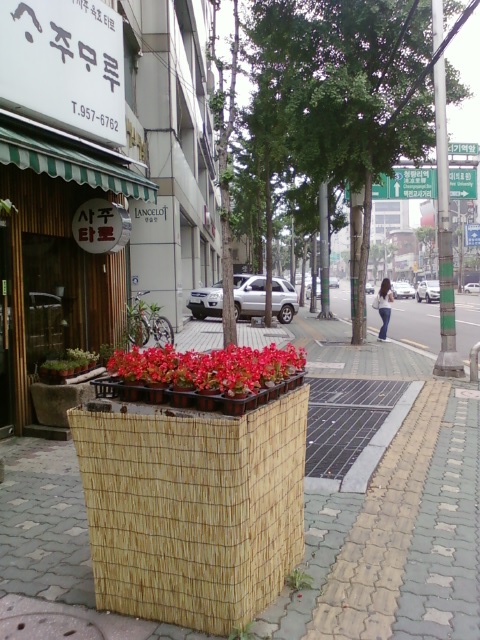
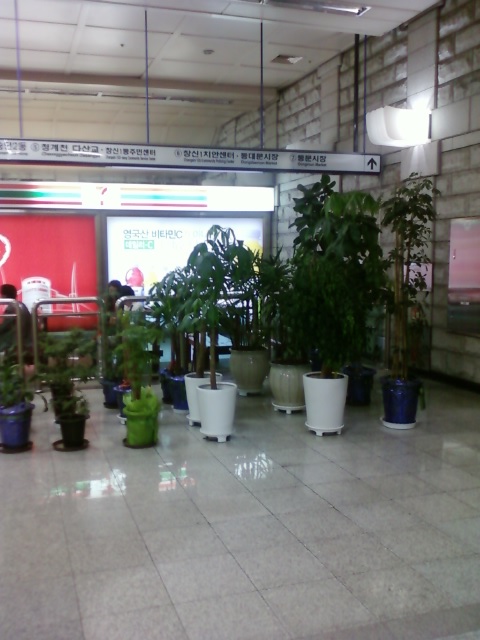
Seoul has suffered from a serious misconception of the meaning of real estate. It seems as if green space was deemed a waste in the building of houses and offices throughout the city. The are big parks, of course, but along most streets trees are not at the center at all. But we have seen over the last few years efforts to introduce plants at stores, in the metro, in every corner of the city. Often the efforts seems spontaneous.  There is a buried lover of plants and agriculture in Korea. Getting away from green was part of moving from the agricultural to the industrial economy. For the reason, neighborhoods should look green, but not too green. But at the same time, there is a nostalgia for the agricultural past just beneath the surface of Korea.

Of course, the plant are often placed in a make-shift manner, suggesting they can disappear at any moment.

Emanuel Pastreich

Circles and Squares

Letter from China to the Nobel Prize Committee asking for the establishment of a Prize for Ecology Studies

 Professor Chen Minghao of Jiaotong University in Shanghai, asked me to translate this letter to the Nobel Prize Committee asking that a Nobel Prize for Ecology be established. At the time, I did not really understand what he was talking about and did the translation just on a whim of sorts, but now, many years later, Chen Minhao’s thought seems most prescient. He passed away last year and I deeply regret I was not able to meet him again and tell him how much I learned from him.

 March, 1994


“Maintaining the Well-being of Humanity is the Spirit of Alfred Nobel’s Legacy”

An open letter to the Nobel Prize Committee

by Minghao Chen

There are only five years left in this century. The aging twentieth century is passing into history while a new century slowly emerges in an aura of possibilities and hopes. Humanity as well has reached a historic turning point in its development; a new path awaits us beyond. We must turn away from our present path of single-mindedly pursuing material and technological progress and choose the way of harmonious coexistence with nature, and economic development closely coordinated with the needs of the environment.

Read more

Seoul: “Paradise sans Poubelle”

Seoul is without doubt increasing its sophistication with astonishing speed. Yet there are a few points that just do not make sense to the expat enjoying life in this city.

For example, why do the police not ticket the delivery men on motorcycles who rush around causing such chaos, and in many cases kill or cripple small children? it would not be hard to raise the bar and protect us all. Almost every time a man on a motorcycle approaches me on a sidewalk I say to him “This is not the road!” (길이 아닙니다!). And in almost every case he responds “Sorry.” Why? Because he knows what he is doing  is wrong.
All we need is for police to start ticketing seriously and this threat to everyone will rapidly disappear–and Korea will shine.

What is fascinating is that the bar is being raised by Seoul local government, Seoul Metro and many other public facilities, but for some reason we just do not manage to do so for those awful delivery men. We have safety doors on the subway platform for a level of safety you will not find many places in the world, but out on the sidewalk, watch out!

And then there is the issue of trashcans.

Korean facilities are increasingly sophisticated and increasingly public architecture and landscaping is improving. At the same time, Seoul parks and streets are littered with trash. Cigarette butts, bottles, wrappers from ice cream bars, beer cans and cardboard. The problem is two-fold. First, Seoul simply does not have any trash cans. People are willing to put up with trash on the ground rather than insisting on trashcans. Planners do not make trashcans a priority.

The decision is a serious mistake.

At the same time, I see extremely educated Koreans simply throw garbage on the ground while walking. Many Korean kids grow up thinking that is just naturalto toss wrappers on the ground. The trend is most disturbing. Sometimes I think the cause may lie with a misinterpretation of “democratization.” Koreans were so happy to escape from the repressive environment of Korea under the strongman Park Chong Hee that being able to just do anything was mistaken for political freedom. President Park may have had many flaws, but when it came to green zones in urban spaces and strict rules for citizens, he was right on the money.

By the way, smaller cities like Gyeongju and Jinju (and many other towns) are as clean, or cleaner, than Japan, so the problem is in part a Seoul problem.

Finally, I want to note that so many food products, bread, kimbap, rice cakes, everything are being wrapped up. More than was true even three years ago.

I almost never see a Korean say he or she does not need a plastic bag when offered one. And very few Koreans bring a cloth bag with them when they shop. Let us hope we see progress on this front going forward.

“Six Months After Korea’s West Coast Oil Spill” (article translated by Emanuel Pastreich)

I translated this article about the Taean oil spill on behalf of a friend who works at Eco-Horizon Institute (Saengtae Jipyeong) as part of my efforts on the critical issue of what to do in the aftermath of this ecological disaster.

The Taean spill blends together in my mind with Hurricane Katherina, the Deep Horizon oil spill and the Fukushima disaster. All are examples of ecological disasters, the biggest security challenge we face today. I must say that most of the security budget we spend is not much use for responding to these terrible threats, and that their frequency seems to be increasing.

Six Months After Korea’s West Coast Oil Spill – Need exists for new effort to stave off a social and ecological disaster

August 8, 2008
By Seung-hwa Lee
(translated by Emanuel Pastreich)

A horrific collision between a crane and an oil tanker off the coast of Korea’s Taean Peninsula last December resulted in over 10,000 tons of crude oil being dumped into ocean just off the coast of one of Asia’s most important marine preserves. The striking coastline where pristine waves crashed on rugged rocks was transformed into a sea of oozing black goop.

The animals and plants of the coast were not the only ones devastated. The residents of Taean have found themselves in a life and death struggle for economic and psychological survival. A dark shadow hangs over their lives and has driven some to despair.

Now that the summer season has returned, there is much talk in the Korean media about the reopening of the beaches and the miracle of the Taean recovery. After all, when over a million people from all over Korea came to help clean the coast of oil in the months after the spill many predicted a quick return to normal. But although the beaches may appear clean, traces of oil can still be found.

The roads once packed with tourists during the summer have little traffic. And the generations of families whose livelihood depended on fishing or tourism wonder what they should do. They watch the bills pile up, getting into unpleasant fights about possible compensation money.

http://english.ohmynews.com/articleview/article_view.asp?menu=c10400&no=383335&rel_no=1

The Greening of America: Innovative Programs to Reinvent the United States

This  article I originally wrote for the Asia-Pacific Business and Technology Report in September 2009.  The publisher of that magazine, Dr. Lakhvinder Singh, is a good friend of mine.  The article is based on a paper I presented at the International Green Growth Forum sponsored by the Korean Ministry of the Environment.

On the campaign trail, Barack Obama made it clear that the environment and alternative energy would be central pillars of his administration. He has since put great effort into promoting an innovative approach to resolving environmental and energy issues, maintaining a focus on a matrix of innovation and policy reform for lowering emissions and reducing dependency on foreign energy supplies, even in the face of cries to address healthcare and economic growth first. Although inertia and political realities have slowed down some parts of the program, reinventing the United States economy and re-imagining the American economy remain important themes.

Some of these themes can be traced back to a report by John D. Podesta of the Center for American Progress entitled “Capturing the Energy Opportunity: Creating a Low-Carbon Economy” (Nov. 27, 2007) that gave concrete suggestions as to how the auction of carbon permits under a greenhouse gas cap-and-trade program could generate 2 million jobs. The Political Economy Research Institute at the University of Massachusetts, Amherst, released a report entitled “Green Recovery: A Program to Create Good Jobs and Start Building a Low-Carbon Economy” in September 2008 that set out a concrete game plan for innovation and job creation through the embrace of green economic principles.

Read more

Wenchuan as an Eco-City (in Chinese)

This is a Chinese-language article that I wrote with John Feffer which originally appeared in China News.  The original article can still be found on their web site.

中国新闻周刊

汶川不应只是摆放在陈列室的展览品,在国际社会的帮助下,汶川应被建成一座节能的经济城市

2008年5月12日发生在中国的汶川毁灭性地震,造成整个四川省超过6万人遇难,500万人无家可归,而灾后的重建工作将需要很长时间。虽然当前救援组织和当地政府已经紧急修建了临时住房并提供饮用水,但同样重要的是我们应该开始考虑在救援人员离开后,国际社会应该如何有效在而合适地发挥长久的作用。

Read more

The Washington Debate on “Security” and “The Ripple Effect”

When I worked in Washington D.C., from 2005 to 2007, I made repeated efforts to organize a conference, even just a small seminar, to discuss the serious security threats resulting from the shortage of water and the degradation of the environment.  I remember vividly the complete lack of interest of certain  individuals in the policy world when I brought up the topic of “non-traditional threats.”  Somehow the greatest problem we face just didn’t seem that important. Better to have another seminar on  North Korea’s nuclear program or the Chiang Mai Initiative.

I had a long discussion with a well-known think tank figure back in 2006 during which I pleaded for support. The seminar, which would have been rather small, was entitled,  “Water: Worth more than Gold and Oil Combined.” The individual in question responded that the topic was “amusing” and maybe could be considered at “some future date.” I was appalled.

With the help of Professor David Steinberg of Georgetown University and  Col.  Larry Wilkerson of the College of  William and Mary (former Chief of Staff for Secretary of State Colin Powell) I  put together a proposal for a conference at Georgetown University on “non-traditional threats.”

The rough proposal is available below.

Non-Traditional Security ,Threats Conference Proposal 2005

We did not get any funding whatsoever. I told David Steinberg that, “This is simply wrong. Do these people think that we will be able to respond to climate change or water shortages with aircraft carriers?”

David offered me some words of wisdom about the way things really work. But I was learning that a lot of people in national security are not interested in national security.

Later the New America Foundation put together a Smart Strategy Initiative under the leadership of Patrick Doherty. Larry Wilkerson has joined that initiative and tells me there are some very meaningful discussions taking place. Doherty, whom I do not know personally, writes:

“Twenty years have passed since the Cold War grand strategy of containment accomplished its objective. After four presidents and ten Congresses, Washington has yet to articulate a formula capable of promoting the general welfare and providing for the common defense–for either ourselves or our posterity. Today our economy is hollowed out, our military is over-extended and the global ecosystem is fast approaching depletion.”

See:

http://smartstrategy.newamerica.net/

The publication of Alex Prud-Homme’s study The Ripple Effect: The Fate of Fresh Water in the Twenty-First Century this month has historic significance. Here is a book that systematically argues that this small detail of mundane life, drinkable water, is shaping up to be the security issue of the century. And the problems we will face at home and abroad cannot be easily addressed by military action.

Prud’Homme notes,

“By 2000 some 1.2 billion people around the world lacked safe drinking water, and that by 2025 as many as 3.4 billion people will face water scarcity, accord- ing to the UN. What’s more, as the global population rises from 6.8 billion in 2010 to nearly 9 billion by 2050, and climate change disrupts familiar weather patterns, reliable supplies of freshwater will become increasingly threatened. In Australia and Spain, record droughts have led to critical water shortages; in China rampant pollution has led to health problems and environmental degradation; in Africa tensions over water supplies have led to conflict; and in Central America the privatization of water has led to suffering and violence.”

His argument is unrelenting:

“In the meantime, human thirst began to outstrip the ecosystem’s ability to supply clean water in a sustainable way. By 2008, the world’s con- sumption of water was doubling every twenty years, which is more than twice the rate of population growth. By 2000, people had used or altered virtually every accessible supply of freshwater. Some of the world’s mighti- est rivers—including the Rio Grande and the Colorado—had grown so depleted that they reached the sea only in exceptionally wet years. Springs have been pumped dry. Half the world’s wetlands (the “kidneys” of the environment, which absorb rainfall, filter pollutants, and dampen the effects of storm surges) were drained or damaged, which harmed ecosystems and allowed salt water to pollute freshwater aquifers. In arid, rapidly growing Western states, such as Colorado, Texas, and California, droughts were causing havoc.”

http://www.alexprudhomme.com/books/the-ripple-effect/quality/