This article outlines a plan for revitalizing rural Korea with an emphasis on traditional goods and architecture.
한국경제신문
2012년2월 08일
한국 농촌 세계화 `전통` 담아야
산업화 이전 유구한 역사 못살려
마을 상징물 만들어 홍보에 주력
된장에 스토리 입히면 관광 자원
이만열 < 경희대 교수·후마니타스칼리지 >
This article outlines a plan for revitalizing rural Korea with an emphasis on traditional goods and architecture.
한국경제신문
2012년2월 08일
한국 농촌 세계화 `전통` 담아야
산업화 이전 유구한 역사 못살려
마을 상징물 만들어 홍보에 주력
된장에 스토리 입히면 관광 자원
이만열 < 경희대 교수·후마니타스칼리지 >
February 2, 2012
One striking aspect of Seoul is the contrasting aesthetics we find on every corner. The Beautiful Seoul Project that Eun Shil Park was so kind as to introduce me to has produced this remarkable “Seoul Time Lapse 2010” video which puts forth an image of Seoul so radically different from what most of us old timers are accustomed to, but quite powerful. I must say I am very much reminded of the Tokyo I knew back in 1991 & 1992.
As part of my work on the website “Daejeon Compass” I took numerous photographs of Daejeon to show just how beautiful a city it is. Here are a few selections for those who might be interested in this remarkable place. We miss is already after less than a year in Seoul.
 This article in Hello DD, the primary online journal for science and technology news related to the Daedeok Research Cluster in Daejeon, features our Daejeon, Three Rivers mug cup. The article mentions my own vision that having people look at this image of Daejeon’s ecosystem while drinking coffee each morning could transform their thinking.
|
Tomato is one of the most innovative journals in Daejeon, active in promoting theatre, film and art in the Daeheung District of old Daejeon. I spent a good amount of time there with my children back in our happy Daejeon days. The interview describes our website introducing Daejeon: “Daejeon Compass.” There is also a reference to my analysis of the most serious problem facing Korea: the gap in imagination.

One of the most innovative programs for education that I have found in Seoul is the “Kids’ Atelier” (어린이 예술 공방) at the Paik Hae Young Gallery in Itaewon. I wrote an article about their excellent programs in the latest edition of Seoul Magazine. This remarkable series of art classes for children creates a total environment in which children learn not only to create art, but also and many other issues in society. Every Saturday, the children gather for a new project with a distinct theme and purpose. The entire space of the house is open to visitors. The garden, the artwork, the café can be explored by children and parents. The parents who come along with their children can sit in the attractive café and engage in their own intellectual discussions on art, or other topics, with the director and others who stop by. In a sense it is a program for children as part of a “salon culture” that involves everyone.For a detailed description of the Paik Hae Young Gallery, see “Unique Cultural Space Thrives in Itaewon”
Paik Hae Young Gallery recently held a remarkable art project intended to increase exchange with the children in Northeast Japan impacted by the recent tsunami and nuclear disaster. Through a student at Kyung Hee University from Sendai, Honda Nika, I managed to get in touch with an elementary school in Higashi Matsushima, a town half destroyed by the tsunami. Nika’s father made a special effort to introduce me to the principle, Mr. Kudo, and we arranged for a unique artistic exchange: Fortune cookies!
This article originally appeared in the Munhwa Ilbo on August 1st, 2011.
이만열/경희대 후마니타스 칼리지 교수, 아시아연구소장
최근 서울 안국역 주변 지역을 중심으로 일고 있는 활발한 예술의 흐름을 보다 보면 놀라움을 금치 못한다. 지금 서울은 세계 어디에 내놔도 그 창의성 면에서 돋보이는 작품들을 선보이는 갤러리가 하루가 다르게 늘어가고 있다. 그것은 문화재나 TV 드라마, 가요뿐 아니라 개념예술, 조각, 회화 등의 예술 영역으로 빠르게 확산되고 있다. 이곳 서울에서 일고 있는 문화의 바람이 아시아를 넘어 세계를 향해 나아가고 있는 것만은 확실하다.
Yoyo Ma is a close friend of my father’s whom I have known since I was a child. Whenever he visited San Francisco he was certain to stop by our home. He knew me before I could speak a word of Chinese and he met me repeatedly as I learned Chinese, Japanese, and finally Korean.
As a Chinese who has spent his career between the Chinese and Western cultures Yoyo Ma understood my work between cultures better than most people and we are able to communicate with a greater degree of depth than might otherwise be the case. I felt great closeness to Yoyo because we both found ourselves deeply imbedded in more than one culture. Yoyo, as a Chinese who had fully embraced the Western classical music tradition and spent his time at Harvard, and later in life, reading Aristotle and other great thinkers and me as a European who had embraced the Asian tradition and spent so many years trying to understand the classics, both of us had to find a space between the two cultures.
The four years that I spent in Daejeon were a remarkable experience. Among the various projects, I derived immeasurable pleasure from various projects aimed at raising Daejeon’s cultural profile. Some of that effort was related to work with the Daejeon Metropolitan City government, but much was spontaneous, growing from my friendship with the artist Yoo Dongjo or my talks with my students. Friends from Daeheung Dong district of Daejeon–where the artists gather–gave many ideas.
Daejeon means literally a “large field” and refers to to the fertile basin surrounded by mountains that makes up the city. Originally, the cultural centers of the area were around the two Confucian scholarly communities, one in the north in Hoedeok and one to the south in Jinjam. The building of the railroad station in the center and the creation of an artificial new town in the 1920s called Daejeon obscured much of those origins.
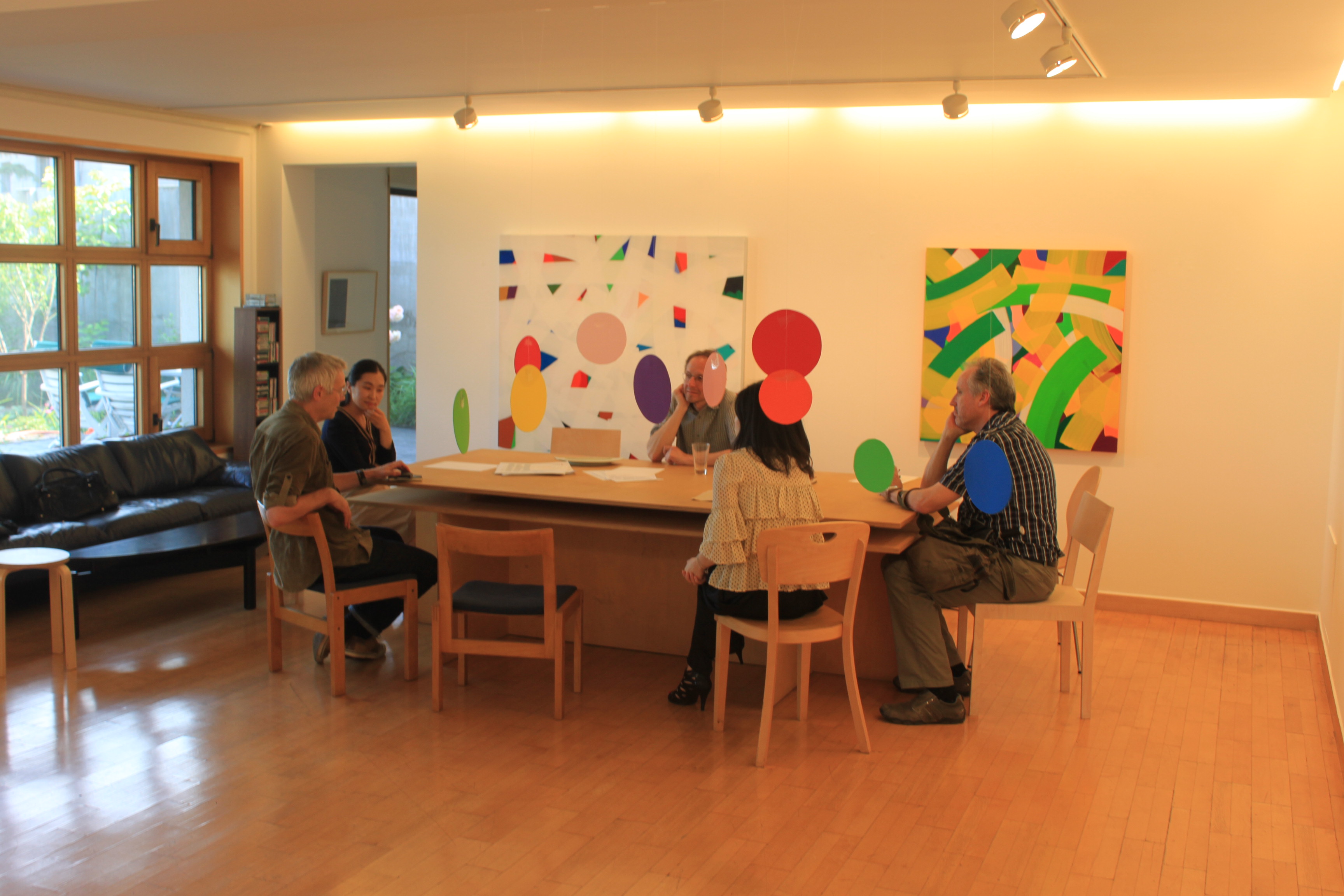
We had a fascinating seminar at the Paik Young Hae Gallery on June 13 (2011) on the topic: “Can there be a Renaissance in Seoul?” Ms. Paik brought together a group of Koreans and internationals interested in the arts for a discussion of what can be done in the arts here in Seoul given the remarkable transformation of the city. Adrian Smith of Kyung Hee University broke the participants into smaller groups for more focused discussions. Adrian has a unique knack for getting people to talk.
The premise was of the discussion was that the Renaissance took place in Italy because of a confluence of factors:
A dynamic cultural environment and outbursts of creative activity;
New advances in technology that permitted a new level of manipulation of materials and creation of unique structures such as the Sistine Chapel
Tthe influx of capital into Italy through new financial institutions, particularly the innovations for finance associated with the Medici family;
Tthe growth of a strong tradition of patronage for artists by the wealthy;
A strong salon culture that brought together individuals from diverse backgrounds to share their ideas and collaborate.
So then, turning to Korea today, we find that Korea has become a cultural center technology, finance less so patronage and salon culture, although the potential for salon culture sarang bang, is real. The discussion concerned how such an environment could be created, spilling over into a variety of individual discussions.
I confess that I proposed the topic, in part based on my reading as an undergraduate at Yale of Michael Baxandall’s “Painting and Experience in Fifteenth Century Italy.” The premise was simplistic, but the response quite exciting.