지난달 어느 도지사가 주최한 모임에 초대를 받았다. 전문가들이 기술을 발전시키기 위해 애쓰는 도(道)의 노력에 대해 토론하는 자리였다. 그 전문가 그룹은 큰 테이블에 둘러앉아 장시간 바이오•나노 기술에 대해 의견을 나눈 후에 스타트업 기업 활성화를 위한 계획을 발표했다.
‘그림의 떡’ 같은 미래를 현실화하려는 논의를 하는 동안에도 나는 우리에게 제공된 간식거리에서 눈을 뗄 수 없었다.
모든 참석자 앞에 놓인 것은 화려한 색상으로 포장된 초콜릿•쿠키•캔디가 한 무더기 쌓여 있는 플라스틱 그릇이었다. 하지만 내 식욕을 자극하는 간식거리는 하나도 없었다.
그게 다가 아니었다. 토론 행사 전체가 그 도를 홍보하기 위해 마련됐지만 테이블 위에 놓인 먹을거리 중에서 현지에서 생산된 제품은 하나도 없었다.
모임 참가자들에게 의견을 구한다면, 아마 그들은 모두 그 지역에서 생산한 과일이나 곡식으로 만든 간식거리를 훨씬 선호했을 것이 틀림없다고 나는 생각한다. 그 고장에는 고유의 전통과 음식이 있다는 것을 확인해주는 독특한 풍미가 담긴 먹을거리 말이다. 나는 한국이 전통적으로 다양한 종류의 말린 과일, 케이크, 견과를 자랑한다는 것을 알고 있다. 그것들을 내놓았다면, 완벽한 간식일 뿐만 아니라 이를 생산하는 현지 농업인들에게도 도움이 되었을 것이다.
나는 8여 년 전부터 지방정부와 일하고 있다. 그 경험을 통해 자신 있게 말할 수 있는 게 한 가지 있다. 향토 음식이 토론회 같은 행사의 식탁에 오르는 일이 드물다는 점이다. 관례적인 행사 실행 계획의 벽을 넘기가 힘들기 때문이다. 사실 도지사 집무실에서 접하게 되는 음식은 현지가 아니라 대형 음식 제조업자가 생산한 것일 가능성이 크다.
하지만 진짜 문제는 ‘누가 만들었느냐’가 아니라 ‘무엇을 파느냐’다. 내가 편의점에 들어갈 때마다 마주치게 되는 것은 초콜릿바, 감자칩, 크래커, 나트륨과 포화지방이 많이 포함된 컵라면 등이 놓인 가공식품 진열대다. 진열대 위에 있는 제품들은 그 어떤 것을 집어도 영양가치가 없는 것들이다. 채소나 과일은 찾기 힘들다. 이런 판매 추세는 점점 더 강화되고 있다.
우리 사회의 소년과 청년은 가공식품에 노출돼 있다. 그들은 심지어 가공식품을 소비하도록 부추김을 당하고 있다. 하지만 그들은 가공식품이 그들의 건강에 미칠 수 있는 부정적인 영향을 거의 인지하지 못하고 있다. 이 제품들은 음식이라고도 할 수 없다. 각 지방 농업인들이 생산하는 영양가 높은 먹을거리와는 비교조차 할 수 없다.
많은 의학 전문가가 가공식품을 섭취하지 말라고 권장한다. 설탕이 많이 포함된 음식과 당뇨병 같은 질병, 심지어는 알츠하이머병 사이의 연관성이 점차 입증되고 있기 때문이다. 우리는 이미 고당분 음식 섭취가 낳은 결과를 목격하고 있다. 국민건강보험공단이 발표한 자료에 따르면 18세 이하 사람들 중에서 당뇨병 치료를 받는 비율이 지난 10년 동안 31% 증가했다. 한 연구에 따르면 2012년 한국의 비만 인구는 전체 인구의 4.2%였다. 2002년 2.5%에서 급상승했다.
최근 일본을 방문했을 때 편의점에 신선한 과일과 야채가 한국보다 훨씬 많이 눈에 띄는 것을 보고 깊은 인상을 받았다. 또한 현지 농장에서 생산된 것들이 많이 포함됐다. 한국인들은 더 잘할 수 있다. 한국의 오랜 고영양(高營養) 식품 전통을 바탕으로 우리 시민들에게 진정으로 몸에 좋은 식사를 제공할 수 있다. 현지 유기농 제품을 편의점에서 팔도록 의무화한다면 건강한 식생활뿐만 아니라 지역 경제 활성화에도 도움이 될 것이다.
어떤 식품이어야 하는가. 우선 영양가 부족에도 불구하고 구매를 부추기는 식품이 아니어야 한다. 몸에 좋은 식품이 생산되도록 만들고 시민에게 좋은 음식 섭취 습관을 가르치는 것은 고층빌딩을 또 건설하는 것이나 최신형 스마트폰을 출시하는 것보다 훨씬 중요하다.
그 무엇보다 소중한 우리 자녀들의 건강을 희생시키며 충동적인 식습관 유도로 단기적인 이익을 얻으려고 하면 안 된다. 우리는 음식을 천천히 먹고, 식품을 생산하는 농업인들과 대지(大地)에 감사하는 마음을 갖도록 권장해야 한다. 또한 인간 세상과 자연 사이의 항구적인 조화의 필요성을 강조해야 한다.
이렇게 말하면 일부 예민한 사람들이 기분 상할지 모르지만, 나는 정부가 건강한 음식을 시민에게 제공할 권리와 의무가 있다고 생각한다. 정부가 경험이 부족한 젊은이들 앞에 진열된 가공식품의 양을 제한하는 규정을 만들고 판매 식품의 표준을 마련하는 것은 전적으로 적절하다. 먹을거리와 관련된 것이야말로 정부가 더 큰 관심을 기울여야 한다.
‘밥이 보약’ ‘식약동원(食藥同源)’ 등 음식이 한국 문화에서 가장 중요한 부분이라는 말을 나는 항상 듣고 있다. 하지만 우리가 한국 음식이라는 보물이 사라지도록 방치하고 있는 것은 아닌지 두렵기만 하다.
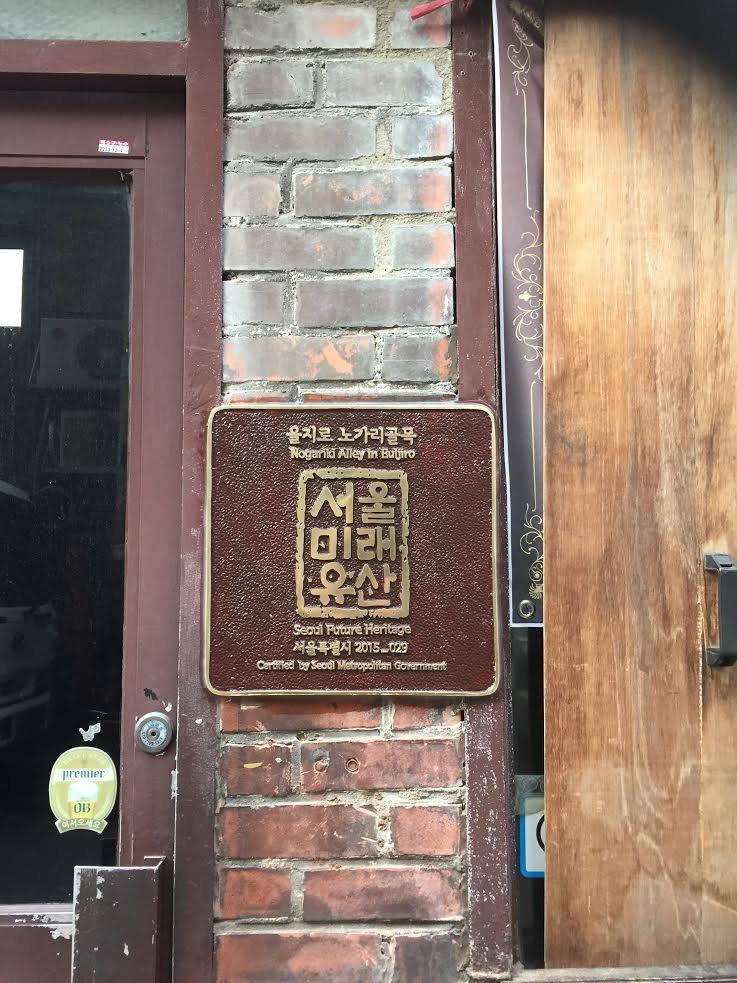
I came across this “Seoul Future Heritage” plaque in one of my favorite neighborhoods, Uljiro sam-ga, in Seoul. The plaque is mysterious. It seems to suggest that the building will be a heritage site at some point in the future. Not entirely clear to me.
It is an interesting how these international meetings of powerful nations have grown as a social phenomenon. Are they nearing the end of their natural development.
G 5 1974
G 6 1975
G 7 1976
G 8 1997
G 20 1999
G 2 2005
G 0 2017
by
Asia Institute Seminar:
“HISTORY, MEMORY AND THE PROMISE OF PEACE IN NORTHEAST ASIA”
Hope Elizabeth May & Emanuel Pastreich
This seminar held on November 23, 2016, traces the ties between Korea and the struggle for world peace and suggests that Korea has in its past the potential to be a leader in the current effort to “wage peace” in the face of increased tensions around the world.
(From Asia Today)
The Asia Institute held a seminar on “History, Memory and Peace in Northeast Asia”on November 23 with Professor Hope Elizabeth May, Professor of Philosophy at Central Michigan University. Professor May discussed the 19th century international Peace through Law Movement (which predated the UN and the League of Nations) and to which the Korean Independence Movement repeatedly appealed. The event drew reporters, diplomats, academics and young students interested in new approaches to peace in East Asia.
The relationship of the United Nations to Korea is normally assumed to begin with the Korean war, but this seminar showed the link between Korean independence and the campaign for world peace and international arbitration which took off in the late nineteenth century, culminated in the Hague Conferences, and produced the United Nations.
Professor May described how the drive for Korean independence was linked to the advocacy for world peace by the Korean delegation sent by Emperor Kojong to the Second International Peace Conference in 1907. This mission, led by the American Homer Hulbert and the Korean loyalist Yi Jun, made a rational argument for the Korean independence as part of a larger embrace of peace.
Professor May discussed how members of international civil society sympathized with the Koreans and gave them a voice at the meeting.
A peaceful approach to the resolution of conflict was at the heart of 1919 Korean independence movement whose Korean Declaration of Independence advocated the avoidance of anger and resentment:
“We have no wish to find special fault with Japan’s lack of fairness or her contempt of our civilization and the principles on which her state rests.”
Professor May placed current efforts for peace in the context of “Peace History,” a “red thread” that ties together today’s movements to previous efforts over the last hundred years. She suggested that we must embrace this “positive history” if we want to move beyond the remarkably disturbing descriptions of Korea’s history that focus on massacres and “atrocity history.”
May argued that this history contains reservoirs of inspiration and “moral energy” that can link us to the community of individuals, past, present and future, who strive for a more harmonious world.
She closed with a quote by Soviet dissident Natan Sharanksy, which helps us to understand how ‘positive history’is a treasure trove of moral resources:
Souls interact across time and space. The decisions people make in a difficult hour, the principles they either abide by or abandon in moments of truth, have consequences not just for their own lives, but well beyond.
Pastreich noted that the history of peace in East Asia could bring new potentials to future discussions about Asia’s future precisely because our vision has become so very limited by a debate in think tanks that offers the choice between military containment and economic integration that is posited on exploiting North Korea’s natural resources and cheap labor.
He suggested that this positive history of peace in Korea suggests that it is possible to present a different model for Korea that draws on the spiritual depth and moral energy of the Korean Independence Movement, and not on a consumer-based economic development model.
One thing is clear: The inability of the Korean media to anticipate even the possibility of a Trump victory will be remembered as a tremendous intelligence failure that has left the great halls of journalistic pomp looking distinctly shabby.
Don’t tell me that the United States media also got it wrong. Major newspapers in the United States continuously wrote about a Clinton victory, even trying to make that scenario seem more likely by using the terminology “probability of a Clinton victory” (92%) instead of percent of people who intend to vote for Clinton. But sloppy journalism is America’s problem, it does not have to be Korea’s problem
Many informed Americans were aware of the bias in the mainstream media during the election, and knew about the unprofessional decision of reporters to coordinate with the Clinton camp concerning their reporting, and about the donations to the Clinton campaign by media companies.
Months of unfavorable news about Clinton had done tremendous damage to her credibility with voters.
But the Korean media repeated the headlines of the mainstream U.S. media and readers assumed the election was already decided.
Although Korea has one of the most educated populations in the world, and numerous reporters who are extremely fluent in English, the rules of Korean media meant that almost none of those reporters consulted the large number of journals, blogs and other thoughtful reporting in the United States that suggested that the election might be close.
For that matter, if Korean foreign correspondents had talked with working class people in America they would have discovered that minorities were unenthusiastic about Clinton and that many whites were enthusiastic about Trump. But foreign correspondents will never meet ordinary Americans at the pompous events held at Washington think tanks.
Korean reporters, unlike Korean manufacturers of smartphones or of container ships, do not have as their goal being the best in the world; they work hard, but their newspapers are dedicated to digesting quickly and summarizing the news available from foreign news agencies, not in developing the domestic capacity to create entirely original and distinctly Korean perspectives on news and global affairs for both domestic and global consumption.
That is a terrible shame because Korea clearly has all the assets needed to be a leader in journalism. Korea has an educated population with many near-native speakers of English, Chinese and Japanese and there are an incredible number of PhDs in diverse fields. As a nation not encumbered with the tradition of imperialism that warps media reporting so often, Korea is well positioned to build a new journalistic tradition of its own, with roots in Korea’s own culture, rather than copying content from abroad.
Part of the process requires giving up all politesse. Foreign correspondents are not there just to make friends with the powerful and to play golf, American politicians, officials, and lawyers must be subject to tough unrelenting questions to get to the bottom of things. So also reporters must avoid being seduced by carefully crafted articles written in an authoritative tone that are meant to be misleading.
Journalists must read broadly from different sources and then use their imagination. To be a good journalist, one must first imagine five or six scenarios that could explain what is happening in politics. One then inspects the facts carefully and slowly eliminates those scenarios that do not hold up — as did Sherlock Homes. That process will get you close to the truth. But if one does not use one’s imagination to postulate what might be, one will quickly fall into the trap of limiting oneself to the scenarios which are offered up by interested parties.
Newspapers should hold up an ideal of the pursuit of truth with the intention of providing practical information for the general reader that will help him to make informed decisions. As such, the media is critical for the nation from the perspective of the ordinary man as a means to assure we have an educated public that can make informed decisions within a democratic system. Reporters should feel a deep responsibility to make complex issues accessible in an original manner.
Media has become a market in recent years, but it does not have to be. The sooner Korea snaps out of that haze, the faster it will be able to objectively judge its own interests and serve as a global leader.
At first readers may be put off by writing that actually locates issues in their historical context and makes proposals for long-term solutions. But over time, I believe, we can lead the public back to responsible politics, get them to stop being consumers and become engaged citizens.
Korea will face tremendous challenges in the years ahead that will require us to pull together as a nation and to make informed decisions.
This is the moment for a deep commitment to journalism of the very highest standards.
한국 언론이 트럼프의 승리를 예측하지 못한 것은 참혹한 정보실패(intelligence failure)로 기억될 것이다. 언론의 위풍당당한 전당(殿堂)을 초라하게 보이도록 만들었다. 미국 언론도 잘못 짚었다고 내게 말하지 말라. 미국의 엉성한 저널리즘은 미국의 문제다. 미국 주요 신문들은 계속 클린턴의 승리를 전망하는 기사를 썼다. 심지어는 그의 승리 시나리오가 보다 신빙성 있게 보이도록 클린턴에 투표할 의향이 있는 사람들의 비율이 아니라 “클린턴이 승리할 확률은 92%”라는 식의 전문적인 표현을 사용했다.
이런 사정에 밝은 많은 미국인은 선거 기간 중에 노출된 미국 주요 매체들의 편향성을 인지하고 있었다. 프로답지 않게 기자들은 기사 작성 전에 클린턴 캠프와 모종의 조율을 했으며 언론사들은 클린턴 캠프에 기부를 했다. 수개월 동안 클린턴에게 불리한 뉴스가 쏟아지자 많은 유권자가 그에 대한 신뢰를 접었다. 그러나 한국 매체는 주류 미국 매체의 잘못된 1면 머리기사 제목을 답습했다. 따라서 독자들은 미 대선이 결판난 줄 알았다.
한국 교육 수준은 세계 최상급이다. 수많은 한국 기자들은 영어 구사력이 지극히 뛰어나다. 하지만 한국 매체의 관행 때문에 이번 대선이 박빙이 될 수도 있다고 내다본 여러 저널•블로그•기사 등 깊이 있는 문헌을 살펴본 기자는 거의 없었다.
한국 특파원들이 미국 근로자들과 이야기를 나눴다면, 소수집단 사람들이 클린턴에게 냉담했으며 많은 백인이 트럼프에게 열광했다는 것을 발견했을 것이다. 하지만 특파원들이 젠체하는 워싱턴의 싱크탱크 행사에서 미국의 보통사람을 만날 일은 없다.
한국 기자들은 한국의 스마트폰이나 컨테이너 선박 제조업 종사자들과는 달리 세계 최고가 목표가 아니다. 그들은 열심히 일한다. 하지만 한국 신문들은 외국 뉴스 기관들이 제공하는 뉴스들을 신속하게 소화하고 요약하는 데 주력한다. 한국 고유의 시각으로 국내외 독자들에게 기사를 제공하는 것은 한국 신문사들의 목표가 아니다.
매우 부끄러운 일이다. 한국은 세계 저널리즘을 주도하는 데 필요한 모든 자산을 명백히 확보하고 있기 때문이다. 많은 한국 사람이 영어•중국어•일본어를 원어민 수준으로 말할 수 있다. 다양한 분야에 걸쳐 믿을 수 없을 정도로 많은 박사학위 소지자들이 있다. 한국은 매체 보도를 종종 뒤틀리게 만드는 제국주의 과거가 없기 때문에, 외국 콘텐트를 복제하는 게 아니라 한국 자신의 문화에 뿌리를 둔 새로운 저널리즘 전통을 수립하는 데 아주 유리하다.
새로운 한국 저널리즘을 만드는 과정은 부분적으로 모든 격식과 예의의 포기를 요구한다. 특파원들은 외국의 힘 있는 사람과 원만한 친분이나 우호관계를 쌓기 위해 파견된 게 아니다. 특파원은 현상의 본질을 파고들기 위해 미국 정치인•관료•변호사들을 거칠고 집요한 질문으로 다뤄야 한다. 기자들은 또한 사람들을 오도하기 위해 교활하게 작성된 권위 있는 어조의 기사들에 매혹되지 말아야 한다.
저널리스트는 다양한 출처의 글들을 읽은 후 자신의 상상력을 사용해야 한다. 훌륭한 저널리스트가 되기 위해서는 정치에서 벌어지고 있는 일을 설명하는 5개 혹은 6개의 시나리오를 우선 상상해야 한다. 그런 다음에는 셜록 홈스가 한 것처럼 신중하게 사실(fact)을 검토해 가능성이 없는 시나리오들을 천천히 하나하나 제거해야 한다. 그러한 과정이 진실에 근접하게 해준다. 자신의 상상력으로 가설을 세우지 않으면 이해관계자가 제시하는 시나리오로 스스로를 구속하는 함정에 쉽게 빠지게 된다.
신문은 진리 추구를 이상으로 삼아야 한다. 일반 독자들이 ‘정보에 기반한 결정(informed decision)’을 내리는 데 필요한 실용적인 정보를 제공하겠다는 의도에서다. 민주주의적 체제 내에서 정보기반의 결정을 내릴 수 있는 교양 있는 대중을 형성하려면 매체의 역할이 국가적으로 매우 중요하다. 기자들은 복합적인 문제에 대한 접근성을 독자들에게 창의적으로 제공해야 한다는 깊은 의무감을 느껴야 한다.
최근 몇 년간 미디어업계는 질 낮은 레드오션 시장이 돼 버렸다. 하지만 그래야 할 이유가 없다. 한국이 그런 안개 같은 상황을 빨리 탈피할수록 한국은 더 빨리 자신의 국가이익을 객관적으로 판단하고 글로벌 리더로서 기여할 수 있을 것이다.
처음에는 독자들이 어떤 사안의 역사적 맥락을 짚어 주고 장기적인 해결책을 제시하는 기사들을 꺼릴 수 있다. 하지만 내 생각에는 시간이 흐르면 그러한 글쓰기가 대중을 소비자가 아니라 참여적인 시민으로 변모시켜 그들을 책임성 있는 정치로 다시 인도할 수 있다.
앞으로 한국은 심대한 도전에 직면하게 될 것이기 때문에 우리들은 대한민국이라는 같은 나라의 구성원으로서 힘을 합치고 정보에 기반한 현명한 결정을 내려야 한다. 지금 한국은 매우 높은 수준의 저널리즘에 대한 깊은 헌신이 필요한 때다. 언론의 모범은 해외에서 찾지 말자.