Korea turns to Maps

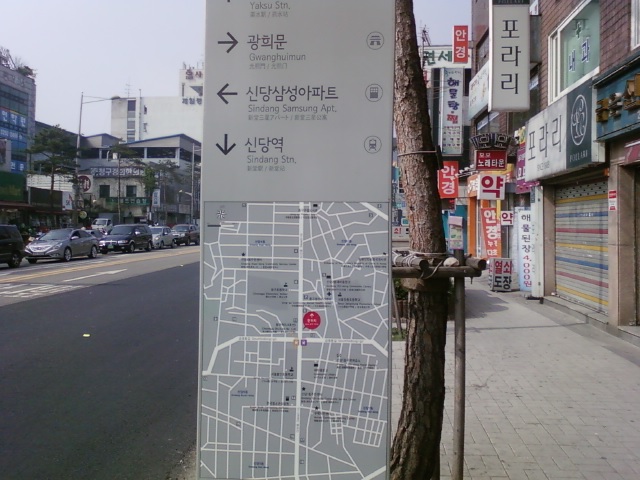
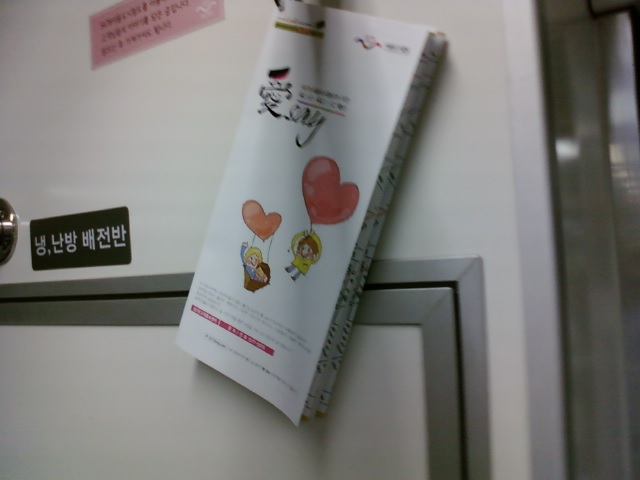
Koreans have not been so big on maps. Whereas in Japan highly accurate maps have traditionally been a mainstay for citizens and a symbol of good living, Koreans prefer to ask the way, or if necessary, use a navigation device. But that aspect of Korea is now changing as well. Rather well organized maps are going up around Seoul that are as good as anything one finds. In fact, several subway stops now feature both maps and photographs taken from above to allow the observer two means of understanding the geography of the neighborhood.  Seoul Metro also has come up with an innovative manner of providing maps to riders.


Emanuel Pastreich

Circles and Squares

Climate change and Homelessness

It is almost August and Seoul is lost in the most serious torrential rains I have ever witnessed. I was starting to grow my own vegetables at home and at work, but agriculture is rather negatively impacted by this level of rain, at least agriculture as we have known it. Needless to say, although climate change is everywhere in the media, I don’t hear anyone saying in daily conversation that this odd rain is related to climate change. Just not a polite thing to do, and so I do not mention climate change much either. Of course climate change is not a simple matter of CO2 emissions. After all, the climate change that turned the Middle East into a desert began before the massive CO2 emissions. But that the desertification of Saudi Arabia was linked to human activity is beyond doubt.

It would be nice if all the consumption that is so negatively impacting the environment were at least helping people to live better. But, unfortunately, there are homeless, and those who struggle to feed themselves, who wander around Seoul and of course many other countries, trying to make a living. The homeless are the most seriously impacted by the heavy, unrelenting rains. For many of them it is matter of survival. There are a large number of elderly in Korea who survive by pulling wagons on which they gather old newspapers and other recyclable goods. For these individuals climate change is a matter of life and death. Of course what impacts them today, may impact us tomorrow.
 

On Yoyo Ma

Yoyo Ma is a close friend of my father’s whom I have known since I was a child. Whenever he visited San Francisco he was certain to stop by our home. He knew me before I could speak a word of Chinese and he met me repeatedly as I learned Chinese, Japanese, and finally Korean.

As a Chinese who has spent his career between the Chinese and Western cultures Yoyo Ma understood my work between cultures better than most people and we are able to communicate with a greater degree of depth than might otherwise be the case. I felt great closeness to Yoyo because we both found ourselves deeply imbedded in more than one culture. Yoyo, as a Chinese who had fully embraced the Western classical music tradition and spent his time at Harvard, and later in life, reading Aristotle and other great thinkers and me as a European who had embraced the Asian tradition and spent so many years trying to understand the classics, both of us had to find a space between the two cultures.

Read more

Life for the Handicapped in Seoul

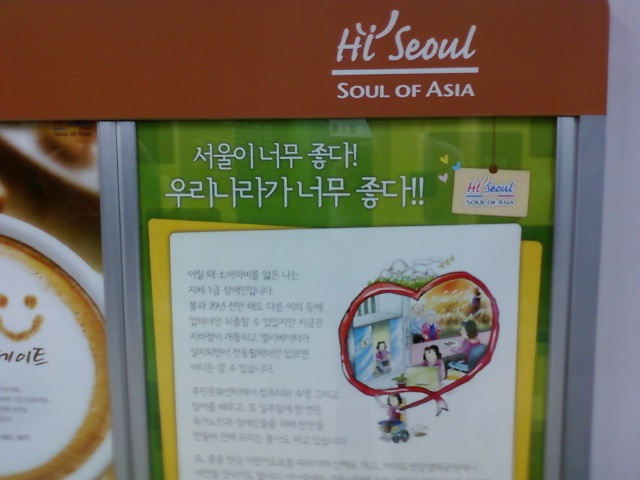
Seoul traditionally was not very attentive to the handicapped, but I have been impressed by recent efforts to make life more convenient for all citizens. There seems to be an effort to create a more open environment. Here a young handicapped woman exclaims, “Seoul is such a wonderful place.” She is referring to the ease of life. It would not be accurate to say that Seoul is particularly convenient, but an effort is being made these days.


Emanuel Pastreich

Circles and Squares

Money Pants in Seoul

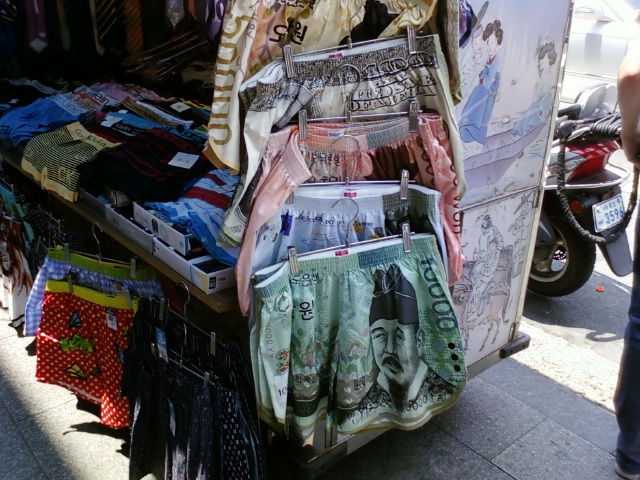
I am not sure what to make of the underwear emblazoned with the currencies of the world that are for sale in Itaewon these days. I suppose they symbolize the coming collapse of currency itself as the process of mechanical reproduction reaches an extreme in this fluid age.


Emanuel Pastreich

Circles and Squares

Greening Seoul’s Soul

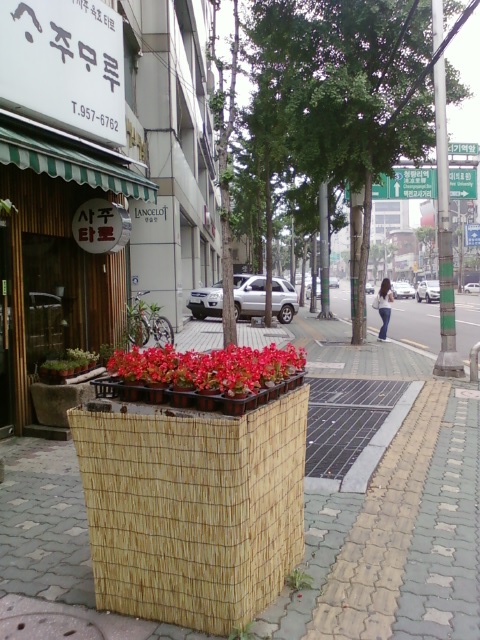
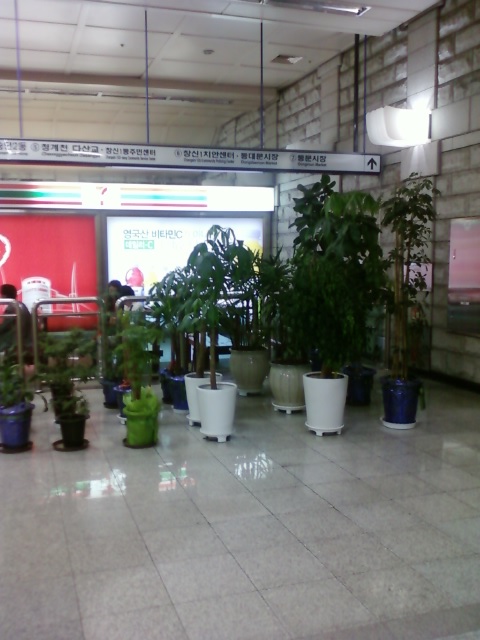
Seoul has suffered from a serious misconception of the meaning of real estate. It seems as if green space was deemed a waste in the building of houses and offices throughout the city. The are big parks, of course, but along most streets trees are not at the center at all. But we have seen over the last few years efforts to introduce plants at stores, in the metro, in every corner of the city. Often the efforts seems spontaneous.  There is a buried lover of plants and agriculture in Korea. Getting away from green was part of moving from the agricultural to the industrial economy. For the reason, neighborhoods should look green, but not too green. But at the same time, there is a nostalgia for the agricultural past just beneath the surface of Korea.

Of course, the plant are often placed in a make-shift manner, suggesting they can disappear at any moment.

Emanuel Pastreich

Circles and Squares

Agricultural goods on the subway

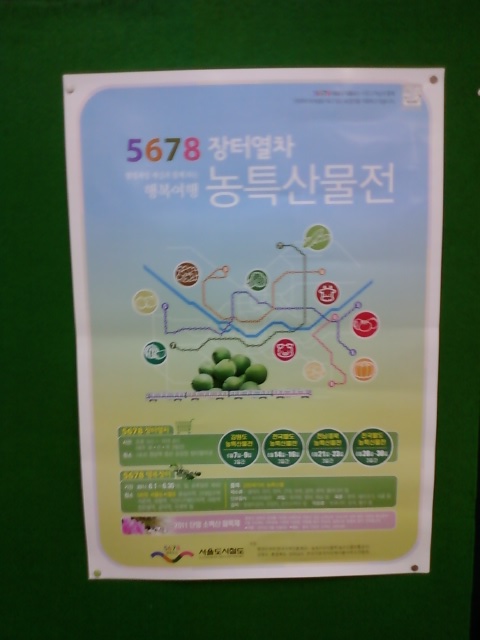
Seoul Metro is involved in a multidimensional project to reinvent what exactly subway means. One of the strongest indications of this project is the decision to set up fresh produce markets in the subway.  I was impressed by the quality vegetables available and the presence of such markets in what would otherwise be a desert makes commuting much more enjoyable. This metro sign identifies various fresh produce markets throughout Seoul Metro.

Emanuel Pastreich

Circles and Squares

Imagining the past in Korea

One of the oddest phenomena in Korea today is the nostalgia for a past that never existed in Korea. We see in advertisements little bits of memorabilia from a distant age in America, but that has no place in Korea today. In this first of these two pictures, we see a few fascinating artifacts that have little to do with anything Koreans might remember from childhood.

The second image is even more startling. I remember from my own childhood such classic VW buses. They are associated closely for Americans with the greening of America in the early 1970s after the terrible political conflicts of the 1960s. But Koreans have no personal memory of these buses, which were not sold in Korea as far as I can ascertain. It seems a special mythology of Korea has been created as cultural variation of the United States and bits of a rather alien origin have been imported into that Korean imagined past.

[slideshow]

Emanuel Pastreich

Circles and Squares

Letter from China to the Nobel Prize Committee asking for the establishment of a Prize for Ecology Studies

 Professor Chen Minghao of Jiaotong University in Shanghai, asked me to translate this letter to the Nobel Prize Committee asking that a Nobel Prize for Ecology be established. At the time, I did not really understand what he was talking about and did the translation just on a whim of sorts, but now, many years later, Chen Minhao’s thought seems most prescient. He passed away last year and I deeply regret I was not able to meet him again and tell him how much I learned from him.

 March, 1994


“Maintaining the Well-being of Humanity is the Spirit of Alfred Nobel’s Legacy”

An open letter to the Nobel Prize Committee

by Minghao Chen

There are only five years left in this century. The aging twentieth century is passing into history while a new century slowly emerges in an aura of possibilities and hopes. Humanity as well has reached a historic turning point in its development; a new path awaits us beyond. We must turn away from our present path of single-mindedly pursuing material and technological progress and choose the way of harmonious coexistence with nature, and economic development closely coordinated with the needs of the environment.

Read more