2012년 6월 7일 예일대학교 동아시아 언어‧문학 존 트리트 교수님 (일본문학전공) 께서 경희대에서 예일대 학한국 전망 관련 해서 특강 하셨어요. 명문 예일대학교는 아직 한국학이 없는 이유를 설명 하시고 예일대와 한국의 인연을 소개 하셨어요. 교수 하고 학생과 매우 유익 한 문답도 하셨어요.
발표문 요약:
존 트리트
동아시아 언어‧문학
예일대학교
예일대 한국학 연구의 과거, 현재 그리고 미래
Professor John Treat’s Talk on the Past, Present and Future of Korean Studies at Yale University
Professor John Treat of East Asian Languages and Literature at Yale, my original department and the department of Professor Steven Owen at Harvard University, delivered this talk to a group of Kyung Hee students and faculty on June 7, 2012 at the Kyung Hee University library.
East Asian Languages and Literature at Yale is the most solid program for learning Asian languages in the United States. Because the program requires undergraduates to take a course in either literary Chinese or literary Japanese, it has never attracted a large number of students. In my year, 1987, there were four majors.
The discussion about the history of Korean studies in the United States, and its evolving nature, was fascinating. Sadly, Yale University does not yet have a Korean studies program, although Professor Treat is working hard to build one.
Asia Institute Gathering to talk about the Environment with Youth (Friday, June 15, 2012)
Asia Institute Gathering
Please do join us for an informal gathering for students to discuss this most critical topic:
“What youth can do for the environment?”
Your presence would be greatly valued, and your suggestions as to what can meaningful responses to the environmental crisis.
(Hosted by Emanuel Pastreich, Professor of Humanitas College)
Friday, June 15
5 PM
Location Room #209 (second Floor) Neo-Renaissance Hall
Kyung Hee University (Hoegi-dong)
Asia Institute Seminar “The Great Green Wall and the Fight against Desertification in China” JUNE 28, 2012
Asia Institute Seminar
The Great Green Wall and the Fight against Desertification in China
Report to the Rio +20 United Nations Conference on Sustainable Development
Thursday, June 28, 2012
6:30-7:30 PM
Asia Institute Seminar with Mark Hasegawa-Johnson, University of Illinois
“The future of Voice Recognition”
KOREA IT TIMES
Asia Institute Seminar with Mark Hasegawa-Johnson
Tuesday, May 29th, 2012
Professor Mark Hasegawa-Johnson received his Ph.D. from MIT in 1996 and serves as associate professor in the University of Illinois department of Electrical and Computer Engineering and a full-time faculty member in the Artificial Intelligence group at the Beckman Institute. His field of interest is speech production and recognition by humans and computers, including landmark-based speech recognition, integration of prosody in speech recognition and understanding, audiovisual speech recognition, computational auditory scene analysis, and biomedical imaging of the muscular and neurological correlates of speech production and perception. Professor Johnson is visiting Korea to meet with experts in academics and industry to discuss his research.
Global Seoul and Human Seoul
One indication of how Seoul is distinct from other global cities is the emphasis on citizens that occasionally crops up in public announcements. I would not claim that the particular public announcement from the City of Seoul that came across on the subway yesterday represents all policy in Seoul, but it does suggest an argument that you will not find articulated by that many city governments through official channels.
Asia Institute Seminar with Professor Noam Chomsky (video)
Asia Institute Seminar
with
Professor Noam Chomsky
Department of Linguistics
Massachusetts Institute of Technology
“WHAT CAN YOUTH DO TO CHANGE THE WORLD?”
The Asia Institute held this Webinar with Professor Noam Chomsky of MIT on December 3, 2011 as a webinar between Seoul, Korea and Cambridge, Massachusetts. Professor Chomsky discussed how youth can effectively work to change the world and improve policies at both the local and international levels. He stressed the need for youth around the world to work together and to come up with their own solutions, saying repeatedly that the answer must come from students, not from him. When told that he was the leading progressive intellectual in the United States, he promptly replied, “I resign!”
There have been several Korean media interviews with Professor Chomsky over the years, but this seminar was the first time that Korean students, including those not fluent in English, were able to ask Professor Chomsky questions directly. This dialog between experts and young people is emblematic of the Asia Institute approach to contemporary issues. Professor Chomsky later remarked, “I much appreciated the opportunity.”
Video on Youtube:
Talk on how Korea can learn from the past in implementing a program to work together with China to combat the spread of deserts (Saturday, May 26, 2012)
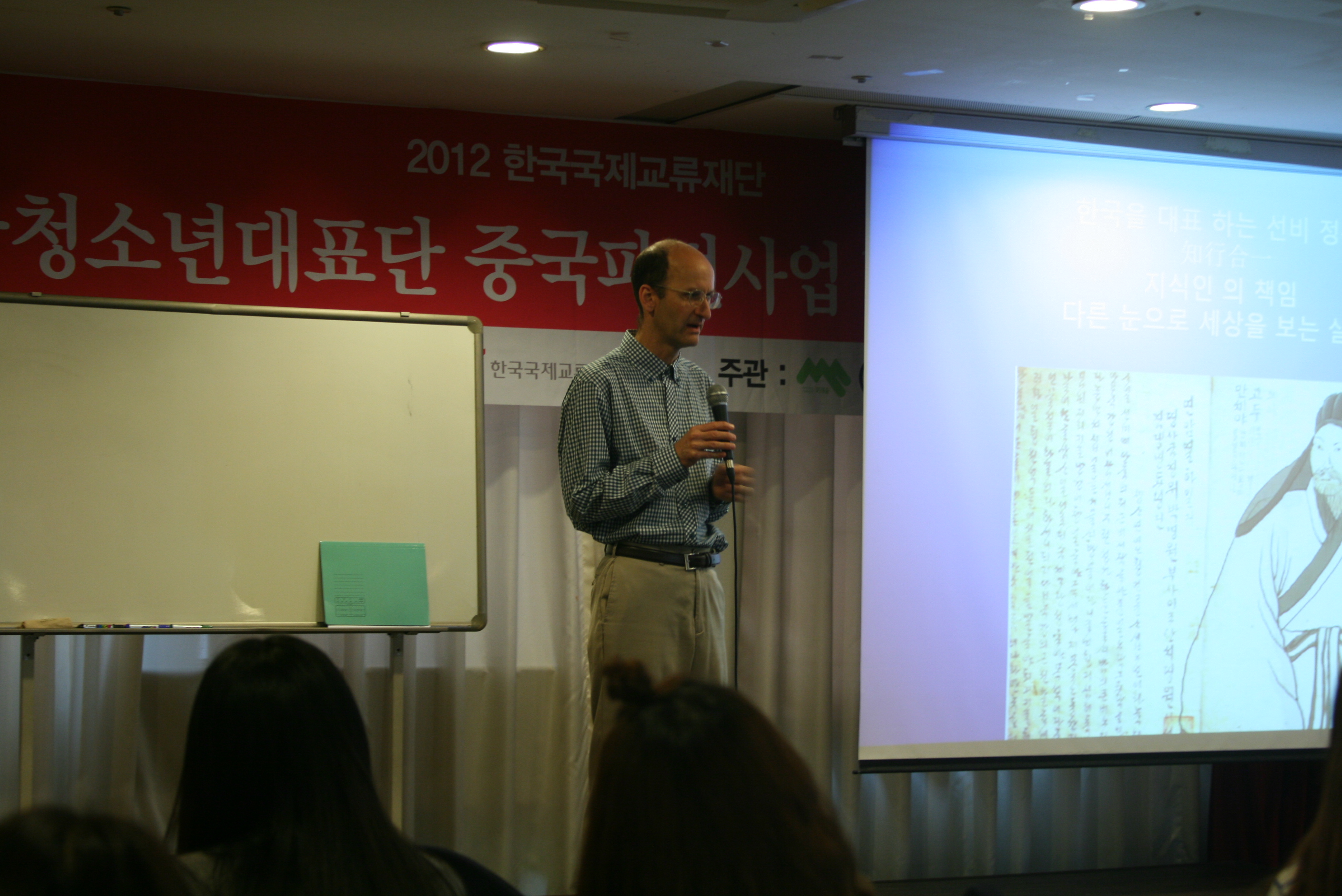
I gave a talk for a group of Korean college students preparing to travel to China where they will work together with Chinese students on anti-desertification projects in July. The students are from universities across Korea and the event was sponsored by the Korea Foundation and Future Forest, the NGO dedicated to Korea-China cooperation on environmental issues of which I am a member. This new effort to bring together young people from Korea and China represents the initiative of the Asia Institute to build close networks between people of different nations that parallel technological and logistical integration.
Seoul goes Global (this time for real!)
Seoul is stepping into a much accelerated rate of internationalization over the last six months, so much that I would argue that Seoul should no longer be considered as representative of Korea, but put in a new class of global cities that are competing for global domination in economics, culture, education and prestige. That is to say, Seoul is going head to head with Dubai, Singapore, New York, London and Shanghai in a race for the top seat. You can refer to my previous short post on the next Byzantium for a few thoughts on this phenomenon.
For example Seoul is going through a wave of enormous building projects such as the Dongdaemun History and Culture Park that may well fundamentally alter the landscape of the city.