I have an important question about Chinese ideographs and would very much appreciate your comments or thoughts.
Many Koreans believe that the Chinese characters were borrowed from China by Koreans and employed in a most unnatural manner for almost all writing until the 20th century. That Chinese writing was, many hold an alien writing form that was at a distance from their own original language.
Centre for Japanese, Korean and Northeast Asian Studies
Jawaharlal Nehru University
Emanuel Pastreich
How does the recent tension on the Korean Peninsula look from an Indian Perspective? India has obviously a profoundly different cultural tradition and historical experience. And yet we are quite aware of the fact that India has had any number of conflicts and disagreements over the last sixty years. After all, Pakistan and India were separated in 1947, the exact moment that the divisions between North and South Korea were forming.
Asia Institute Seminar Gregg A. Brazinsky Associate Professor of History and International Affairs George Washington University
The Outsider in Korean Politics
August 11, 2012
Emanuel Pastreich:
So one immediate question that comes to mind is whether President Roh Muhyun should be regarded as an outsider. Certainly he had all sorts of conflicts with his own party. But was he really an outsider, and was that outsider quality important
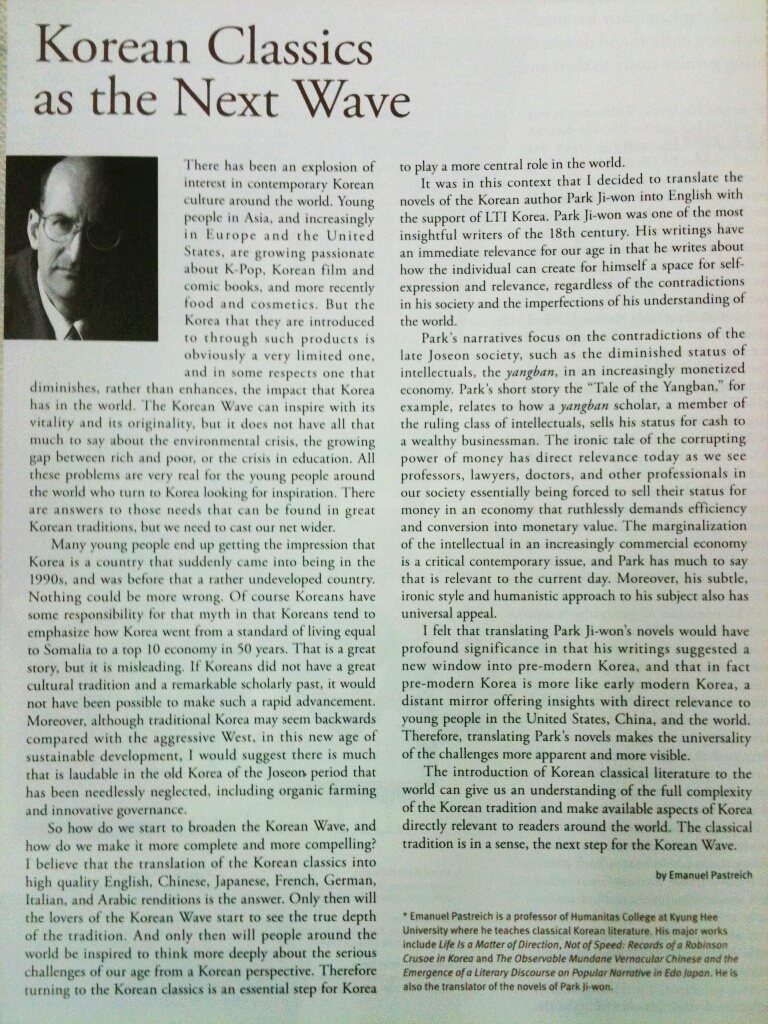
Emanuel argues in this article for Korea Literature Translation Institute that the Korean classics, and the Korean classical tradition should be the next focus for the Korean Wave.
Emanuel’s article in September 2012 issue of Korea Literature Translation Institute. “Korean Classics as the Next Wave”
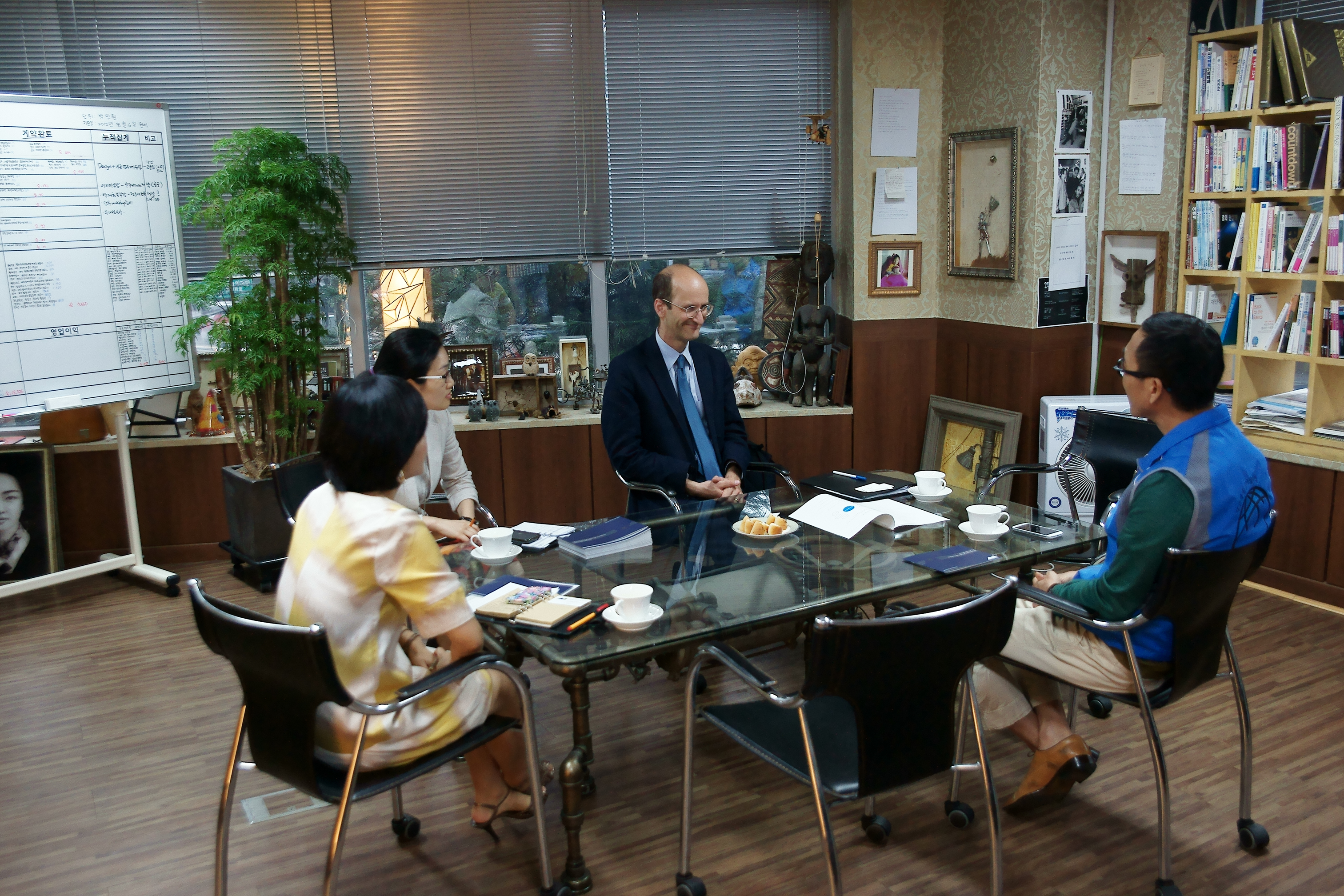
I was invited to give a talk at JSB Incorporated, one of the most innovative companies in Seoul working on environmental design on August 30, 2012. I had a chance to speak at length with the CEO Choi Jaejung, a remarkable figure who is known for his love of art and the environment (both he and his wife are artists) and his open style of administration.
급변하는 우리네 도시의 모습을 보면 미래 모습은 감히 상상조차 되지 않을 때가 있습니다. 그래서 이번 3/4분기 명사초대석에는 도시의 미래에 대해, 그 올바른 방향성에 대해 말씀해 주실 분을 모셨습니다.
JSB도시환경 최재정 대표님 과 같이 말씀 나누는 순간
경희대 후마니타스 칼리지 이만열 교수님께서는 대만, 일본, 미국에서 유학하며 동아시아 언어와 문화에 대해 공부하셨고, 현재는 우송대학교 아시아연구소장을 겸직하며 도시의 생태·문화적 발전을 위해 다방면으로 힘쓰고 계십니다. 이번 명사초대석에서는 ‘도시의 미래, 변화를 위한 방향은 무엇인가?’라는 주제로 강의를 진행하셨습니다.
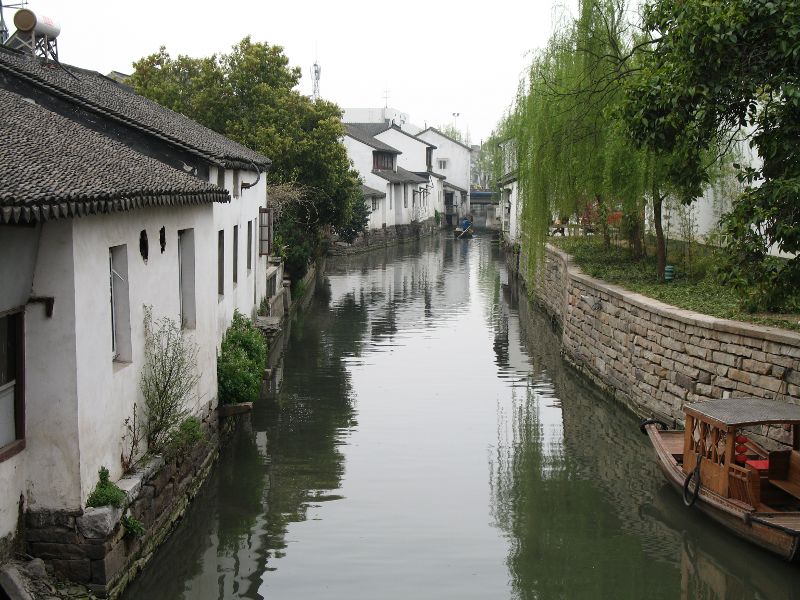
I have not been in Suzhou since 1991. I remember the old canals that I had read about so often were being rebuilt and prettied up in ways that I must say were not exactly to my liking. Suzhou was changing quite rapidly at the time and I felt I could see something slipping away before my eyes.
The canals of Suzhou embody the understated wealth and erudition of this intellectual mecca. If I had to imagine an ideal hope, perhaps Suzhou of the Ming Dynasty would be it.
But now an enormous “Gate to the East” 东方之门 is rising above Suzhou that dwarfs everything else. Two towers come together as one, perhaps symbolizing a marriage of East and West, or of past and present.
The changes are profound, and reminds us that increasing Chinese economic and political self-confidence has not manifested itself in a reaffirmation of traditional Chinese aesthetics, with a few notable exceptions.
I presented a paper on Michael Nielsen’s new book: “Reinventing Discovery: The New Era of Networked Science” at the second annual summer seminar for young Asian researchers of the Asia Research Network. I have worked with the Asia Research Network informally for the last two years, but this was my first chance to see first-hand their work.
The Asia Research Network grew out of the collaboration between Professor Hara Masahiko at Riken (and Tokyo Institute of Technology) and Professor Haewon Lee of Hanyang University on nano materials. The joint research laboratory of Riken and Hanyang University in Seoul is the most significant example of sustained collaboration between Japan and Korea. Significantly, the Asia Research Network http://www.asianrn.org/ is growing rapidly and promises to be a platform for a new level of collaboration in Asia.