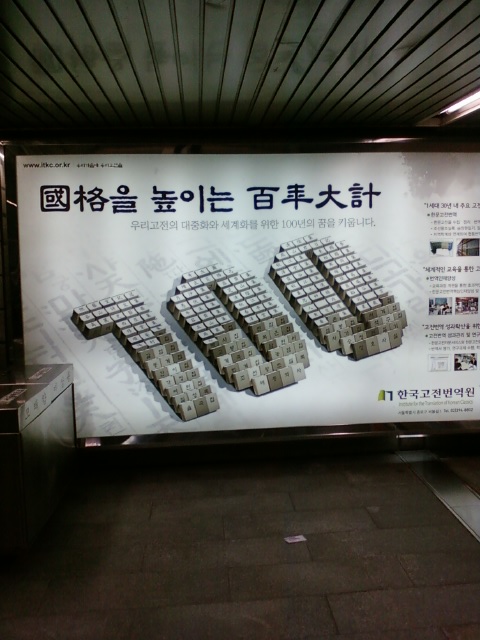
This Advertisement introduces the immense project being undertaken at present by the Institute for the Translation of the Korean Classics (한국고전번역원) to render large sections of the Korean literary and intellectual canon into contemporary Korean language. Because literary Chinese was the intellectual language of Korea until the twentieth century, there is a vast amount of the Korean tradition that is simply not accessible to contemporary readers. Few Koreans today learn classical Chinese. That discontinuity in the Korean cultural tradition is critical to understand how Korean culture is different that of France or Italy, nations in which a remarkable cultural continuity over the last thousand years remains intact. If you ask an educated Korean about the writings of a 17th century Korean philosopher, he or she would most likely stare at you blankly—with a few exceptions. But if you asked an educated Italian intellectual about a major Italian philosopher, he or she most likely has read some of the philosopher’s writings in the original.
The work of the Institute for the Translation of the Korean Classics is aimed at opening up the classical tradition to contemporary Koreans. The greater challenge will be making that tradition accessible to internationals. Although daunting, such an effort is absolutely essential if Korea is to get the recognition globally it deserves.
By the way, the situation is even more severe in Vietnam where also most of the writings until the 20th century are in literary Chinese but very little has been translated into contemporary Vietnamese.