Translation of Murakami Haruki’s Speech at Barcelona in Japan Focus

I watched a video of Murakami Haruki’s Barcelona speech about the Tsunami and Fukushima nuclear accident on the internet about two days after its release. I was struck by this effort by a writer who is best known for his studied distance to engage in the contemporary world in an extremely concrete manner. I felt the speech was so significant that it deserved to be translated into English. I did the translation within a few days and passed it on to John Treat, a professor of Japanese literature at Yale University whom I had the chance to host here in Korea recently. After I discussed the translation a bit with John, I passed it on to my friend Mark Seldon, editor of Japan Focus, suggesting we should publish it in Japan Focus for a wider audience.

Mark recommended that I take the translation down from my website and prepare an authoritative version. I contacted Murakami Haruki’s office, through the introduction of Jay Rubin at Harvard—who is one of Murakami’s primary translators—and discussed the translations and Murakami’s publisher’s policy. This translation is by no means an “authorized edition” but in fact I talked with the office at length and sent the material by email to Murakami Haruki. There are several other versions out there, but I think this one is most accurate.

I spent quite a bit of time with Murakami Haruki back in the summer of 1994 when he was on sabbatical at Harvard for one year. We spent a bit of time together as I describe in my essay “On Murakami Haruki.”

Japan Focus

July 18, 2011

Speaking as an Unrealistic Dreamer

Speech by Murakami Haruki on the occasion of receiving the International Catalunya Prize

Translated by Emanuel Pastreich  


I last visited Barcelona two years ago in the spring. An amazing number of readers gathered when I held a book signing. Long lines formed and I still could not finish signing all the books even after one and a half hours. The reason it took so long is that so many of the female readers wanted to kiss me. That was time consuming.

I have held book signings in many cities around the world, but Barcelona was the only place in the world where the female readers asked for kisses. That one example is sufficient evidence of just what a fantastic city Barcelona is. And what good fortune it is that I have another chance to return to this city whose beautiful streets are resplendent with refined culture and a long history.

Murakami Haruki

But, unfortunately, I am not going to talk about kisses today. I must talk about something a bit more serious.

Read more

Multilingual Seoul

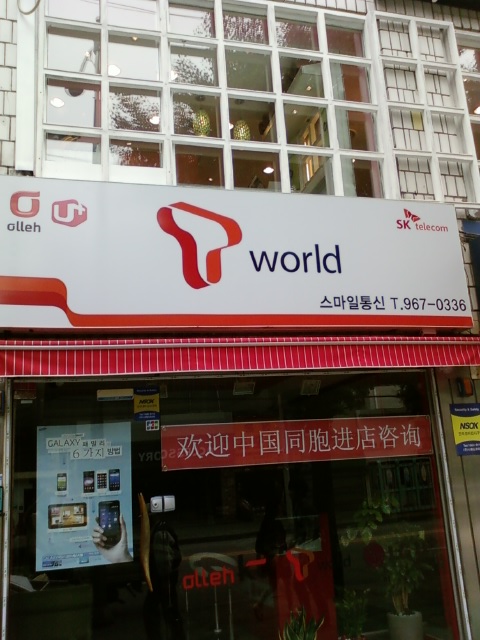
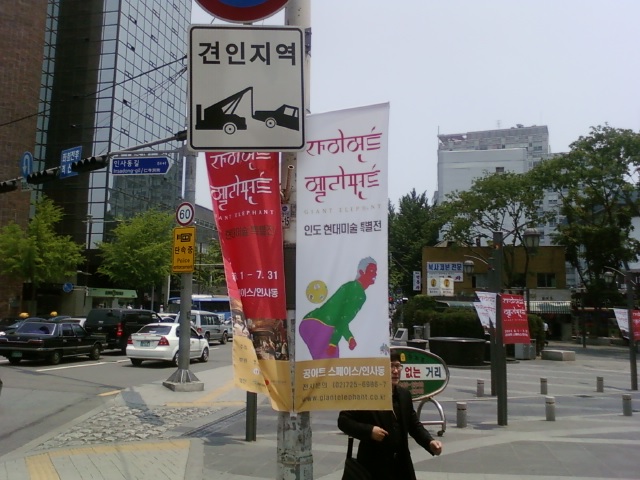
One sees a rapid increase in languages around Seoul other than Korean and English. Here are two notable bits of signage.

One is a mobile phone store with a sign in Chinese aimed at the increasing Chinese market in Korea. I am told that Chinese students have often more disposable income than Korean students at Korean universities. Have not conducted a study yet.

The other sign is for an Indian culture event. The poster does not assume a readership of Hindi, or maybe it does. In any case, Koreans previously had no tolerance for the Hindi language. That environment is changing quite rapidly.

“U.S. Scholar Explores Asian Literature” – Korea Herald

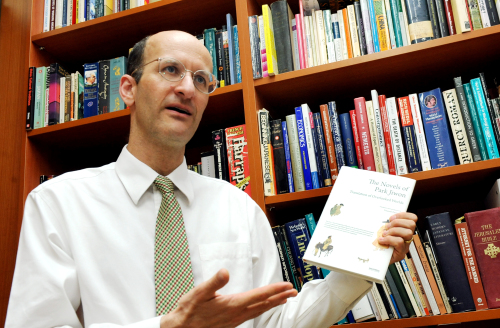
Here is an article regarding the release of my two new books, The Observabale Mundane and The Novels of Park Jiwon, which was published in the Korea Herald on June 27.

U.S. scholar explores Asian literature

An American professor has brought the classical novels of the novelist Park Ji-won of the Joseon period onto the global stage by translating ten short stories into English.

Emanuel Pastreich, who goes by the Korean name Lee Man-yeol, recently published two books in English with Seoul National University Press: “The Novels of Park Jiwon” and “The Observable Mundane, a study of Japanese Chinese novels. He expanded parts of his dissertation on how Chinese vernacular literature impacted Korean and Japanese literature and expanded it into two separate books.


Professor Emanuel Pastreich, director of the Interdisciplinary Studies Program of the Kyung Hee University (Photo: Park Hyun-goo)

Read more

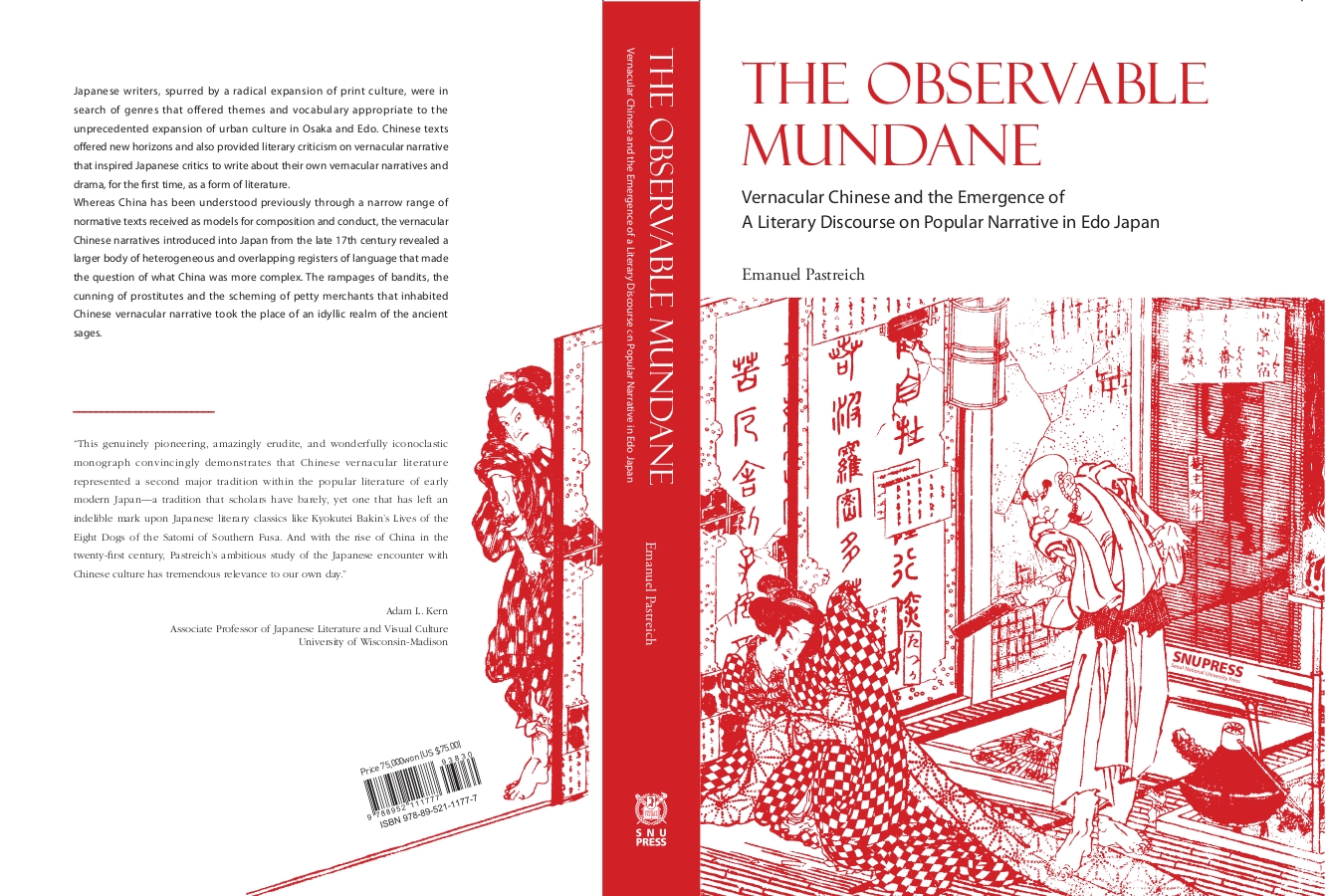
“The Observable Mundane,” study of Chinese vernacular literature in Japan (SNU Press)

Seoul National University Press has finally published my book, The Observable Mundane: Vernacular Chinese and the Emergence of a Literary Discourse on Popular Narrative in Edo Japan.  It is a scholarly study of the impact of Chinese vernacular narratives on the conception of literature among Japanese writers and critics in the Edo period (17th-19th centuries). Emanuel argues that Chinese vernacular literature, because it has some of the great authority of the Chinese tradition, but employed common parole, inspired a new evaluation of the potential of the vernacular that adumbrated the rise of the modern novel. The Observable Mundane is the first book on Japanese literature published by Seoul National University Press.

[twitter-follow screen_name=’epastreich’]

June 30 Reception for the Publication of Two Books by SNU

Publication Reception 출판 기념회

Reception commemorating the release of two books from

Seoul National University Press written by Emanuel Pastreich (이만열 교수님)

of  Kyung Hee University’s Humanitas College.

The Novels of Park Jiwon: Translations of Overlooked Worlds

&

The Observable Mundane: Vernacular Chinese and the Emergence of a Literary Discourse on Popular Narrative in Edo


Time:  June 30th Thursday, 5pm–7pm

(초대일시: 6월 30일 목요일, 오후 5시-7시)


Place:  PAIK HAE YOUNG GALLERY


PAIK HAE YOUNG GALLERY

101-40 Itaewon, 1-Dong

Yongsan-Gu, Seoul 140-201

T. 82-2-796-9347  F. 82-2-796-9348

paikhy@paikhygallery.com

www.paikhygallery.com

Directions from Itaewon Subway Station(line 6) Exit #2
Walk toward till you see the Fire Station across and turn left at the Chosun Antique.

Walk up to the hill about 5 mins to the Grand Hyatt Hotel direction.

Follow the yellow line and you will see the white building of Paik Hae Young Gallery.

SEE ATTACHMENT for details and MAP 

SNU PRESS RECEPTION INVITATION

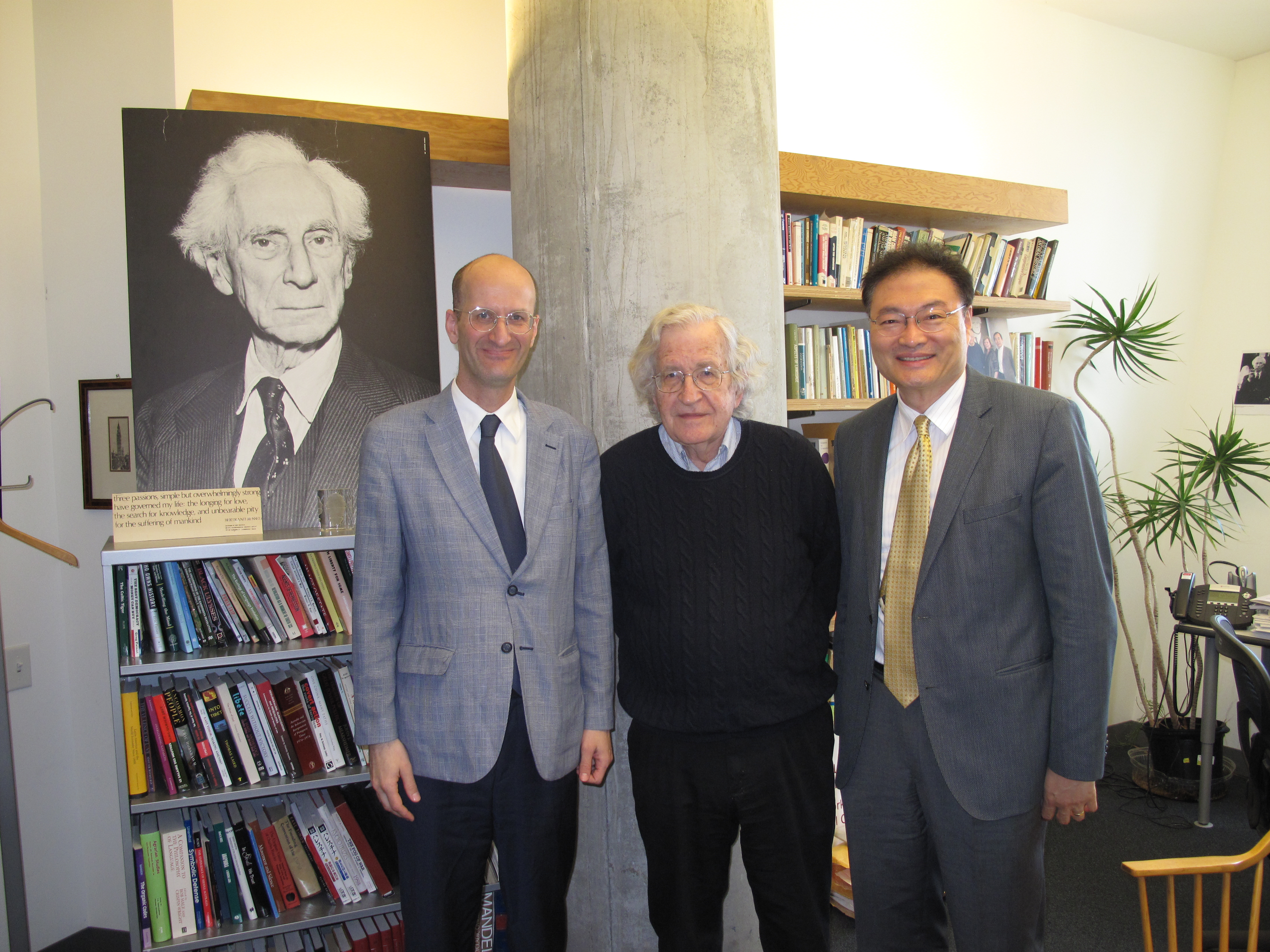
Meeting with Noam Chomsky on May 25

I corresponded with Noam Chomsky about five years ago frequently and started up the conversation again over the last few months. We had never had the occasion to meet in person, but on my recent visit to MIT as part of the larger effort to promote global collaboration in technology convergence I managed to meet him at his office. Here is a picture which includes also my close friend Eugene Pak of Seoul National University’s AICT (Advanced Institutes of Convergence Technology). A fourth member of the group is Bertrand Russell, logician,  political activist and author of “Has Man a Future.” I read that book as a child when I found it in the library of my aunt Jeanne in Luxembourg. Clearly Noam has him included in all portraits taken to indicate the spirit behind what he is doing today.

Interesting, the Wikipedia biography for Bertrand Russell has no mention of Noam Chomsky.

Read more