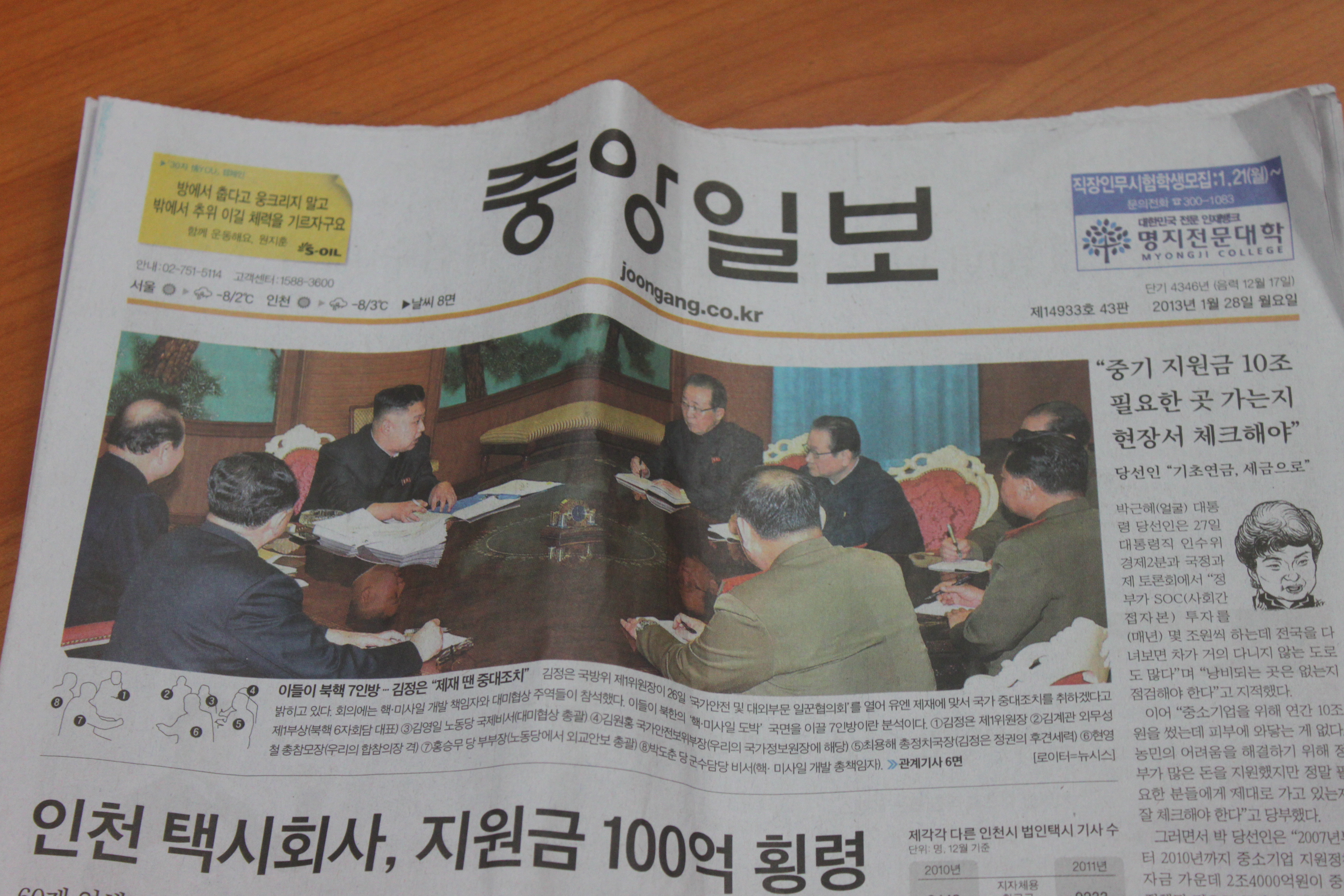
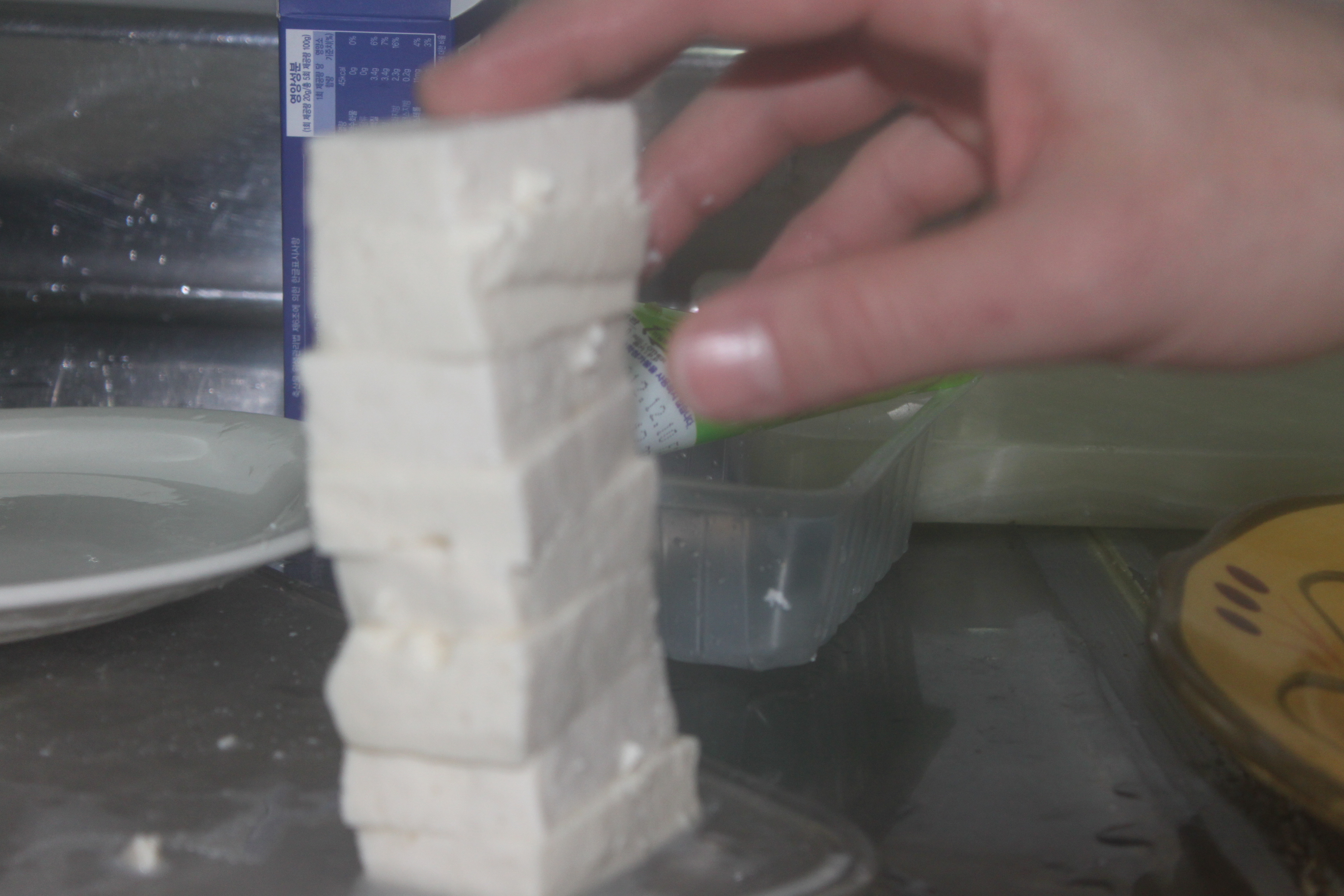
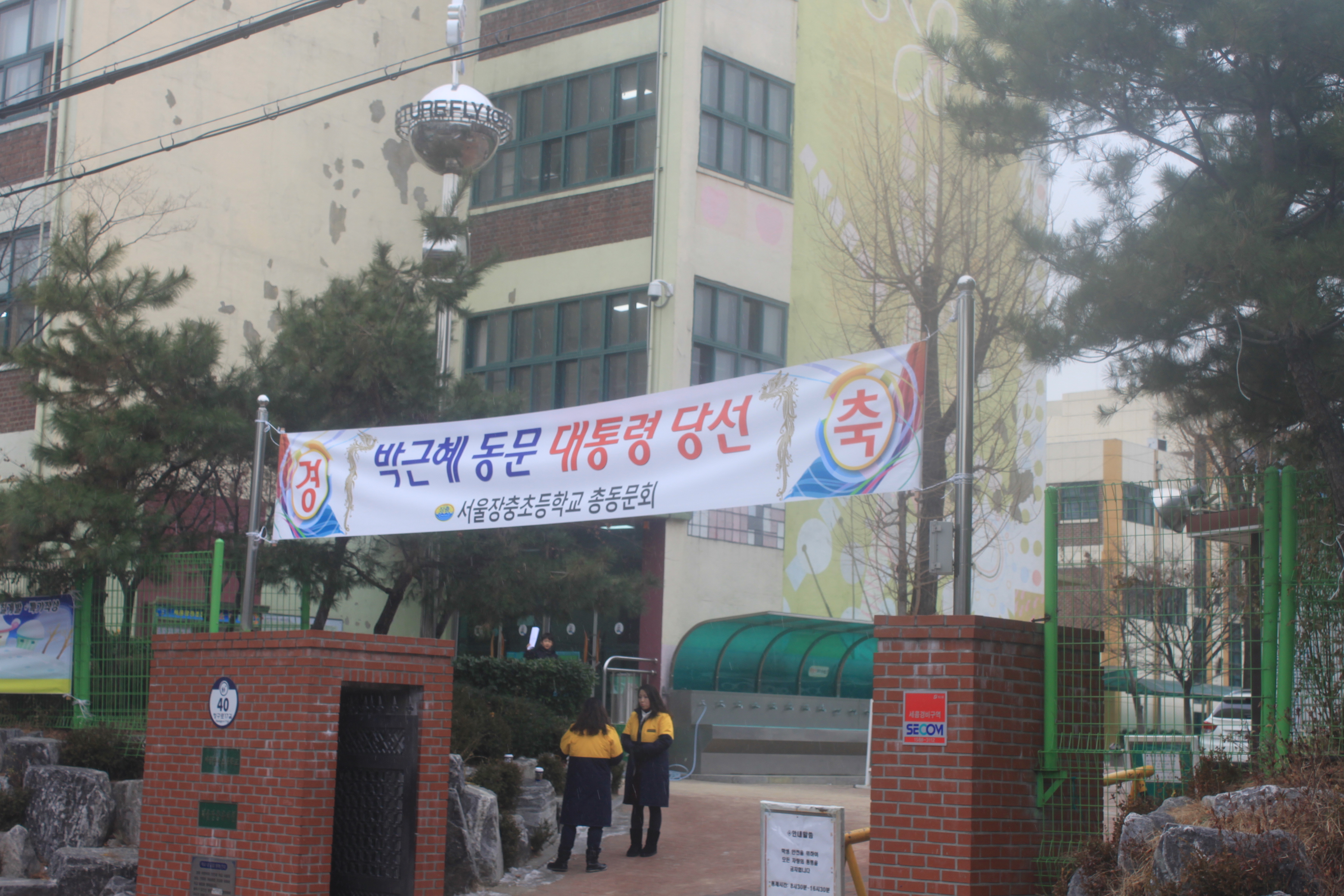
I have always felt there is something sublime about crossing the Hangang River on winter day when the sky is blue. I can remember something of that sensation even from my year in Seoul in 1995.I am not sure if I read it right, but this new financial product seems to be offering you the lottery and a pension at the same time. True innovation.Photo from January 29, 2013 Joongang Ilbo Newspaper shows leader of North Korea Kim Jung Eun gathered at a table talking to his top advisers. The photo is remarkable in that it is not the flat propaganda photograpy we are used to from North Korea but a rather “Western” looking glimpse of a power meeting. The feel on takes away from it is not that different than most photos of leaders in the rest of the world. The ideological wall seems to have finally fallen on both sides.My daughter and I made this tower out of dufu recently when cooking a dinner together. We could not get it to stand up on its own. Let us call it avant garde food art.Jangchung Elementary School is just next door to our home and my daughter Rachel is now in the third grade there. It so happens that president elect Park Geun Hye graduated from Jangchung Elementary some years ago. The school put up this congratulatory banner. Rachel had a chance to see Ms. Park up close when she made a surprise visit to the opening of the recent Pororo feature film.
There is an elephant in the room that most people want to ignore. It is the biggest news around, but no one takes it seriously.
We talk about racism, sexism and anti-gay sentiments, but there is something at least as serious out there that has no name. I struggle to come up with a term. Let us call it “anti-youthism”.
This article by Ambassador Kown Byung Hyun, the founder of Future Forests, explains vividly the effort to get youth in both Korea and China involved in the enormous project of confronting the threat of desertification. Future Forests is a close partner of Asia Institute and this article presents quite well the important work that Ambassador Kwon has undertaken.
The Moral Equivalent of War: Joining with our Chinese Neighbors to Stop the Spread of Deserts in Northeast Asia
By Ambassador Kwon Byung Hyun
Former South Korean ambassador to China
Founder & President Future Forest
It seems as if we are constantly preparing to fight the last war and completely unprepared for new challenges. But one needs only travel to the edge of the Kubuchi Desert in Inner Mongolia to see that mankind faces threats on an unprecedented scale that call our for our united action. We must use the full extent of our imagination to come up with solutions to this crisis through new global alliances that require us to completely rethink terms like “security” as we create a new civilization that can lead humans from the dark night of endless consumption to a hopeful future.
My engagement in the long-term effort to stop the spread of deserts in China started from a very distinct personal experience. When I arrived in Beijing in 1998 to serve as ambassador to China, I was greeted by the yellow dust storms. The gales that brought in the sand and dust were very powerful and it was no small shock to see Beijing’s skies preternaturally darkened. I received a phone call from my daughter the next day and she told that the Seoul sky had been covered by the same sandstorm that had blown over from China. I realized that she was talking about same storm I had just witnessed. That phone call awakened me to the crisis. I saw for the first time that we all confronted a common problem that transcends national boundaries. I saw clearly that the problem of the yellow dust I saw in Beijing was my problem, and my family’s problem. It was not just a problem for the Chinese to solve.
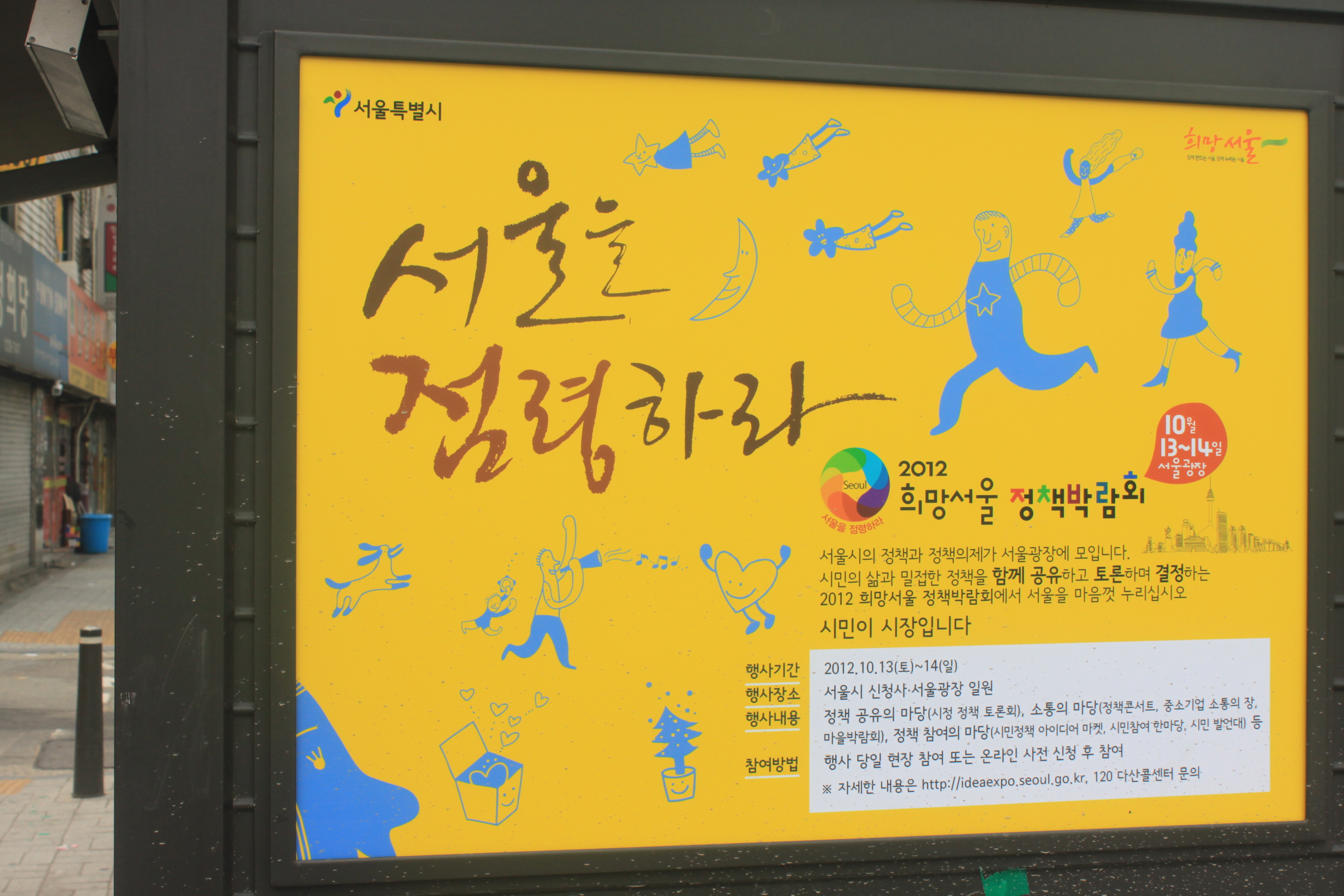
It is fascinating to see that the term “Occupy Seoul” which is associated with protest movements around the world, has been adopted by the City of Seoul as part of its regular administrative policy.
“Occupy Seoul” refers to a “policy expo for a ‘Seoul of Hope'” held October 13-14, 2012. The event is billed as a “gathering for participation in policy” or “Seminar on City Goverment Policy” Suggesting that citizens will be able to participate in the policy debate and provide their opinions.
As I did not attend the event, I cannot describe its content or assess the significance of the approach. It is interesting that the City of Seoul was able to adopt this term, however.
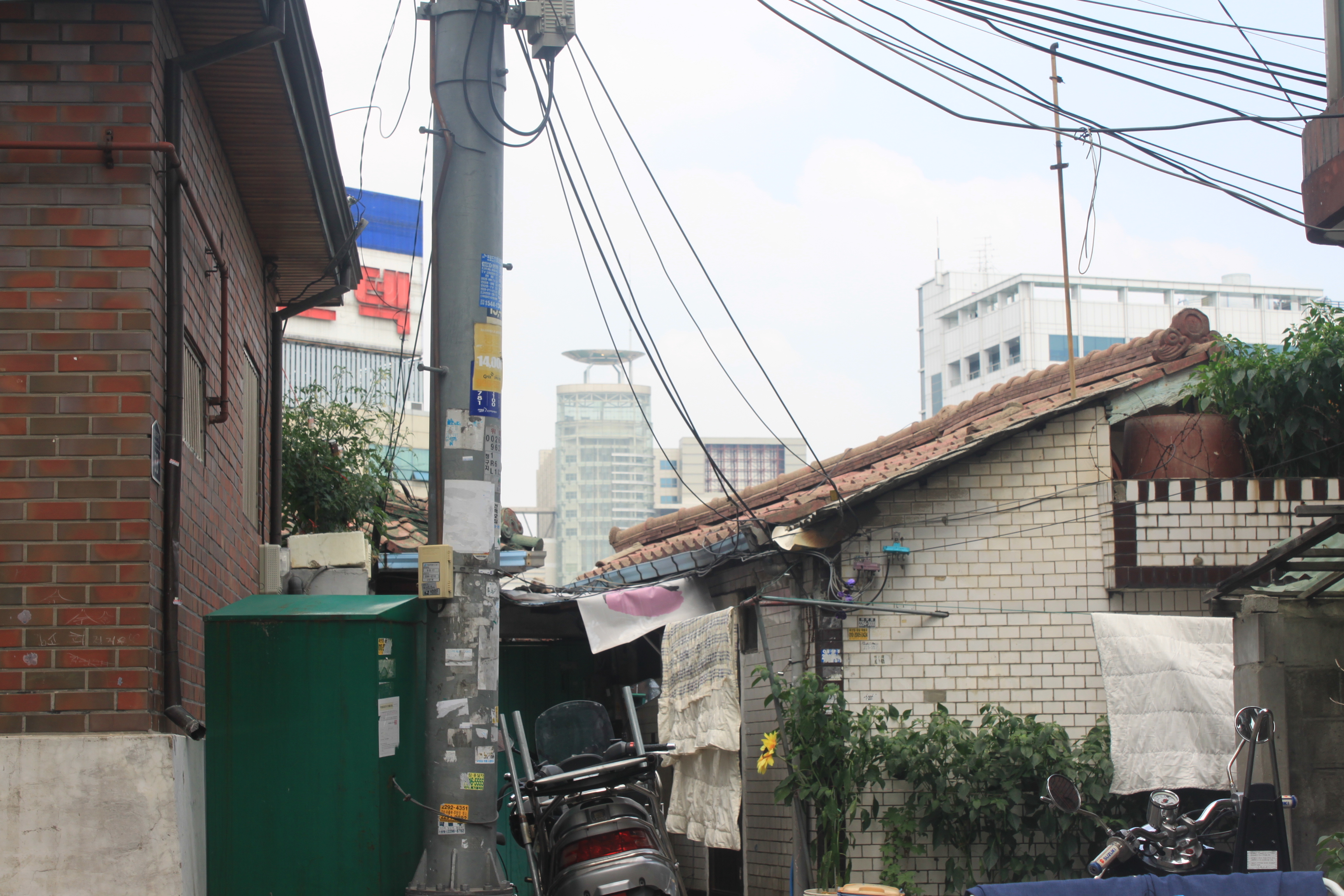
One striking aspect of Seoul these days is the contrast between the traditional world of family neighborhoods of a small scale including many brick houses of one or two stories and family businesses such as plumbers, carpenters and small stores on the one hand and a rapidly growing city of large-scale shopping malls, office buildings and apartments.
Lumber merchant in front of new office building.
The traditional street in Sindang-dong with the larger new developments around the new Dongdaemun History Park behind it.
The two worlds have very little to do with each other and form essentially two sides of Seoul. To some degree, the combination of the two is part of Seoul’s attraction. But at the same time, one cannot help but wonder what exactly powers the sudden rise of the large-scale buildings.
There is a lot of discussion about how to enrich and restore democracy, whether in Korea or in the United States. Little of that discussion spends much time considering what exactly “democracy” means. The failure to address the nature of democracy makes us blind to the implications of the systems we employ to pursue “democracy.”
Let me put it this way. If we elect dictators every four years and then have the right to dismiss them if they do not do what we thought they would do, is that a democracy? I would say it is not. We are in effect treating politicians like products, like Tide, which we assume will get out stains. And if Tide does not get the stains out, well we can buy another product. We assume of course that we have other choices in shopping, or in elections, to pick something else. Whether we have alternative products, or just the same products with slightly different packaging, remains a serious question.
Republican Party candidate for President Mitt Romney summed up his strategy in this remark after his acceptance speech at the Republican National Convention on August 30, 2012:.
“President Obama promised to begin to slow the rise of the oceans and heal the planet. My promise is to help you and your family.”
The implications of the use of the past tense in this sentence are profound; “promised to” as opposed to “promises to” suggests that Obama has already failed in his promise. We are not looking at a simple contrast of Obama as a polar bear hugger and Romney as a man who cares about you. If that was the case, there would not be any need to employ the past tense. The implication is on the surface that Obama made a promise he could not keep. That implication suggests that the concern with rising oceans may not be entirely misplaced.
Steps that you have already thought of, but that you have never seen written down anywhere!
Emanuel Pastreich
August 19, 2012
One of the great tragedies of our age is the ineffectiveness of efforts to address the environmental issues of our day. People are distracted from the problem of climate change by a specious debate about whether climate change is as dangerous, or dramatic, as some would claim, or whether it might be less severe, even a part of natural processes. That discussion is a remarkable waste of time. Even if you believed there was no climate change whatsoever (which is hard to argue considering that the Middle East was once fertile farmland), the crisis of overpopulation, water scarcity and pollution of ground water, the destruction of forests and ecosystems, over-fishing and damage to the atmosphere itself is more than enough to suggest radical change is taking place in our environment that puts us all at risk.
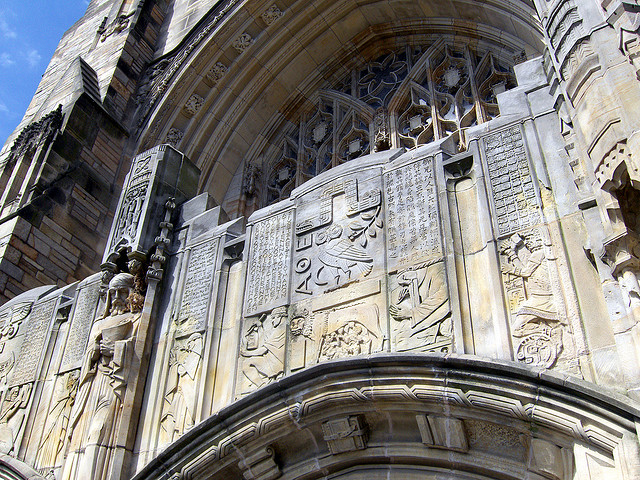
The stone inscriptions at Yale spoke to me as an undergraduate, particularly the haunting carvings of the Sterling Memorial Library. This enormous bibliographic cathedral is a mixture of late Art Deco and Gothic Revival that was designed by James Gamble Rogers and completed early in the depression in 1931.
Above all, the carvings over the main entrance to Sterling Memorial Library made the deepest impression on me as I passed through them almost every day. From left to right above the right door stand four tablets with ancient scripts: Arabic, Greek, Chinese and Mayan passages with their respective scribes standing below.
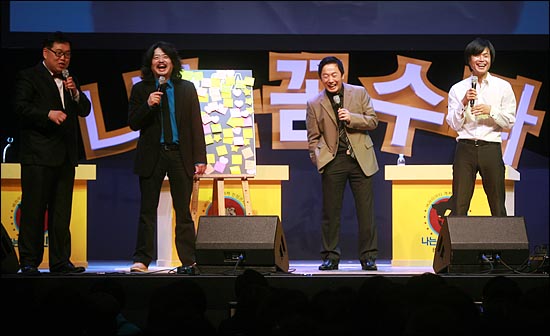
The rise of the podcast comic radio program “I am a selfish bastard” (“Na nun Ggomsu da”)was a profoundly important political event in Korea. The title “I am a selfish Bastard” phrase refers explicitly to President Lee Myung Bak in the most vulgar of wording. The show functions as something like the Korean equivalent of the Daily Show, making fun of the Lee Myung Bak administration without mercy, but there is more to the show than just comedy.
Members of “I am a Stupid Bastard” at their best.
“I am a selfish bastard” took an extremely original approach to media and news unlike anything Koreans had witnessed before.