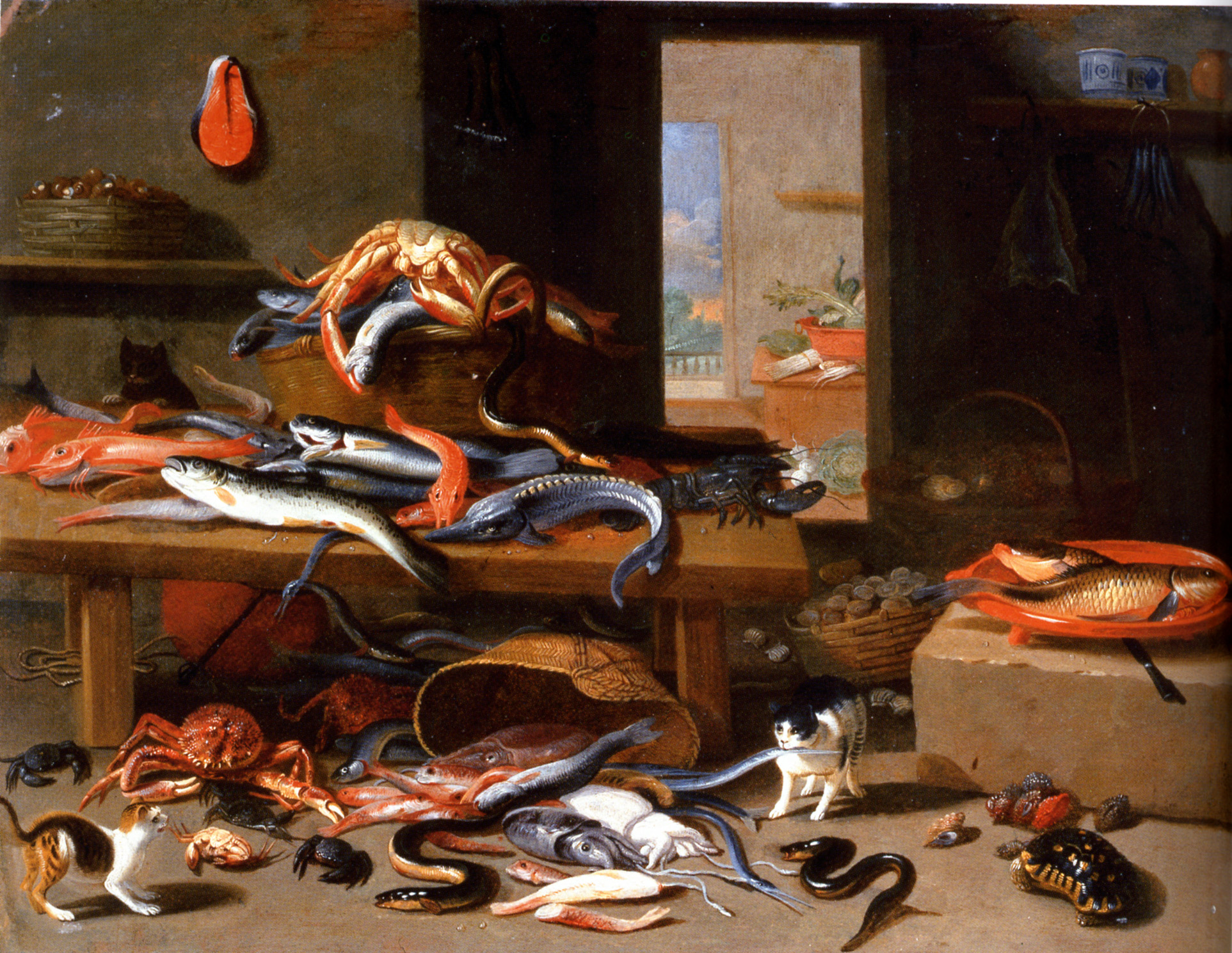
The real reason I am a vegetarian: So all Chinese also will become vegetarians

Many Koreans ask me why I am a vegetarian, and why I increasingly follow a more strict diet. They find it puzzling because Americans are assumed to be great meat lovers, and it is also assumed by many that meat eating is essential to good health and to being a cultivated and civilized person. I have to admit that at this point that I find the eating of meat to be distinctly uncivilized, although I tolerate the habit of my close family and friends. My sister Milena is the only one in my family who pursues this ideal.


Koreans assume first and foremost that I am a vegetarian because I am concerned about my health. The assumption is that I either think I will be healthier if I do not meat.


This assumption is not incorrect. I do feel that I am healthier for not eating meat, although perhaps not for the reasons that people assume. It is not so much that I believe eating meat in moderation is still bad for your health, but rather that I believe, based on credible reports, that the meat we eat is full of antibiotics,steroids, hormones and  other chemicals (which are increasingly poorly regulated) that are clearly bad for our health.


But that is not the main reason.

Read more

Manchuria: The Hidden Face of East Asian Civilization

Manchuria: The Hidden Face of East Asian Civilization 


We tend to overlook the importance of Manchuria in East Asia. It is the case of a country that was so successful that it put itself out of business and literally disappeared as a cultural and political entity.

Manchuria was the most powerful nation in the region in the 17th century with a remarkable administrative organization the rewarded those with talent and vision and a powerful vision for the region. And yet today, the Manchurian language is unknown to all but a few specialists and even then is a dead language. Even more striking is the fact that few, if any,  would identify themselves as “Manchu” today. Basically everyone has become Chinese. What happened in the process of modernity and of nation building, the transformation of Asian civilization that led to the complete destruction of Manchurian identity? I think therein lies the answer to many of our questions about the civilizations of China, Japan and Korea and some hints as to what is to come.

We can think of Manchuria as the  inspiration for much of the administrative and strategic culture of East Asia in the 17th and 18th centuries. When Chinese think back on what was Chinese imperial power at its height, they are inevitably thinking about the reigns of Kangxi and Qianlung. For that matter the decor in Chinese restaurants, the traditional furniture and vases that we see in hotels and in the Chinoiserie across Europe is product of exactly that period of Manchu rule. You could say that the first conception of modernity in East Asia started with the  exposure of China and Korea to the military culture of Manchuria inthe 1620s. Modern administration and military efficiency in East Asia was learned from the Manchu model. Even if the Koreans detested the Qing Dynasty of the Manchus, they never the less learned from it.  Many many Chinese went over to the Manchu side in the late Ming. It was in a sense the institutional equivalent of Samsung for the 17th century, an all-powerful organization (the eight banners administrative system) perfectly organized and unstoppable–a contrast with the weak Ming.

There  were scholars like Phillip Kuhn at Harvard who had some proficiency in Manchu, but still limited. Increasingly scholarship is based on Chinese texts–almost meaningless in the early Qing when the Manchu texts were far more central to governance.

Part of the problem of locating the Manchurian impact in East Asia results from unstated influence.  For example, you might say that there is hardly a trace of North Korea to be found if you walk around in South Korea. And that fact is true in the simplest sense. But South Korean culture evolves and grows today  in opposition to what Pyongyang is, or what Pyongyang  is imagined to be. There never need be any overt communication or sophisticated dialog between the North and South, but what they do is always linked together. Such was the case in Manchuria as well. Although Korea or Japan may not have spoken much about Manchuria, they were profoundly aware of its institutional and cultural power.

If we look at Japan during the Meiji Restoration of 1867. The argument made for the political and institutional reforms of the time was that Japan should restore the “tenno” to the status he enjoyed before the Shogun (head general) took that authority away in the pre-modern period. Yet what happened was that Meiji  was made institutionally an “emperor”  as opposed to a tenno who had governed previously as more of a high priest than the head of an empire. The model for the emperor at that time is commonly suggested to be European powers like England and France, but if you look at the consolidation of power and the structure of  Meiji Japan, it was based more upon the models for administration offered by the Manchu emperors Kangxi and Qianlong (of the high Qing in the 17th and 18th centuries) than anything in the West or in Japan’s history. Oddly, at the very moment that the Qing power waned, the Japanese adopted that authority for themselves under the guise of “modernization.”

It does not stop there. England adopted the civil service system, which would power the new British  imperial global system, in the 1870s, at precisely the moment that such a system had ceased to function effectively in China. But the British proposals for civil service refer very explicitly to the Chinese origins of this system. That is right, England took the skeleton required for running an imperial system from China, the country it was in the process of turning into a semi-colony after the Opium Wars. We can see that process as a form of cultural “king killing.” As the old civilization loses its symbolic power, the best parts are selected by others.

I suggest that Korea risks having its own civilization disappear like that of Manchuria. Although Manchuria had so much impact on the administrative culture of China, Manchuria as a unique cultural identity has vanished. No one speaks Manchu and few identify themselves with that cultural tradition. It is in a sense Manchuria was completely absorbed  in other cultures and has ceased to have a ready identity.

Also, in the case of Japan, imperialism in China was articulated through the support of a modern Manchu state, an attempt to create by fiat the Manchu Kingdom that had lost its support. We can see the tragedy of Pu-i in the Japanese effort  to make use of the Manchu imperial past. It was part of the expansion into China, but that was linked to the adoption of Manchu governance as part of modernization. But I wonder whether the fascination with Manchuria had a bit to do with Japanese admiration for this non-Chinese tribe that had so well digested Chinese bureaucratic culture and so effectively modernized its military in the 17th century. It is in this sense that Manchuria is the hidden civilization of modernity.
 

The DMZ as Prelude

The DMZ as Prelude


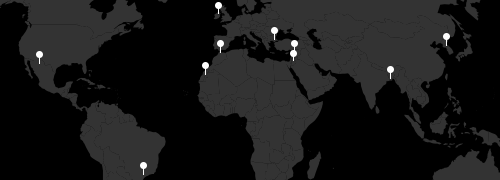
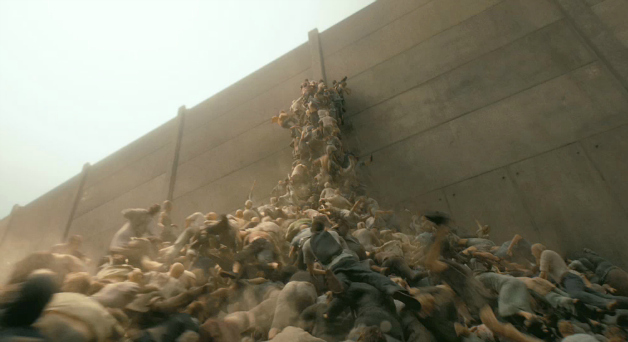
Although it is common in the media, and in books about Korea, to refer to the Demilitarized Zone (DMZ) that rudely rips the nation in two as a “remnant of the Cold War,” I have argued on several occasions that  the DMZ is not a remnant, but rather a prelude to a new geopolitical reality: the forceful separation of different economic systems by barriers. This building of walls to keep economic systems, and even classes and ethnic groups separate,  is increasing around the world and we may well find that the DMZ is not a relic of past ideological battles, but rather the precursor of a new global phenomena.

The most striking parallels to the DMZ are without a doubt the walls recently erected around Gaza in Israel/Palestine and the militarized wall between the United States and Mexico. However, a recent special feature in the Guardian has drawn attention to a group of other notable walls around the world. Needless to say, similar walls are emerging at the urban level throughout all the cities of the world. Perhaps this proliferation of walls parallels the border-less society that is evolving at another level.

Recently, at an Asia Institute seminar in Seoul, John Feffer made a challenge to the Korean people, he said, and I paraphrase,


“For Korea to achieve reunification is to set forth a model for the entire world of how we can overcome  the economic and cultural gaps between the developed world and the developing world. Korea will have to wrestle with tremendous problems, but it can give hope to the world, and concrete best practices, through its successful reunification that will have meaning far beyond the Korean Peninsula.”

The DMZ is best seen in the context of this larger challenge for our age.


“Our Walled World” 

The Guardian

November 19, 2013

Our Walled World


World War Z
World War Z


Our Walled World


Is the term “capitalism” outdated?


I wonder whether the term “capitalism” itself belongs in the ash bin of history.  Does it really help us understand how society and economic transactions work today, or does it rather us from a more serious consideration of what is actually happening in our society, how digital technology impacts value, how trade distorts production processes, how cultural assumptions impact transactions?  We are looking at a digital translation of all phenomena combined with a highly integrated trade and logistics system. This is not “capitalism” in the 20th century sense of the word, and perhaps this new economic system deserves its  vocabulary.

“The standard code for women in the Republic of Korea”

“The standard code for women in the Republic of Korea” 


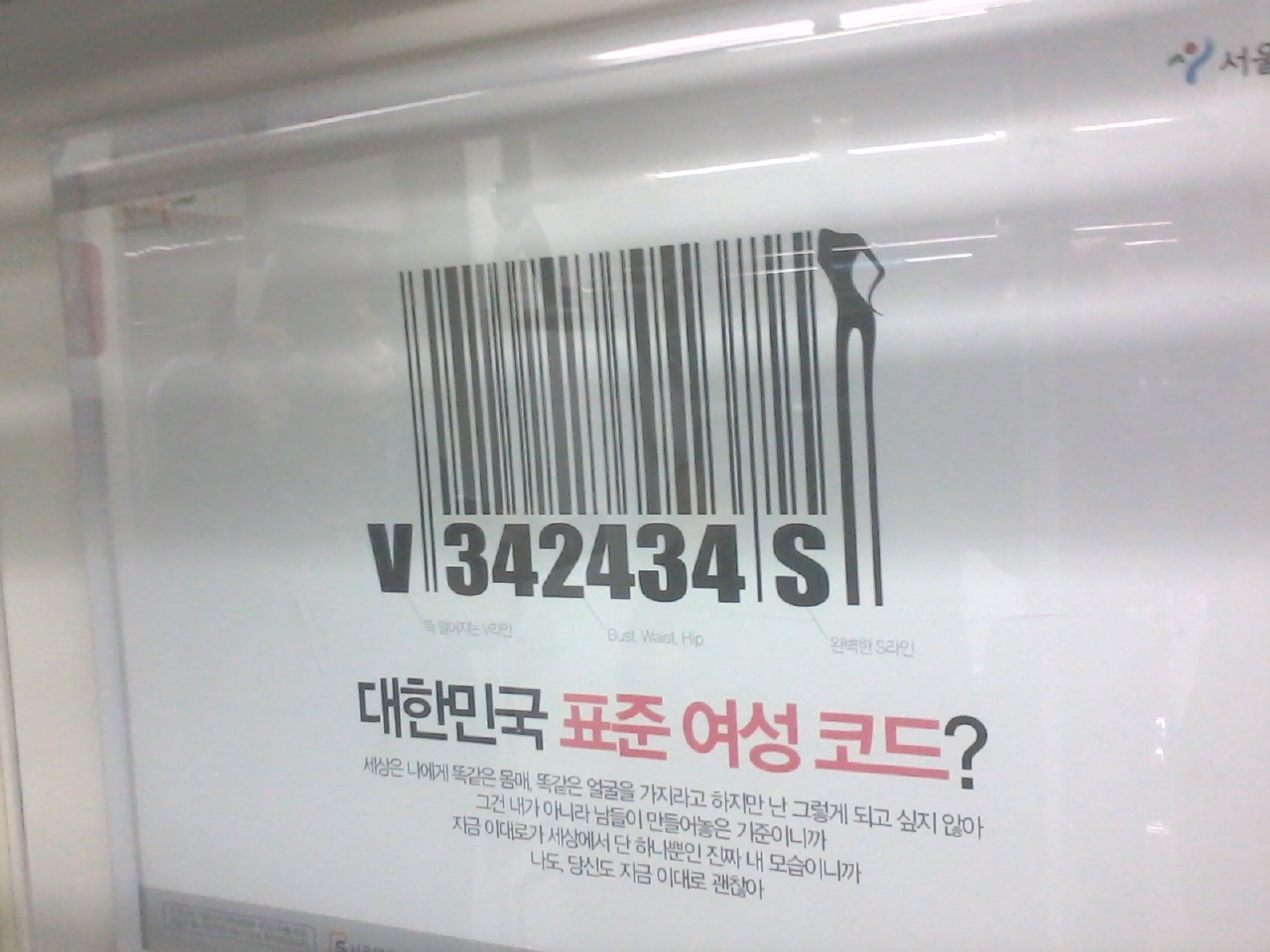
This remarkable public advertisement has appeared recently in the Seoul Metro and sponsored by the City of Seoul. The graphic is a modified bar code which is referred to as “The standard code for women in the Republic of Korea” beneath.

the “V” is glossed as “V Line” the following numbers are glossed as “bust, waist & hip” and the “S” as “a perfect S line”

The text below reads

“Society tells me i must have the same body, the same face, as everyone, but I do not want to be like that. To do so to conform to a stardard made not by myself, but by others. The way I am now is the one and only true form for me. It is just fine for me, and fine for you, to just be the way we are.”

The ad is remarkable in part because of the striking creativity of employing the bar code image as a symbol of the oppressive domination of women by images and the resulting usage of plastic surgery and other techniques as an artificial means to conform.

The ad is also noteworthy because the city government produced it as a means of playing a positive role in society and offering up an alternative discourse for women in opposition to the dominant one of consumption and indulgence. It seems like a positive model for the role that government can play in society.


being human

The Snail is Smothered by his Shell

The Snail is Smothered by his Shell

Emanuel Pastreich

December 25, 2013 

Do humans determine what will happen, or is it the system, the material culture that grows up around us the power that determines the future? Humans are surrounded by objects and institutions that are not part of their bodies, but an essential part of their lives and experience. Perhaps the closest analogy to human culture is the snail and his shell, an essential external item that is nevertheless not actually the snail. But recently those institutions and habits of the human are shifting and changing so quickly, and growing so rapidly, that we find complete chaos around us. It is a chaos that we cannot see.  An ideological chaos in which each person thinks he or she is doing his or her best but cannot even make the slightest modifications in behavior.

We cannot even require reuse-able glass with a deposit for all liquid products sold. It is such a simple step that would do much to help reduce such mindless consumption, but not only can we not implement such a policy, in spite of all our sophisticated conversations over cappuccino at Starbucks, we cannot even formulate it as a priority.

Perhaps this fog in our thinking is one of the greatest dangers of rapid technological change. There is the distinct risk that when we encounter the greatest crisis of climate change many citizens of the world will only be vaguely aware of what is happening to them.

“Be Here Now” and the Nature of Political Change

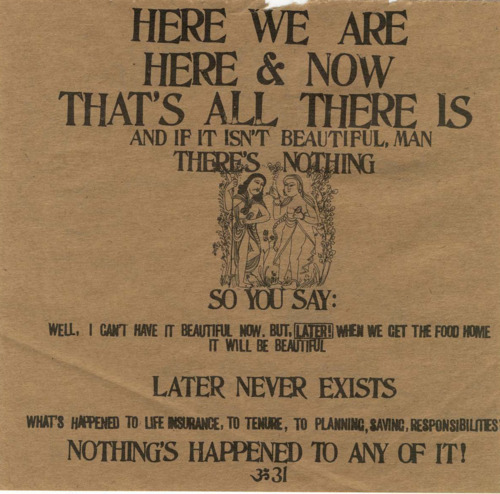
Although there are many who were involved in the debate over the Vietnam War, in many respects Richard Alpert’s book played a central and underestimated role. Perhaps that was the whole point of Alpert’s approach, especially when he assumed the name Ram Dass and became a yogi of sorts. I have gone through a few sections of the book I found on the internet recently and found them of great relevance today.

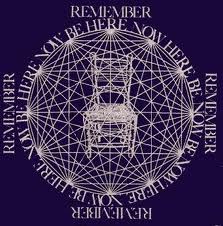
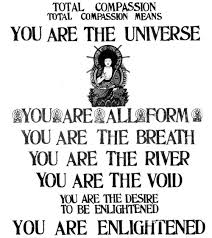
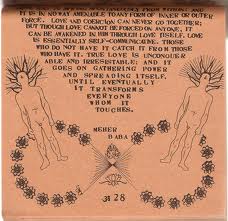
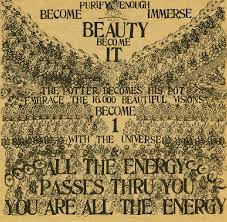
"Be Here Now"   This classic book by Ram Dass (Richard Alpert) was released in 1971 at the height of political chaos in the United States towards the close of the Vietnam War.
“Be Here Now”
This classic book by Ram Dass (Richard Alpert) was released in 1971 at the height of political chaos in the United States towards the close of the Vietnam War.

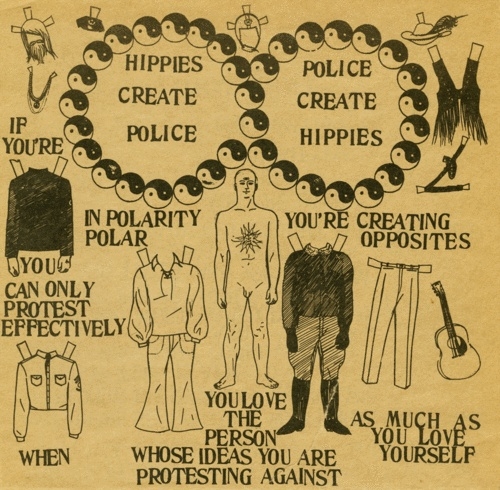
This illustration about the seeming conflict between the police and the hippies is of great interest.

Deceptively simple, this description of the duality that underlies all political discourse made a deep impression when I first saw it many years ago.

Using Buddhist ideas about duality, Alpert suggests how the two forces we see in front of us feed off of each other. I would not suggest that “Be Here Now” offers a solution, but it does offer much in the way of insight.


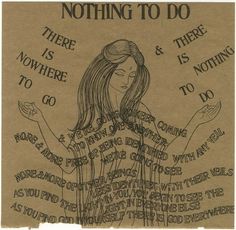
A few more selections:


56509ce026dad1ad95d89cf8e0deb4bcimages (1)images (2)images (3) images (4)imagestumblr_lfv5wdaCjW1qc01tho1_500다운로드

Emanuel on the North Korean Problem


The 5th International NGO Conference on History and Peace


Workshop on Universal Norms


(July 24, 2013)

Kyung Hee University

The North Korea Problem

The intractable problem of North Korea remains the greatest obstacle to integration in Northeast Asia, one that has consistently defied efforts at diplomatic resolution. Without any doubt, serious engagement on the North Korean crisis is the fastest road to meaningful and sustainable integration (to be distinguished from economic interpenetration that can evaporate, or even inspire a xenophobic backlash).

But most discussion about North Korea is simply not that serious. Granted there are great dinners offered at the Six Party Talks, but the content of those discussion is so limited (whether North Korea will stop its nuclear power program) and most of the problems, from trade and integration to climate change and the role of the nation state in a rapidly changing era—not to mention the failure of the United States to comply with its obligations under the Non Proliferation Treaty—are simply off the table.

James Baldwin made a statement that summarizes the essential issue for diplomacy in East Asia:

“Not everything that is faced can be changed but nothing can be changed until it is faced.”

It is critical for us to face the reality of the North Korean tragedy, and the manner in which that problem has evolved; then, on the basis of an entirely new conception of the issues, we can take meaningful steps to address it.

Read more

Shadows of War in Daily Consumer Life: “Cataclysm”

One striking thing in Seoul today is the absence of explicit reference to the multiple wars that are going on around the world. Even Guantanamo Bay never comes up in conversation with Koreans and is rarely mentioned in the media. But that does not mean that Koreans are unaware of these endless wars dragging on out there. Oddly, even as those wars remain invisible in the daily life of Seoul, little hints of violence appear in the margins and corners of society. They can be found in the video games children play. But oddly also that violence is implied in the T-shirts that Koreans wear. I have noticed many youth in Seoul wearing T-shirts dotted with skulls.

The store “Soul Man” features a variety of hip clothes for young men. Look a little more closely.

Clothing store near Kyung Hee University in Seoul

IMG_7643

Ths maniquin is wearing an odd T-shirt in the display. The maniquin is wearing a case for a bus pass like dog tags and looks like he is ready to hang out in Greenwich Village, but note the odd T-shirt. Above the ominous words “Cataclysm” we see a group of soldiers in black and white with an American flag in color flying in front. The color contrast suggests that the soldiers may be dehumanized. The entire shirt suggests a systematic and ethical collapse.

Cataclysm

“Thoughts on the Question of Value”

value

Thoughts on the Question of Value

Emanuel Pastreich

October 16, 2013

I am sure that you have noticed the disturbing trend in our world to evaluate just about everything in a materialist manner and to take pleasure only from material objects. Oddly, we find highly educated people, people who have read literature and philosophy, wasting their time talking about how expensive food they have eaten was or how big the car that they drive is. This trend is getting worse, especially as the previous generation that knew something of frugality is dying off. Some of our friends want to calculate the value of the entire world in monetary terms. How much the dinner cost? How much did you pay for the house?

The consequences of such thinking based entirely on a monetary equation, this object has this much value, are profound. Not only is food, housing and daily experience evaluated in monetary terms (which is to say numerical terms), but in that process people also are assigned monetary values. There is a powerful trend to determine how important people are to us in terms of how much money they possess, or how much money or power they control through organizations. We favor the uncle who can pay for an expensive meal or drive a Lexus over the uncle who is a kind and thoughtful man. I have frequently had the experience that someone initially is very warm to me when they learn I am from Yale, but then cool off when they learn that I am a poor professor and not of the proper class that they assumed.

We are bothered by this constant need to evaluate everything in terms of its monetary value. Although we make the calculations of “value” naturally, somehow that behavior just seems wrong to us in some fuzzy ethical manner. But the habits are so deeply engrained in our society. For example, art is given a value, a price, and that price then determines how the art is appreciated. A beautiful hand-woven dress made by an old woman in the mountains has limited monetary value, but a designer dress sold at a boutique in downtown Shanghai will be extremely expensive—and most people will readily accept that norm. If you compared the two dresses carefully, it would not be clear that the designer dress was in any means superior to the hand-woven dress. But the price comes first, before any aesthetic appreciation. Most people would show great appreciation for the designer dress regardless of its actual quality—not to do so would seem abnormal.

Even those of us who denounce such thinking and who advocate a greater concern for the environment often find ourselves falling into exactly such a mode of thinking in daily life. It seems to be an inescapable part of our culture that impacts everything we do, if we are not reducing reality to dollar value, we are measuring it in meters or kilograms. Even if we do not want to assess the world based on monetary value, everyone else around us is doing so and we feel as if we have no choice. Once we hear that a dress cost $2,000, the dress simply looks different for us.

But it is more than just social pressure that drives us into this sort of monetary thinking. There is something else out there that drives us to fall back on monetary assessments, a force that draws us to these primitive price categories for assessing the value of our possessions and of our experiences.

Part of the problem can again be traced back to the end of the Cold War and the unexpected impact it has had on every aspect of our lives. Previously, there were large parts of our economy, of our society, that were government owned and did not belong to anyone. That was true in the Soviet Union, the People’s Republic of China and in Eastern Europe, but it was also true in places like the United States in which there was a strong demand from the public to maintain public institutions and lands.

There was a strong sense of the nation and the common interest in the United States, for example, that derived in part from a need to counter the constant attacks from the Soviet Union that suggested that workers were terribly exploited in capitalist nations. Although the United States constantly criticized the Soviet Union for lacking freedom, the United States still had to show itself to be committed to supporting some level of

Read more