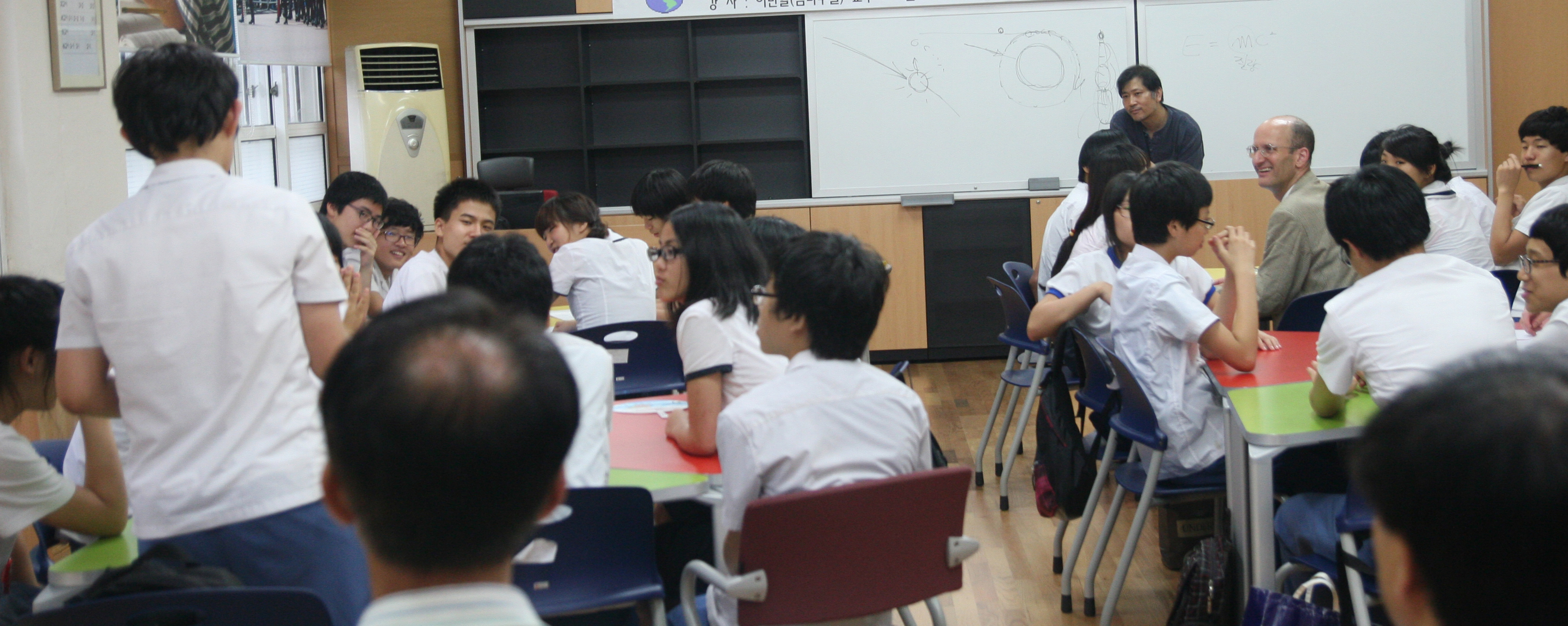
Alternative Instruction Program at Daeseong Middle School, Gochang, Korea

Alternative Instruction Program at Daeseong Middle School, Gochang, Korea


My close friend Gosan, with whom I have been working with on an alternative education project for the last six months, invited me to participate in one of his classes at Daeseong Middle School in Gochang, Korea. I travelled down yesterday and attended Gosan’s alternative class last night. There were about 25 students who had decided to use the time that they would normally devote to homework to attend this one hour class at six PM. First, The enthusiasm was palpable.


Gosan talked about the manner in which we assess problems and how we can make use of the knowledge we have to solve problems with which we are confronted. He broke the students into small groups of five or six (I was seated with one group) to discuss the topic.

 Gosan explained at length the principles of physics that the student had covered in their class. He then posed a rather unexpected challenge:

Read more

“The Korean Peninsula and the Struggle between World Powers” (talk)

ICAS Winter Symposium

Humanity, Peace and Security

Dirksen Building SD-226  B

Washington D.C.

12:30-4:30 pm

February 24, 2005

The Korean Peninsula and the Struggle between World Powers

100 Years after the Taft-Katsura Agreement and the Portsmouth Treaty

Opening Remarks

Any serious attempt to achieve a lasting and effective resolution to the economic and security issues of the Korean peninsula must perforce address the perceptions and beliefs of the Korean people themselves. Unfortunately, we Americans find ourselves making decisions regarding the future of the Korean peninsula without any sense of the historical context surrounding the present standoff with North Korea. Nor do we grasp the historical events long before the present day that have determined Korean attitudes towards the United States. This paper does not focus on the negotiations with North Korea that have gone on since 1994. Rather it considers the decisive first encounters between the United States and Korea in the nineteenth and early twentieth century and goes on to present a comparison between the geo-political issues critical in the present day and those critical one hundred years ago in the hope that some larger issues normally not treated in an analysis of security issues may be broached.


Pastreich ICAS Talk Feb. 17, 2005

“Impending Changes on the Korean Peninsula and the Future of U.S.-Korean Relations” (Talk)

Joint Annual Conference 2007

ICKS-KAUPA


Impending Changes on the Korean Peninsula and the Future of U.S.-Korean Relations


East-West Center

Joint Annual Conference 2007 of ICKS-KAUPA

June 28, 2007

Emanuel Pastreich


“The Change in Paradigm for US-Asia Relations:

A Socio-cultural Perspective”


The New Challenges we face today in East Asia

For all the talk of the nuclear programs of North Korea and the threat of terrorism we have been severely distracted from the equally serious threats that we face in East Asia which are growing daily and may well eclipse all other concerns in the years to come. The need to rethink our paradigm for security in East Asia is a pressing issue for all of us. Nevertheless, the well-established models and assumptions about what the very term “East Asia” means, based on a familiar nation-state paradigm, obscure more than they illuminate. We must put forth a new model for how individuals, organizations, societies and economies function today that takes into account the impact of economic and technological linkage, the results of a run-away consumer society, and the threat of environmental and atmospheric degradation.

We need to give serious thought to the shifts within the basic relations between individuals, corporations, states and non-government players. That does not mean that nation states have disappeared, but rather that the relationship between the elements of which they consist has been fundamentally altered. Moreover, those alterations are so profound as to be essentially invisible to most observers. If we were to create a map based upon where exactly where products are manufactured, how they are distributed and where they are consumed, it would be an accurate description of how the global economy works, but would be entirely alien to almost all observers. By the same token, the patterns by which pollution spreads through the oceans and the atmosphere, the consequences of over-fishing, the impact of climate change on agriculture and the pressures of population growth are equally as obscure as they are critical.


New Security Concerns in Asia Pastreich East West Center 2007


“Social Impacts of the Taean Oil Spill: An International Perspective” (guest report)

Senior associate of the Asia Institute Charlie Wolf produced this thoughtful report on the Taean Oil Spill and its larger implications which I think fits in nicely with my previous postings.

Charlie Wolf


Social Impact Assessment Center

(senior associate of the Asia Institute)

“Social Impacts of the Taean Oil Spill: An International Perspective”


Presented at the Taean International Environment Forum

“Lessons Learnt from the Taean Oil Spill & Marine Conservation”


Held at Anmyundo, Taean, Chungnam Province, Korea,


8 December 2008.


Taean Oil Spill Wolf Report

“Six Months After Korea’s West Coast Oil Spill” (article translated by Emanuel Pastreich)

I translated this article about the Taean oil spill on behalf of a friend who works at Eco-Horizon Institute (Saengtae Jipyeong) as part of my efforts on the critical issue of what to do in the aftermath of this ecological disaster.

The Taean spill blends together in my mind with Hurricane Katherina, the Deep Horizon oil spill and the Fukushima disaster. All are examples of ecological disasters, the biggest security challenge we face today. I must say that most of the security budget we spend is not much use for responding to these terrible threats, and that their frequency seems to be increasing.

Six Months After Korea’s West Coast Oil Spill – Need exists for new effort to stave off a social and ecological disaster

August 8, 2008
By Seung-hwa Lee
(translated by Emanuel Pastreich)

A horrific collision between a crane and an oil tanker off the coast of Korea’s Taean Peninsula last December resulted in over 10,000 tons of crude oil being dumped into ocean just off the coast of one of Asia’s most important marine preserves. The striking coastline where pristine waves crashed on rugged rocks was transformed into a sea of oozing black goop.

The animals and plants of the coast were not the only ones devastated. The residents of Taean have found themselves in a life and death struggle for economic and psychological survival. A dark shadow hangs over their lives and has driven some to despair.

Now that the summer season has returned, there is much talk in the Korean media about the reopening of the beaches and the miracle of the Taean recovery. After all, when over a million people from all over Korea came to help clean the coast of oil in the months after the spill many predicted a quick return to normal. But although the beaches may appear clean, traces of oil can still be found.

The roads once packed with tourists during the summer have little traffic. And the generations of families whose livelihood depended on fishing or tourism wonder what they should do. They watch the bills pile up, getting into unpleasant fights about possible compensation money.

http://english.ohmynews.com/articleview/article_view.asp?menu=c10400&no=383335&rel_no=1

Emanuel’s proposal for a festival at Taean for Children (August, 2008)

The terrible Taean Oil Spill of December, 2007 caused such damage to the eastern coast of Korea that many were demoralized. Fishermen found themselves suddenly without a livelihood. That spill took place at the time I worked as advisor to the governor of Chungnam Province.

Of all the work I did with the province of Chungnam, I think the response to the oil spill was the most meaningful. I visited the headquarters for the clean up site, helped clean the tar on the beach and spoke with both residents and members of the local government team in charge. It was an opportunity to help coordinate the international response. But it was my visits to local elementary schools that made the deepest impression on me. Here were these children struggling to understand how their parents suddenly no longer had work as fishermen. They were gripped by an  invisible threat hovered over their communities. The teachers were quite frank about the psychological stress.

I worked with several people at the local level to make up this proposal for an international children’s festival that would bring new hope to the children. Here are versions in Korean, English and Japanese. Ultimately, there was just too much sensitivity about the oil spill and we could not actually hold it, but there were several figures in local government who did their best at the time.

 “The Delicate Little World of Taean”

A Festival for Children of Art & Music Celebrating the Environment

July, 2008

[proposal]

Emanuel Pastreich

A thick oozing sheet has coated the pristine coast of Taean in Korea since December of 2007, transforming once spotless beaches into a black crust lining a sea of death.

As the shock of Korea’s worst oil spill sinks in, we are forced to think about the terrible consequences of our dependence on oilnot only for the fishermen of Taean, but for the entire world.

We think about such matters most of all when we watch our children. After all, the implications of oil, from creeping pollution to climate change, gather like dark clouds on the horizon, dark clouds that we are fearful to speak of with our young ones.

The only way forward is to create a sustainable world.

To do that, we must change culture itself, and we can only achieve that goal if we first turn to our children and offer them a vision of how the world could be.

Delicate Little World of Taean (English)

Delicate Little World of Taean (Japanese)

Delicate Little World of Taean (Korean)