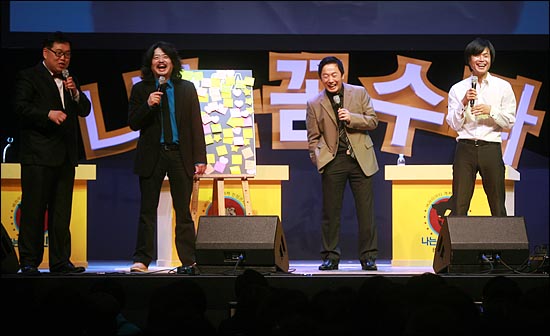
The rise of the podcast comic radio program “I am a selfish bastard” (“Na nun Ggomsu da”)was a profoundly important political event in Korea. The title “I am a selfish Bastard” phrase refers explicitly to President Lee Myung Bak in the most vulgar of wording. The show functions as something like the Korean equivalent of the Daily Show, making fun of the Lee Myung Bak administration without mercy, but there is more to the show than just comedy.
Members of “I am a Stupid Bastard” at their best.
“I am a selfish bastard” took an extremely original approach to media and news unlike anything Koreans had witnessed before.
The Korean media has been roiled by a series of strikes and labor campaigns since President Lee Myung Bak appointed or promoted close personal associates as CEOs for three major broadcast companies.
The main strikes against KBS, MBC and YTN were above all born of resistance against the control of broadcast company policy by President Lee Myung Bak.
The media is considered absolutely critical for the functioning of democracy and such attempt by the president to seize control of the public media was
I first visited Park Sidong’s remarkable Seokjangni Art Museum on the DMZ in March, 2012 after attending a seminar held at a military outpost overlooking North Korea. I was on a panel with artists and scholars discussing how an innovative residency for artists held right on the DMZ could serve as the first step towards bringing peace to the peninsula. The idea struck a chord with me. Could it be that rather than holding yet another seminar or writing yet another op-ed, just having artists practicing art could help facilitate the cultural and ideological shifts required to move beyond the current stalemate? I think there is that chance.
I gave a talk at KBS’s education center in Suwon on the topic of the Korean Wave and the future of KBS on July 24, 2012. The talk was intended for new employees of KBS and there were perhaps 150 young people, fresh out of college, who represent the future of Korean media.
The talk stressed the importance of Korean youth to take advantage of their remarkable cultural influence in the world to create a better future for us all. I gave examples of the impact that Korea can have in either a positive or negative manner, and drew attention to the great depth of the Korean cultural tradition, far beyond current K Pop, to inspire people around Asia and around the world to reach for something greater than consumerism and self-gratification.
The talk encouraged the next generation at KBS to imagine a unique global KBS that reaches beyond its limits, a medium that can go beyond CNN, BBC and Al Jazeera.
The response of the young KBS employees was quite enthusiastic and one even came up to me to tell me about her plans to learn more about China.
The National Library of Korea selected my book “Life is a Matter of Direction, not Speed” (인생은 속도아니라 방향이다) for its list of 100 books to read this summer vacation.
The July edition of Eureka Magazine 유레카논설, a journal aimed at middle and high school students in Korea featured this article of mine presenting suggestions for how students can make the most of their educations.
Entitled
“Cultivating a Strategic Perspective and Looking far into the Future”
“전략적 사고를 기워 멀리 내다보라” the article argues that students should study about the humanities because such studies better equips them for the challenges of the future.
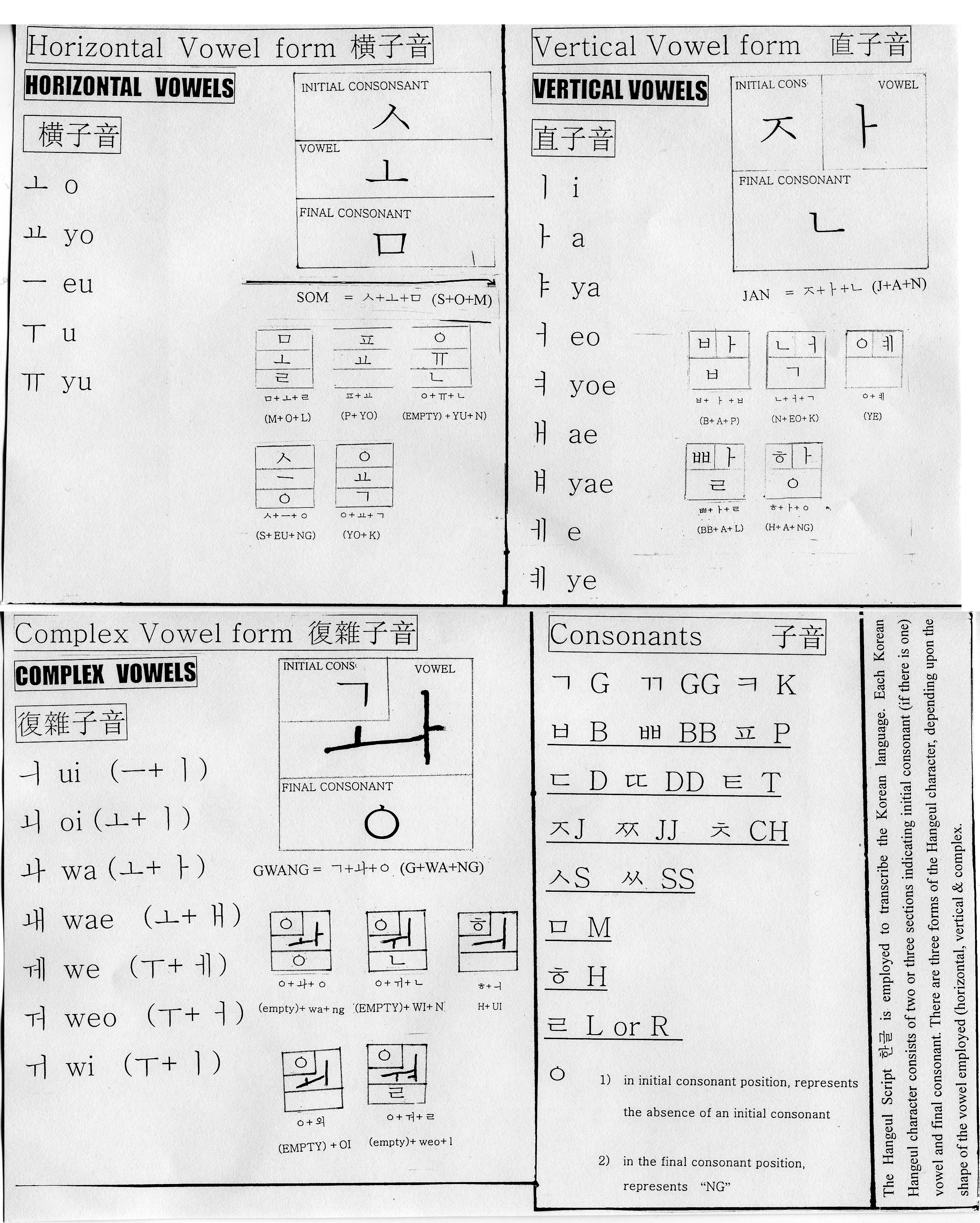
I made this chart for understanding the hangul script back in 1995. I was learning Korean myself at the time and felt frustrated that hangul was not taught in a systematic manner. This simple chart (here designed for Chinese and Japanese speakers as well) is above all systematic. Hangul are broken down into three forms: horizontal, vertical and complex, according to the shape of the vowel.
My friend Iwabuchi Hideki, currently working for the Ministry of Education,Culture,Sports,Science & Technology, published a very interesting book this month in which he and his colleagues offer an interpretation of Korea’s success in science and technology aimed at a Japanese audience, suggesting, in a sense, that Japan think of a “Korea as Number One.”