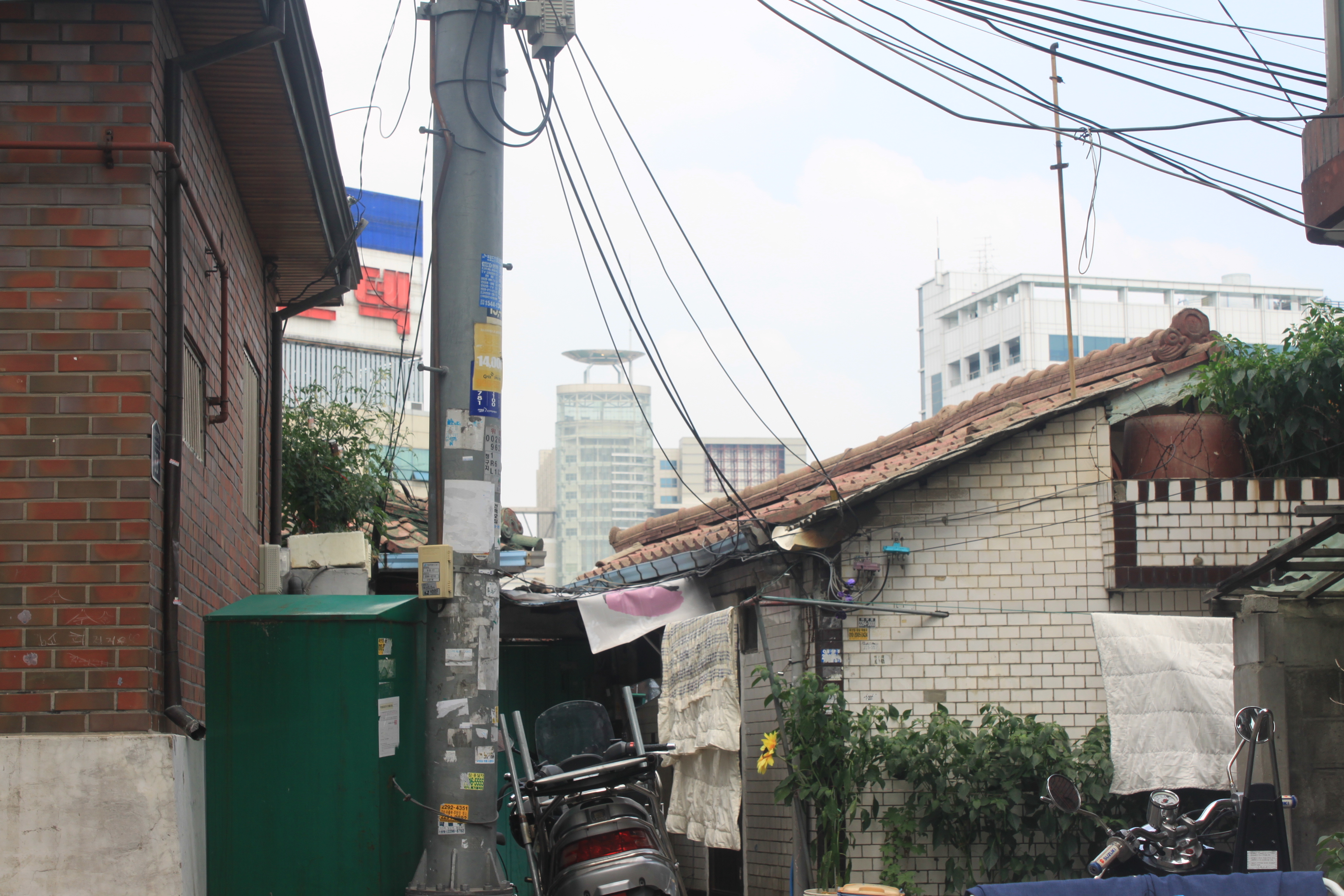
A tale of Two Cities: Seoul in 2012

One striking aspect of Seoul these days is the contrast between the traditional world of family neighborhoods of a small scale including many brick houses of one or two stories and family businesses such as plumbers, carpenters and small stores on the one hand and a rapidly growing city of large-scale shopping malls, office buildings and apartments.

Lumber merchant in front of new office building.


The traditional street in Sindang-dong with the larger new developments around the new Dongdaemun History Park behind it.


The two worlds have very little to do with each other and form essentially two sides of Seoul. To some degree, the combination of the two is part of Seoul’s attraction. But at the same time, one cannot help but wonder what exactly powers the sudden rise of the large-scale buildings.

Read more

Asia Institute Seminar with Noam Chomsky: “The Problem of the Media in Korea”

Asia Institute Seminar

 “The Problem of the Media in Korea”

 Monday, April 09, 2012


Noam Chomsky

Professor of Linguistics

MIT


Emanuel Pastreich:

You may remember that in a seminar we held a few months ago there were a series of questions from the Korean students concerning a individual by the name of Jeong Bongju who had not been able to obtain a visa to come visit the United States.

His story is quite significant with regards to the question of the media, specifically the decay that some of us perceive in the quality of media in Korea and around the world. Jeong Bongju, a former politician, has become immensely famous in Korea through his television comedy show “Na num Ggomsu” (translates as something like “I am a small-minded jerk”).

This show is essentially comedy, but it treats serious political issues more accurately and more directly than anything you will find on network television. His willingness to talk so frankly, and explicitly, about issues that most powerful people would like to have disappear is one reason that he has caused so much trouble.

But even if we appreciate that the show brings up topics otherwise not treated, the trend is disturbing. There is something so dysfunctional about media environment in which the comedy show becomes the only medium in which the truth is accurately conveyed. There is of course a long history of “the play’s the thing wherein I’ll catch the conscience of  the king” –but we find the use of comedy to convey real news increasingly pervasive.

In the United States we have similar programs like “The Daily Show” with Jon Stewart that mix comedy with truth. Perhaps such programs are an indication of the decay of media institutions, or perhaps it is a natural product of the info-tainment revolution. Or perhaps such mixtures of comedy and truth have a new significance. What do you think?

Noam Chomsky:

You’re right that the court jester was the one figure who was allowed to tell the truth. That is a tradition that extended until the present, in totalitarian states as well. Yes, the situation is dysfunctional. But I’m not sure it’s a matter of the decay of media institutions, because I don’t think they were better in the past.

Read more

Asia Institute Seminar with Clyde Prestowitz “Free Trade and the Status of SMEs in the Global Economy”

Asia Institute Seminar


“Free Trade and the Status of SMEs in the global economy


21st April, 2012


Clyde Prestowitz

Founder and President of Economic Strategy Institute

Former counselor to the Secretary of Commerce  


On Free Trade

Emanuel Pastreich:

The proper relationship between market liberalization as part of larger trade liberalization efforts and the need to protect agricultural industry has become an enormous issue in Korea, debated at every level of society and it will be one focus of attention in the upcoming election.  As the issue is generally treated in a symbolic manner (concerns about mad cow disease rather than a debate on the concrete impact of market liberalization on the agricultural sector) there is much confusion as to what exactly is at stake. That said, there is a far wider consensus in Korea than is the case in other countries about the importance of trade to Korea’s economic growth. Most Koreans seem to believe that Korea has no choice but to trade.

Clyde Prestowitz:

When you say “there is a wide consensus,” what exactly do you mean? “Trade” implies a two-way street, that one should both buy and sell through trade and that both are good. Are you saying that there a consensus in Korea that Koreans need to buy or that they need to sell?

In my experience, I would say, most Asian countries, with one or two exceptions, focus on exports, on selling. They know that if they want to export, they sometimes have to buy something in return, but they don’t really want to buy things. So they enter into market opening agreements in which they agree to open their markets in return for overseas market access, but typically the Asian country’s market doesn’t open very much, even after the agreement is implemented. Asian nations feel a conflict because they know they should be buying because of the agreements, but they also know that buying is not their interest. I doubt there is a consensus in Korea about the value of trade, as opposed to the benefits of exports. Exports are something most everyone can agree is a good thing.

Read more

Asia Institute Seminar with Robert McChesney “Korean Media in Comparative Perspective”

Asia Institute Seminar


May 9, 2012


“Korean Media in Comparative Perspective”


Robert W McChesney

Gutgsell Endowed Professor in the Department of Communication

University of Illinois


Emanuel Pastreich:

The reliability of the mainstream media has become an enormous issue in Korea today as many feel that the newspapers and television broadcasts no longer serve a role of keeping citizens informed. Recently the TV comedy show “I am a Selfish Prick” (“Nanun Ggomsu da”)  was rated as more accurate than the mainstream media—even though most of its content is tongue in cheek. What exactly is the problem with media and how can we approach it?

Robert McChesney:

Firstly, one must begin understanding that the media is a problem for Korean society. By “problem” I do not mean that the media is poor quality or produces dubious content that has negative effects upon our culture, politics, and society. By this framing, if the media were doing a commendable job, there would be no problem. Whether their content is good, bad or a combination, the media is a problem for any society, and an unavoidable one at that.  The problem of the media exists in all societies, regardless of their structure.

Emanuel Pastreich:

So the very existence of media in any country, not just Korea, will bring forth issues that are problematic. Is that is to say there is not a pure state of an objective media that we could reach if we just follow a certain set of policies? To become a democratic society does not make one immune from such problems?

Robert McChesney:

Media are at the center of struggles for power and control in any society, and this is arguably even more the case in democratic nations, where the issue is more up for grabs.

The political nature of the problem of the media in democratic societies is well-known, virtually all theories of self-government are premised on having an informed citizenry, and the creation of such an informed citizenry is the province of the media.  The measure of a media system in political terms is not whether it creates a viable democratic society, but whether the media system, on balance, in the context of the broader social and economic situation, challenges and undermines anti-democratic pressures and tendencies, or whether it reinforces them.  

Read more

Asia Institute Seminar with Larry Wilkerson “The Real Issues on the Korean Peninsula”

Asia Institute Seminar


“The Real Issues on the Korean Peninsula”


August 28, 2012


Asia Institute Seminar


“The Real Issues on the Korean Peninsula”


August 28, 2012


Larry Wilkerson

Pamela C. Harriman Professor of Government and Public Policy

College of William & Mary

(former Chief of Staff, Department of State) 


Emanuel Pastreich:

So the conflict between North Korea and South Korea just goes on and on. We can blame this state on this president or that administration on the Northern side, or the Southern side but clearly the problem goes beyond the capacity of one individual, or even a group, to change. What might be a new way of tackling this problem?

Larry Wilkerson:

I have a solution. I am not sure that it is a politically acceptable solution. Certainly it would not be acceptable to any United States administration we are likely to encounter soon. But this solution deserves to be discussed. I can sum it up succinctly: get the United States out of the process. When I say “get the United States out”I don’t necessarily mean, although it may be possible in the future, the removal of United States forces from South Korea. That is a step that would come later.

The first step is to get the focus away from nuclear weapons and nuclear power in all interactions with North Korea, and also to take the focus off of the United States and its concerns. The United States has developed a lumbering bureaucracy related to East Asia with its own complex security concerns in Northeast Asia that cannot represent the interests of the Korean Peninsula. Let us put the focus back on the Korean people themselves in both North Korea and South Korea.

I am convinced that if we let South Korea and North Korea go forward in their discussions without the constant interference of the United States, they will find a route to accommodation or reunification, whether through a “sunshine policy” or some very different route. Let them deal with the problem themselves. Although the man in the street is not aware of it, the United States is constantly interfering with the attempts of the Koreans to determine their own future.

The United States can offer its support to Korea, but not in the sort of obstruction and interference we have seen so far. When and if necessary, Korea can invite China, Russia and Japan to enter into the effort. That is the only real way to move towards reunification. Consistently the United States has gummed up the works. Requiring all these countries to be part of the process through the Six Party Talks is a perfect example.  

Read more

Asia Institute “The Outsider in Korean Politics” with Francis Fukuyama


Asia Institute Seminar

“The Outsider in Korean and American Politics”

20th April 2012


Francis Fukuyama

Olivier Nomellini Senior Fellow

Freeman Spogli Institute for International Studies (FSI)

Stanford University


Emanuel Pastreich:

Korean politics has been distinguished by the sudden rise of outsiders to prominence, to a degree we do not observe in most other countries. We have witnessed the rise to the presidency of Roh Moo-Hyun in 2002, a complete outsider without the political and financial connections generally assumed to be required in Korea. Then there are such figures as Park Wan  Soon, mayor of Seoul, and Ahn Cholsoo, Dean of the Graduate School of Institute of Technology Convergence, who is generally considered a major candidate for president even without having any political experience whatsoever—and it is certainly not impossible that he could be elected president under the right circumstances.

Francis Fukuyama:

The United States has also seen its share of outsiders who make a bid for political power, and there are times when they receive considerable support from the public. One of the most common patterns is for  an outsider who has made a name for himself,particularly in business, comes forward claiming that he can run the government more effectively with his business experience. The United States has several examples of such figures, such as Meg Whitman, the founder of eBay, who ran for the

Read more

Asia Institute Seminar “Populism in Korea” with Benjamin Barber


Asia Institute Seminar]

“Populism in Korea”


May 15, 2012


Benjamin  Barber

Benjamin R. Barber

Distinguished Senior Fellow

Demos


President and Founder

CivWorld


Emanuel Pastreich:

Today in Korea much criticism is made of so-called “populism” and the promotion of large-scale welfare programs such as free meal programs for elementary school students. In a previous age, such programs were pretty common in Korea, but of late many write about the dangers of over-dependency on the state. The question is not a simple one, for even if we agree that government should be responsible for educating and feeding all students and even if we thought government should guarantee some form of employment to all students, nevertheless, we would have to recognize that there must be some limit.

Benjamin  Barber:

The problem with this issue is that as soon as someone says something like “dependency on the state” they are making certain quiet assumptions about the key terms for discourse and that framing of the question makes it difficult to respond.

Read more

Asia Institute Seminar with Dr. Eckhard Schroeter: “Korean Social Welfare in Comparative Perspective”

Asia Institute Seminar

“Korean Social Welfare in Comparative Perspective”


Dr. Eckhard Schroeter

Professor

Chair of Public Administration 

Zeppelin Universität 


August 28, 2012

Emanuel Pastreich:

Should government be entirely responsible for the social well being of the individual, should responsibility be split with employees? Should individuals be responsible for themselves? Where exactly do you see the funding coming from that will cover expenses like medical treatment? Will you just tax the people more? Will you tax corporations more? If you just tax the people more, the problem is not really solved, especially if the political system is such that such expenses are passed on to the poorer members of our society. If you tax corporations, they can just pass that cost on to people and adopt new policies to protect themselves. As long as corporations have a high level of influence, it is quite difficult to change the situation indeed. What do you think?

Eckhard Schroeter:

I strongly believe in the principle of subsidiary (belonging to the larger whole) in policy. Individuals and smaller and lower-level groups and organizations are our immediate points of reference. Above them are larger collectives and above that is the nation, or welfare state, that can step in when required. We should look at welfare policies as an essential approach to risk management in the fact of the vicissitudes of life. We are subject to multiple risks in the course of a lifetime to our health and our well being. We all are at risk. In today’s complex world, the stakes associated with those risks are so high that we need to rely on larger collectives to socialize our risk management. The approach is extremely practical and understandable to anyone.

Read more

“From Pacific Pivot to Green Revolution” in Foreign Policy in Focus

Foreign Policy in Focus

“From Pacific Pivot to Green Revolution”

By John Feffer and Emanuel Pastreich

October 4, 2012

The low rolling hills of the Dalateqi region of Inner Mongolia spread out gently behind a delightful painted farmhouse. Goats and cows graze peacefully on the surrounding fields. But walk due west just 100 meters from the farmhouse and you’ll confront a far less pastoral reality: endless waves of sand, absent any sign of life, that stretch as far as the eye can see.

This is the Kubuchi desert, a monster born of climate change that is slouching inexorably east toward Beijing, 800 kilometers away. Unchecked, it will engulf China’s capital in the not-so-distant future. This beast might not be visible yet in Washington, but strong winds carry its sand to Beijing and Seoul, and some makes it all the way to the east coast of the United States.

Read more

“Asia Institute Seminar on ‘Women in Science’ in Seoul”

Asia-Pacific Business and Technology Report

“Asia Institute Seminar on ‘Women in Science’ in Seoul”

Friday, September 28th, 2012

The Asia Institute hosted a seminar bringing together experts from around the world to discuss the critical topic of the role of women in science and technology at the India Education Center in cooperation with the Center for Women in Science, Engineering and Technology on September 26. The participants were science attaches from the embassies of Canada, Japan, Germany, Turkey, the United Kingdom, India and Finland.

Read more