不可思议! 美国国会禁止国防部投入资金来应对气候变化问题

最近美国国会做出决议,禁止国防部投入资金来应对气候变化问题,这一决定深刻地反映出了我们当前面临的危机的严重程度——不仅是美国,也关乎全世界。毕竟,没人会天真地认为美国的制度性衰朽不能影响世界其他地区。如果美国实施自杀性的政策,它很容易拖累他国。并且,我们不能假定:由于事实是如此明显,那么事实本身就能够阻止这些盲目的人追求极为狭隘、短视的目标。

就在全球都针对气候变化问题产生更多共识的时候,美国众议院却通过了一项《国防授权法案》(National Defense Authorization Act)的修正案,其中明确禁止五角大楼动用其经费去解决气候变化问题。[1]

成功推动这项修正案的议员戴维·麦金利(David McKinley)认为,“对气候变化杞人忧天的人宣称人类活动排放的CO2是造成气候变化的根源,这完全是危言耸听。大部分人没有意识到96%的CO2排放是自然性的。”

他的说法是彻头彻尾的误导,言外之意是气候变化事出无因。事实上,在2013年3月,美国太平洋司令海军上将塞缪尔·洛克利尔(Samuel J. Locklear III)还谈到“气候变化是我们这个时代最大的安全威胁”,并且“这是最有可能发生的事情,其将严重破坏安全环境,或许比其他我们经常谈到的问题更具可能性”[2]。对于这位上将而言,议员的话根本就是在打脸。

然而,很明显,在这个被叫做“华盛顿”的粪坑中,头面人士们在执行着一项“神圣的使命”——确保每一个美国人拥有复活节岛原住民的命运。正如一位匿名内部人士坦言,“对国家安全的真正威胁就是砍掉我的预算。”

具体而言,修正案禁止国防经费被用于以下领域:

“经过授权批准或经本法案通过的资金不能被应用于美国全球变化研究项目-国家气候评估;气候变化第五次评估报告-政府间小组;联合国第21项议程-可持续发展计划;以及2013年5月行政命令下的有关碳排放社会成本的监管影响分析的技术更新(Technical Update of the Social Cost of Carbon for Regulatory Impact Analysis Under Executive Order)。”


[1]  “House Bans Pentagon From Using Climate Change as Nat Security Threat,” http://nsnbc.me/2014/05/25/house-bans-pentagon-using-climate-change-nat-security-threat/

[2]  “U.S. Pacific Commander: Climate Change Greatest Threat In Region,” http://thinkprogress.org/security/2013/03/11/1698091/paccom-commander-climate-change/

“일회용의 대한민국” (중앙일보 2014년 6월 3일)

중앙일보

일회용의 대한민국”

2014년  6월   3일


임마누엘 페스트라이쉬


 링크


나는 커피를 참 좋아한다. 그런데 카페에서 커피를 주문하는 것은 곤혹스럽다. 커피 자체는 역시 맛있다. 그런데 이 커피가 종이컵 옷에 플라스틱 모자를 쓰고, 때로는 종이벨트까지 매고 나타난다. 여기에 5~10장의 냅킨, 설탕과 크림을 휘저을 스틱을 동반한다. 이따금 물휴지와 홍보용 전단까지 따라온다.

 자원 고갈의 이 시대에 한국에서 엄청난 물질의 낭비를 보는 것은 고통스럽다. 특히 안타까운 점은 대부분의 한국인이 그러한 습관이 잘못됐다는 것을 인식조차 하지 못한다는 것이다. 직원 역시 고객에게 이만큼 많은 일회용품이 필요한지 묻지 않으며, 매장 내에서 음료를 마시는 고객에게도 종이컵 대신 머그컵을 사용할지 묻지 않는다. 애초에 컵을 씻을 공간을 없애 돈을 절약하는 가게도 많다.

Read more

“Promoting the Seonbi Spirit” Korea Magazine, June, 2014

KOREA MAGAZINE

JUNE 1, 2014


“Promoting the Seonbi Spirit”


INTERVIEW WITH EMANUEL PASTREICH OF THE ASIA INSTITUTE


There is a tremendous tradition in Korea of the intellectual as an organic and responsible part of society, a tradition that produced many great scholars who were willing to sacrifice themselves in the interest ofcountry and to make their learning into something for everyone,” explains Emanuel Pastreich.

This is the seonbi spirit, he says. Pastreich is well versed in the subject, given that he is an expert on comparative Asian studies, is a professor at Kyung Hee University’s College of International Studies and serves as a director at the pan- Asian think tank, the Asia Institute. As he explains, “Whether Yi Sun-sin and the armies of righteousness that rose up when the king had fled after the Hideyoshi invasions, or Dasan Jeong Yak-yong and his attempts at agrarian reform under King Jeongjo, Korea has a remarkable tradition of intellectuals dedicated to political causes.” It is for this reason, he says, that Korea is so democratic.

Read more

United States House of Representatives makes it explicit that Climate Change cannot be seen as a threat

“United States House of Representatives makes it explicit that Climate Change cannot be seen as a threat”

Emanuel Pastreich

May 31, 2014

This recent tale of the decision to block funding from the Pentagon for stopping climate change sums up the depth of the crisis that we face today in the United States, and around the world. After all, no one should be so naïve as to assume that institutional decay in the United States will not impact the rest of the world. If the United States pursues suicidal policies, it can easily drag many down with it. Moreover, we should not assume that because the facts are blatantly obvious that such a state of affairs will impede efforts of the blind to pursue the most narrow and short-term goals.

In the face of a growing consensus on climate change around the world, the House of Representatives of the United States has slapped an amendment on the National Defense Authorization Act (NDAA) that explicitly prohibits the Pentagon from using those funds to combat climate change.

The House of Representatives approved an amendment to the National Defense Authorization Act (NDAA) which prohibits the Pentagon from using its funding to combat climate change.

The champion of this amendment, House Representative David McKinley, argued that,

“Climate change alarmists contend that man-made CO2 is the cause of climate change. Most people may not realize that 96 percent of all the CO2 emissions occur naturally.”

This statement is blatantly misleading, and assumes that there are not causes of climate change. In fact, it flies in the face of whatAdmiral Samuel J. Locklear III, United States Commander of the Pacific Command noted in March, 2013, that “climate change is the greatest security threat of our age” and that it “is probably the most likely thing that is going to happen . . . that will cripple the security environment, probably more likely than the other scenarios we all often talk about.’’

But clearly, major figures in the cesspool we call “Washington” have assumed the sacred mission of assuring each American the same fate as the original inhabitants of Easter Island. As one anonymous K Street insider once said, “The only threat to national security is a threat to my budget.”

Specifically, the amendment blocks the use of defense fund in this manner:

 “None of the funds authorized to be appropriated or otherwise made available by this Act may be used to implement the U.S. Global Change Research Program National Climate Assessment, the Intergovernmental Panel on Climate Change’s Fifth Assessment Report, the United Nation’s Agenda 21 sustainable development plan, or the May 2013 Technical Update of the Social Cost of Carbon for Regulatory Impact Analysis Under Executive Order.”

 link

“섬을 둘러싼 ‘中日 분쟁’의 역사적 고찰” (인사이트 2014년 5월 30일)

인사이트

“섬을 둘러싼 ‘中日 분쟁’의 역사적 고찰”

2014년 5월 30일

임마누엘 페스트라이쉬


 조어도열도(釣魚島列島)/센카쿠열도와역사

15 세기에 유럽에서 시작되어서 전 세계적으로 확장된 급진적 팽창주의의 전통을 일본이 답습했던 것과는 달리 중국은 그러한 전통을 가지고 있지는 않지만, 우리는 중국 역시 다른 국가와 민족을 향한 무력의 역사를 주기적으로 행해왔다는 것을 그들의 역사에서 확실히 발견할 수 있다. 그것은 인류가 가지고 있는 본성의 하나로서 그리 놀라울 일이 아니라고 본다.비록 남중국해에 많은 섬들이 영토분쟁의 긴장상태에 있긴 하지만, 이해하기 쉬운 예로서 그 지역 긴장의 가장 큰 원인이 되고 있는 조어도열도[釣魚島列島](또는 센카쿠 열도)에 집중해보기로 하겠다.

내가 조어도열도[釣魚島列島](또는 센카쿠 열도)에 관해 언급하고자 하는 것은 중국이나 대한민국이 일본이나 다른 나라들과의 사이에 가지고 있는 분쟁과 관련이 있기 때문이다. 물론 조어도열도[釣魚島列島](또는 센카쿠 열도)에 대한 논란은 역사에 그 뿌리를 두고 있다.

이 섬들은 중국인들에게 일본 제국주의에 대한 기억과 중국의 영토 보전에 대해 일본이 묵살하고 있다는 것을 환기시킨다. 그러한 기억들은, 가족을 통해 전해졌든지 아니면 책이나 영화를 통해 배웠던지 간에 일본의 행동에 중국인들이 어떻게 반응하는가 하는 것에 계속해서 영향을 끼친다.

하지만, 발생하고 있는 사건이 그저 역사의 문제라고 말하는 것은 충분한 설명이 되지 못하며, 아마 심지어 오해의 소지까지 있다고 생각한다.

중요한 문제는 무엇이 최근 들어 심각한 도서[島嶼]분쟁을 발생하게 했는가 하는 것이다. 조어도열도[釣魚島列島](또는 센카쿠 열도)는 오키나와, 대만과 중국 본토 사이에 위치하고 있다. 이 위치는 대만과 오키나와의 양쪽 모두에게 잠재적으로 쟁점이 되는 지역이라는 점에서 중요하다.

Read more

아시아인스티튜트 의 “작은 세미나” (고등학생을 위해서)

고등학생위주의 토론:

“작은 세미나” (고등학생을 위해서)
“교육에는 ‘무엇’ 이 없다”

2014년 5월 27일 (화) 오후 6시

“지시인으로 산다는 것은 무거운 것이다”

2014년 6월 3일 (화) 오후 6시

“언론, 잃어버리다”

2014년 6월 10일 (화) 오후 6시

2014년 6월 17일 (화) 오후 6시
“문화와 관습, 우리가 신경써오지 않았던 것들”

관심이 있는 고등학생들 EPASTREICH@GMAIL.COM로 연락 주세요

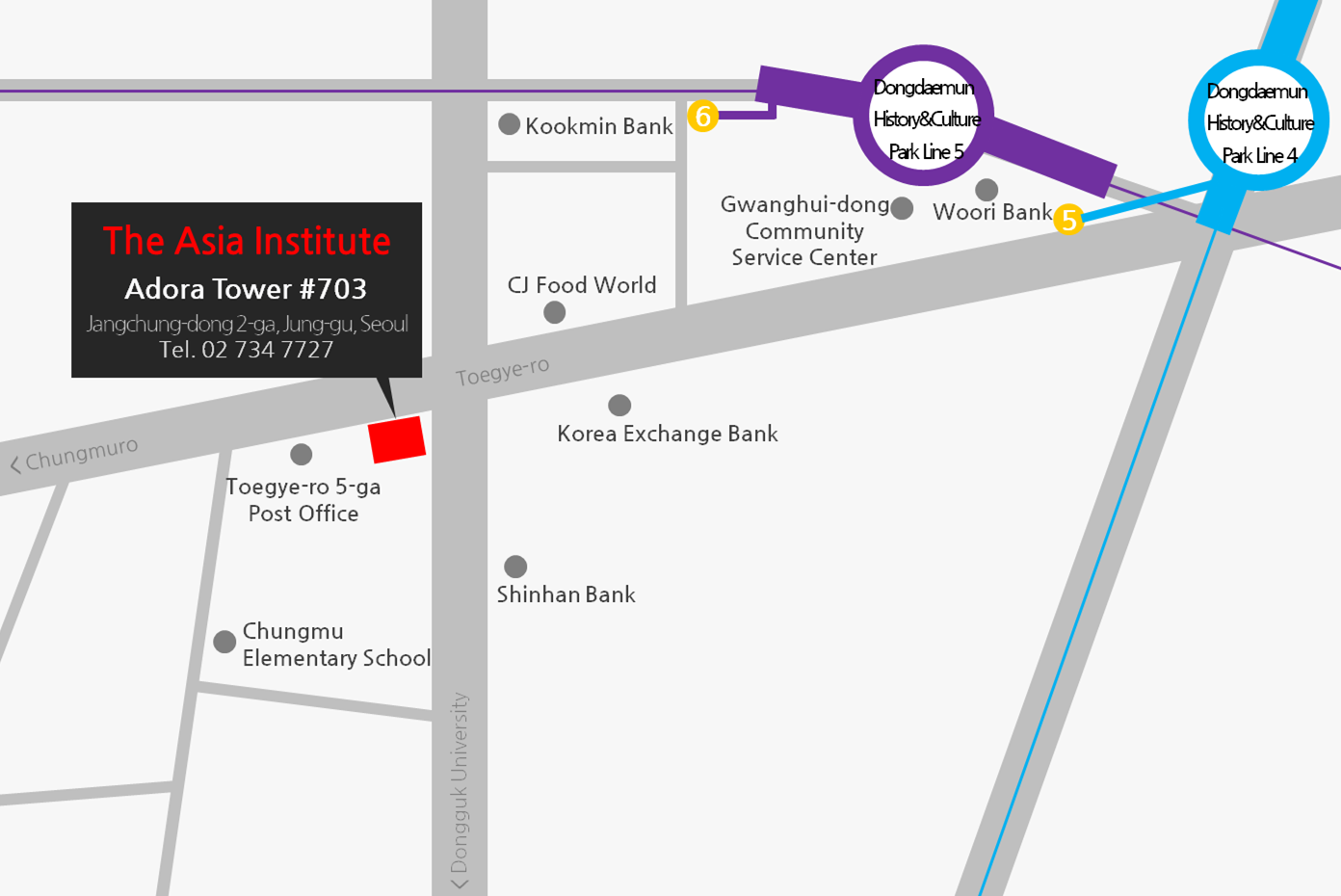
Asia Institute map with #

The “Great Society” Speech delivered fifty years ago

The “Great Society” Speech delivered fifty years ago


It was just six months after the assassination of President John F. Kennedy that President Lyndon Johnson came to the University of Michigan to deliver the commencement address on May 22, 1964. Speaking in Michigan Stadium, he delivered a historic speech that put forth a vision for a better society that went beyond the piecemeal efforts to address racism and social inequality undertaken previously. Today, exactly fifty years later, we can see a complete absence of that vision and political bravery among those sad souls who call themselves “leaders.” Although Johnson would ultimately compromise himself so deeply in the deals made to keep the Vietnam War from undermining his domestic agenda, I think we can see here an honest effort by a rather conservative and insular man to rise above his limitations and the limitations of his time.


President Johnson said to the students:


“Your imagination, your initiative, and your indignation will determine whether we build a society where progress is the servant of our needs, or a society where old values and new visions are buried under unbridled growth. For in your time we have the opportunity to move not only toward the rich society and the powerful society, but upward to the ‘Great Society'”.

It is interesting that Johnson mentions poverty first and then racism. Unlike self-satisfied politicians who talk of a “lack of tolerance for diversity” Johnson, in his home-grown style, recognized that poverty was the essential issue that had to be addressed.


The “Great Society” Speech


It is a great pleasure to be here today. This university has been coeducational since 1870, but I do not believe it was on the basis of your accomplishments that a Detroit high school girl said (and I quote), “In choosing a college, you first have to decide whether you want a coeducational school or an educational school.” Well, we can find both here at Michigan, although perhaps at different hours. I came out here today very anxious to meet the Michigan student whose father told a friend of mine that his son’s education had been a real value. It stopped his mother from bragging about him.

I have come today from the turmoil of your capital to the tranquility of your campus to speak about the future of your country. The purpose of protecting the life of our Nation and preserving the liberty of our citizens is to pursue the happiness of our people. Our success in that pursuit is the test of our success as a Nation.

For a century we labored to settle and to subdue a continent. For half a century we called upon unbounded invention and untiring industry to create an order of plenty for all of our people. The challenge of the next half century is whether we have the wisdom to use that wealth to enrich and elevate our national life, and to advance the quality of our American civilization.

Your imagination and your initiative and your indignation will determine whether we build a society where progress is the servant of our needs, or a society where old values and new visions are buried under unbridled growth. For in your time we have the opportunity to move not only toward the rich society and the powerful society, but upward to the Great Society.

The Great Society rests on abundance and liberty for all. It demands an end to poverty and racial injustice, to which we are totally committed in our time. But that is just the beginning.

The Great Society is a place where every child can find knowledge to enrich his mind and to enlarge his talents. It is a place where leisure is a welcome chance to build and reflect, not a feared cause of boredom and restlessness. It is a place where the city of man serves not only the needs of the body and the demands of commerce but the desire for beauty and the hunger for community. It is a place where man can renew contact with nature. It is a place which honors creation for its own sake and for what is adds to the understanding of the race. It is a place where men are more concerned with the quality of their goals than the quantity of their goods.

But most of all, the Great Society is not a safe harbor, a resting place, a final objective, a finished work. It is a challenge constantly renewed, beckoning us toward a destiny where the meaning of our lives matches the marvelous products of our labor.

So I want to talk to you today about three places where we begin to build the Great Society — in our cities, in our countryside, and in our classrooms.

Many of you will live to see the day, perhaps 50 years from now, when there will be 400 million Americans — four-fifths of them in urban areas. In the remainder of this century urban population will double, city land will double, and we will have to build homes and highways and facilities equal to all those built since this country was first settled. So in the next 40 years we must re-build the entire urban United States.

Aristotle said: “Men come together in cities in order to live, but they remain together in order to live the good life.” It is harder and harder to live the good life in American cities today. The catalog of ills is long: there is the decay of the centers and the despoiling of the suburbs. There is not enough housing for our people or transportation for our traffic. Open land is vanishing and old landmarks are violated. Worst of all expansion is eroding these precious and time honored values of community with neighbors and communion with nature. The loss of these values breeds loneliness and boredom and indifference.

And our society will never be great until our cities are great. Today the frontier of imagination and innovation is inside those cities and not beyond their borders. New experiments are already going on. It will be the task of your generation to make the American city a place where future generations will come, not only to live, but to live the good life. And I understand that if I stayed here tonight I would see that Michigan students are really doing their best to live the good life.

This is the place where the Peace Corps was started.

It is inspiring to see how all of you, while you are in this country, are trying so hard to live at the level of the people.

A second place where we begin to build the Great Society is in our countryside. We have always prided ourselves on being not only America the strong and America the free, but America the beautiful. Today that beauty is in danger. The water we drink, the food we eat, the very air that we breathe, are threatened with pollution. Our parks are overcrowded, our seashores overburdened. Green fields and dense forests are disappearing.

A few years ago we were greatly concerned about the “Ugly American.” Today we must act to prevent an ugly America.

For once the battle is lost, once our natural splendor is destroyed, it can never be recaptured. And once man can no longer walk with beauty or wonder at nature his spirit will wither and his sustenance be wasted.

A third place to build the Great Society is in the classrooms of America. There your children’s lives will be shaped. Our society will not be great until every young mind is set free to scan the farthest reaches of thought and imagination. We are still far from that goal. Today, 8 million adult Americans, more than the entire population of Michigan, have not finished 5 years of school. Nearly 20 million have not finished 8 years of school. Nearly 54 million — more than one quarter of all America — have not even finished high school.

Each year more than 100,000 high school graduates, with proved ability, do not enter college because they cannot afford it. And if we cannot educate today’s youth, what will we do in 1970 when elementary school enrollment will be 5 million greater than 1960? And high school enrollment will rise by 5 million. And college enrollment will increase by more than 3 million.

In many places, classrooms are overcrowded and curricula are outdated. Most of our qualified teachers are underpaid and many of our paid teachers are unqualified. So we must give every child a place to sit and a teacher to learn from. Poverty must not be a bar to learning, and learning must offer an escape from poverty.

But more classrooms and more teachers are not enough. We must seek an educational system which grows in excellence as it grows in size. This means better training for our teachers. It means preparing youth to enjoy their hours of leisure as well as their hours of labor. It means exploring new techniques of teaching, to find new ways to stimulate the love of learning and the capacity for creation.

These are three of the central issues of the Great Society. While our Government has many programs directed at those issues, I do not pretend that we have the full answer to those problems. But I do promise this: We are going to assemble the best thought and the broadest knowledge from all over the world to find those answers for America.

I intend to establish working groups to prepare a series of White House conferences and meetings — on the cities, on natural beauty, on the quality of education, and on other emerging challenges. And from these meetings and from this inspiration and from these studies we will begin to set our course toward the Great Society.

The solution to these problems does not rest on a massive program in Washington, nor can it rely solely on the strained resources of local authority. They require us to create new concepts of cooperation, a creative federalism, between the National Capital and the leaders of local communities.

Woodrow Wilson once wrote: “Every man sent out from his university should be a man of his Nation as well as a man of his time.”

Within your lifetime powerful forces, already loosed, will take us toward a way of life beyond the realm of our experience, almost beyond the bounds of our imagination.

For better or for worse, your generation has been appointed by history to deal with those problems and to lead America toward a new age. You have the chance never before afforded to any people in any age. You can help build a society where the demands of morality, and the needs of the spirit, can be realized in the life of the Nation.

So, will you join in the battle to give every citizen the full equality which God enjoins and the law requires, whatever his belief, or race, or the color of his skin?

Will you join in the battle to give every citizen an escape from the crushing weight of poverty?

Will you join in the battle to make it possible for all nations to live in enduring peace — as neighbors and not as mortal enemies?

Will you join in the battle to build the Great Society, to prove that our material progress is only the foundation on which we will build a richer life of mind and spirit?

There are those timid souls that say this battle cannot be won; that we are condemned to a soulless wealth. I do not agree. We have the power to shape the civilization that we want. But we need your will and your labor and your hearts, if we are to build that kind of society.

Those who came to this land sought to build more than just a new country. They sought a new world. So I have come here today to your campus to say that you can make their vision our reality. So let us from this moment begin our work so that in the future men will look back and say: It was then, after a long and weary way, that man turned the exploits of his genius to the full enrichment of his life.

Read more

Confusing “Technology” with “Science.”

May 23, 2014

Emanuel Pastreich


Confusing “technology” with “science” is a very serious mistake and one of the greatest risks of our age. The 18th century was the age of science when great researchers like Isaac Newton sought out the basic principles of physics through the careful investigation of the universe. The world was transformed by the rational and considered study of the material world in that century. It was an age of discovery and the drive to understand informed society. But the 18th century was not more advanced than our age in terms of technology. The various technologies we enjoy today, like antibiotics, the telephone and the automobile were not available and many suffered as a result.

By contrast, we live today in an age of technology, an age in which technology is advancing at an exponential rate, racing beyond the ability of our culture, our society and our own brains to respond and to adapt to that change. It is a profoundly dangerous moment as our society crashes forward into a future we do not understand in the slightest. But, although we can say this is an age of technology, it is not an age of science in the slightest. If anything the use of new media and glossy presentations of reality has led to a profound sloppiness on the part of many people in terms of how they perceive the world. We foolishly think that if something looks appealing on the computer screen, it must be true, or superior. Our scientific thinking, how we deduce the truth from the careful investigation of facts, has become sloppy, but out technology keeps accelerating beyond our control. If we confuse this “technological” advancement with “science” we will not be aware of just how blind we have become. And that is far more dangerous. It is dangerous to be blind. It is far more dangerous to be blind, but to be unaware that one is blind. That is where we are now.

“A DREAM OF TRUE COLLABORATION FOR KOREA AND AFRICA” (Asia Institute Seminar with KISSA)

AI logo small

20120228001013_0


“A DREAM OF TRUE COLLABORATION FOR KOREA AND AFRICA”


Friday, June 27, 2014


Haggai Kennedy Ochieng (Kenya)
Ph.D. candidate at Kyung Hee University

Joa Lee (Korea)
International Program Coordinator Kyung Hee University


Moderated by Emanuel Pastreich, Director of the Asia Institute


There is tremendous potential for collaboration between Africa and Korea that could contribute positively to the Earth’s future. Korea has a rich tradition of public planning, a wide range of technologies and a strong tradition of competence, hard work and professionalism. The nations of Africa also have much to offer Korea, not just in terms of natural resources, but also in terms of cultural diversity, sustainable lifestyles and new perspectives on self and society. The challenge is making sure that the collaboration between Korea and Africa can fulfill the dreams of both Koreans and Africans and lead to a truly win-win partnership. A young Korean with experience in Africa (Joa Lee) and an African with experience in Korea (Kennedy Ochieng) share their perspectives on the potential of the relationship and lead a discussion on this critical topic.

Read more

Larry Wilkerson discusses climate change and the future of East Asia on The Real News

Larry Wilkerson, former colonel and chief of staff to Secretary of State Colin Powell, appeared on “The Real News” program’s  “Reality Asserts itself” with Senior Editor Paul Jay on May 12, 2014 to talk about the environment and security in East Asia. His remarks focus on the implications of climate change for US-China relations, and draws on the themes of the Asia Institute seminar in Washington D.C. The United States Re-balancing in East Asia: Adopting a 100-year Time-Frame”on the Pacific Pivot at which he was a speaker.


Wilkerson states:


“Admiral Samuel J. Locklear III, United States Commander for the Pacifc Command–Probably the most influential man in terms of immediate US. China policy and US Asia–he said this recently: 

‘China and the United States probably have more in common than they have different. It is not a large majority, but it is a majority.’

The problem that we have, the challenge that we have is to deal with is the fiction created by that minority. Those issues where we don’t agree. Well that is what a great states pact does. It says: “We are going to push those issues aside,work on them if we can in the corridors, and try to fix what we can.

But we have got to have a relationship that basically brings the two together, because you can’t do it alone. You can’t. No country can do  it alone, meet the challenges of this century which are huge.

If [it is the case that policy makers look at China as just another predator] then let just keep being predators and watch the planet cast us off.  Because the planet will cast us off, or at least a sizable majority of us. There is no question in my mind about that. The planet will go one, as it went on after the dinosaurs. But human life might not. And that is the   nature of the challenge we confront in this century. In this century: In my grandchildren’s lifespan, major impacts will begin to occur, indeed may already be occurring. 

Nations like Tokelau understand that they are going to be underwater, and that they have to relocate their whole populations. These things are going to occur with a frequency and a drama that is going to convince everyone. But is it going to be too late? 

No country can do it alone. 

These problems are huge. 

video