
오늘의 중앙일첫면을 보면 크게 “무너지는 빙하 떠오르는 항로 지원 신계계” 게재 됩니다. 많이 실망 했지요. 기후변화는 한국이 직면 하고 있는 가장 큰 위기 인데요. 경제 발전의 기회 처럼 묘사 됩니다.
오늘의 중앙일첫면을 보면 크게 “무너지는 빙하 떠오르는 항로 지원 신계계” 게재 됩니다. 많이 실망 했지요. 기후변화는 한국이 직면 하고 있는 가장 큰 위기 인데요. 경제 발전의 기회 처럼 묘사 됩니다.
Emanuel Pastreich
I visited a big bookstore in Gwanghwamun last week looking for some recent books written in Chinese about politics and economics.
Since May 16, the fiftieth anniversary of the launch of the Cultural Revolution in China, there has been a very heated debate within China about the legacy of Mao Zedong, which includes a diverse range of opinions. I have read a bit on the Internet about recent debates in China and I wanted to read in a bit more detail.
The foreign books section of the mammoth bookstore has been remodeled recently and I was told that there would be a Chinese book section a few months ago. That made sense. After all, there is a substantial population of Koreans who read Chinese and many Koreans take a strong interest in contemporary China. Moreover, the Chinese population of Seoul has increased not only in terms of tourists, but also in terms of exchange students and long-term residents.
But the Chinese book section that I found at the bookstore is one of the poorest collections of books I have ever seen. The Chinese books are hidden away in a corner of the Japanese book section without any signage indicating that the books are in the Chinese language. Unless you asked an employee, you would not know this section existed.
There are only seven shelves of Chinese language books, and Chinese language textbooks take up the top two shelves. The remaining shelves are filled with Chinese translations of foreign books by notable authors like Murakami Haruki and J. K. Rowling — and a biography of Barack Obama and a few Chinese translations of the Bible.
Asia Today
“We need a new concept of security due to technological change and climate change”
May 10, 2016
Emanuel Pastreich
Technology is evolving at an unprecedented rate. Even though Moore’s Law, the rule-of-thumb that computer chips double in power every two years, is drawing to a close, computers will continue to rapidly transform our world. These transformations have a profound impact on the security of nations, even though they are not well understood.
As we look towards the future, we risk spending tremendous amounts of our precious resources preparing for wars that will never happen and miss out on the chance to prepare for life and death challenges which are almost a certainty. The technology-fueled changes in the nature of national security mean that we can take our eyes off the past and re-focus our attention on real threats. – even the ones that don’t match up with our assumptions.
There are two major issues that need to be discussed openly and cooperatively between the Republic of Korea, Japan, the People’s Republic of China and the United States.
First we must consider whether technological change will render many weapons systems inappropriate in the years to come and ask ourselves whether a more profound rethinking of military issues is required, perhaps one that moves beyond the traditional nation-state assumptions we have used so far.
Second, we must consider whether we must limit the development of weapons systems, and rather turn increasingly to rigidly enforced weapons limitation treaties for fundamental ethical reasons because of the increasingly destructive potential of the next generation of weapons. We need to ask ourselves whether we will even have the budgets to pay for conventional weapons over the next twenty years in light of the tremendous costs of adaption to, and mitigation of, climate change. Could it be that we must reach binding agreements to limit, or ban, weapons so that we can effectively devote our precious resources to the basic steps required for human survival?
How technology is changing the nature of security
Will the nature of military conflict be so transformed by emerging technologies that most of our weapons systems will cease to play a meaningful role in the near future? We can’t assume that our conflicts will end or that deterrence is unnecessary. As technologies that can kill tens of thousands become cheaper and more accessible to small groups, even to individuals, we should certainly continue to think about how we will respond.
However, it is not clear that the battles of the future will be between nation states per se, which are rapidly fragmenting. Nor is it at all clear that the weapons we employed in previous conflicts will be helpful in such conflicts.
Three of the most important transformations are: 1) the emergence of drones and robots; 2) the sophistication of cyber warfare and 3) the emergence of 3D printing and other means of transmitting objects through non-conventional means.
The conventional military is made up of tanks, fighter planes, missiles and battleships and aircraft carriers, all of which are extremely expensive and vulnerable to these new weapons.
Please join the Asia Institute as a member (student, regular, life) or institutional sponsor. We need your support for our programs and with your support we will expand what we do at Asia Institute until what is already one of most innovative and rigorous think tanks in Asia becomes the most visible.




Nine years ago we founded the Asia Institute and decided to on the intersection of three critical issues; 1) the rapid evolution of technology; 2) the crisis of climate change; 3) the unprecedented changes in the nature of international relations. Recent developments suggest that our approach has been correct and our seminars, reports and articles have provided a wealth of invaluable material for the general public.
We need your support so that we can continue to be the only think tank out there that addresses the real issues of our age.
Student membership (elementary, middle, high school & undergraduate) 5,000 Won/month
Regular membership: 10,000 Won/month
Lifetime membership: 1 million Won
Institutional sponsorship, or special contributions (please contact us directly for a meeting)
http://www.asia-institute.org/category/membership-sponsorship/
Registration page
http://goo.gl/forms/ghvZ8bDWY3qVksr42
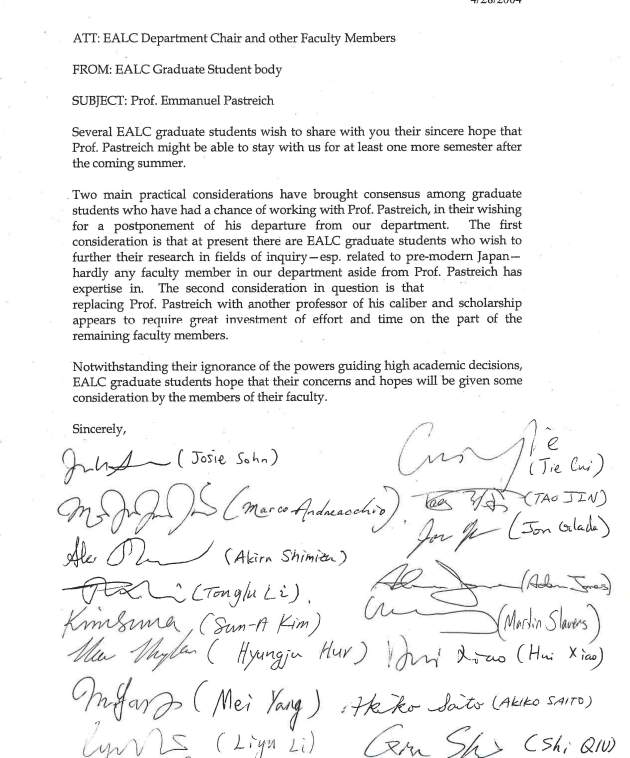
I received this letter from the graduate students at the Department of East Asian Languages and Cultures in April, 2001. The students asked the department head, Professor Jerry Packard, to consider keeping me on as a professor even after the department tenure committee had decided to dismiss me without talking to me even once, and in spite of all of my publications and my service to the university.
I was deeply touched that my students made this effort. Not a single faculty member at University of Illinois, let alone any faculty at any other university, or anyone else anywhere has ever commented on my illegal dismissal from the University of Illinois, or any of the actions taken against me before then.
I applied for fifty or more jobs in the fall of 2004, academic NGO, government and other. But there was nothing to be found. After two months of unemployment, I was offered a position working at the culture center of the Korean embassy in Washington D.C.
エマニュエル パストリッチ
http://www.huffingtonpost.jp/emanuel-pastreich/seoul-international_b_10201484.html?1464588600
ソウルでは韓国籍の児童も入学できるインターナショナルスクールの数がここ10年間に急増した。チャドウィック・スクール(Chadwick International)、ドワイト・スクール(Dwight School Seoul)、コリア・インターナショナルスクール(Korea International School)などが人気を集めており、外国籍の児童のみが入学可能な既存のソウル外国人学校やソウル・インターナショナルスクールらと肩を並べるようになった。
そこに在学する韓国人学生たちは皆、アイビーリーグ進学を希望しており、生徒や保護者から人気のある立派な施設や環境も完備している。
しかし、この優良な環境はもちろんタダではない。ソウル外国人学校の高校課程の場合、アイビーリーグ入学相談などを含む学費が、年間で約35000米ドルに達する。
ところで、人々にあまり知られていないインターナショナルスクールがソウル市東端の峨嵯(アチャ)山近くにある。プールや校庭などの施設はないが、この学校は単なる学業成就以上を望む父母たちから厚い信頼を得ている。
その名を韓国ケント外国人学校(Korea Kent Foreign School)と言い、子弟を通わせている父母たちは、学校があまり知られていない現状にむしろ満足しているという。
韓国ケント外国人学校は、アフリカや東南アジアなどの開発途上国の外交官の子弟が、既存のエリート学校から疎外されている現状を目の当たりにして心を痛めた創立者が、道徳的な原則に基づき彼らの経済状況に合わせて、教育が受けられるようにと創立したのが始まりである。
今ではケント学校は東アジアで最も多様な生徒たちが通う学校になっており、開校時の教えはキリスト教に影響を受けたものだったが、生徒の中には他の信仰を持つ生徒も多く、宗教を超えた幅広い活動を実践している。
ケント学校の施設は、簡潔かつ実用的で、訪問者を圧倒するステンドグラスや荘厳な階段などは見られない。一方で、細かい所に目を引くものがある。例えば、階段には標語が貼られており、次のような文章が書かれている。
「ちょっと待って!電気を消してください。電気を無駄遣いすれば何が起こるか分かりますね?温暖化が進んで凶作になりハリケーンも頻繁に起こります。それだけでなく動物の絶滅の危機も早まります。」
他の階段に貼られている標語には「校内食堂では残さず食べるように」といった内容が書いてある。また、学校の玄関には学校の特色を表すピンクのポスターが貼ってある。そこには「環境や様々な状況への態度を決めるのは、まさに、私たち自身だ」といった内容が書かれている。
ケントは、他のインターナショナルスクールとは性格が異なっている。
上周笔者去了首尔光化门的一家大型书店,想看一下书店有多少政治、经济领域的中文原著。今年5月16日中国文化大革命50周年纪念日之后,中国从各个角度围绕毛泽东留下的遗产展开了一场激烈讨论。在以网络为基础的讨论之外,笔者需要查看一些更加具体的单行本文献。
该大型书店最近对外国书籍展厅进行了重新翻修。笔者在几个月前听说店里新设了中文原著展区,这是一个好消息。事实上,可以读懂中文书籍的韩国人不在少数,不少韩国人都对现代中国抱有很大兴趣,而且生活在首尔的中国人数量也在日益增多,除中国游客之外,交换学生和长期居留的中国人也为数不少。
但笔者在书店看到的情况却令人感到无语至极,简直是笔者见过最差的图书展区。书店的中文书展区隐藏在日文书展区的一个角落里,也没有任何写有“中文书展区”的标志,如果不向店员询问,根本就找不到中文书展区在哪里。
摆放中文书的书架板也只有区区七个,而且其中两个书架上都摆着中文学习辅导书。
其余五个书架上摆的也只是村上春树、JK罗琳等著名作家作品的中文译著、奥巴马总统的传记和中文版圣经等等,还有一些无名作家的入门书、实用书等等。
书架上没有一本中文小说,也没有任何近些年出版的关于现代中国社会、政治、经济、文化的著作。
エマニュエル パストリッチ
エマニュエル・パストリッチ慶煕(キョンヒ)大国際大学院教授(52)は韓国人よりも韓国に対する自負心が強い外国人だ。韓国文化の価値と潜在力を口がすっぱくなるほど力説して回っている。「韓国が一群の経済奇跡を成し遂げた背後には、数千年の間続いた知的伝統がある」という主張も彼の常套句だ。昨年、朴槿恵(パク・クネ)大統領が閣僚会議で言及して話題になった彼の著書『韓国人だけが知らない別の大韓民国』でも、ソンビ(朝鮮時代の学識が高く高尚な人)精神と礼学・風水など私たちの伝統文化の強みを前に出すことをはばからなかった。
18日、ソウル仁寺洞(インサドン)で会った彼は小説家・韓江(ハンガン)のマン・ブッカー・インターナショナル賞受賞の便りを話題に上げた。「韓国文化の多様性と活気に世界が注目するのは当然だ」としながら自身の「先見の明」に満足しているようだった。
--2011年出版した『人生は速度でなく方向だ』の改訂版が出版された。過去5年間、韓国人の意識にはどのような変化があったと考えるか。
「自負心という側面から両極化現象が高まった。『ヘル朝鮮』と言いながら韓国社会を否定的に見て自分を見下す人も多くなったし、伝統文化の再評価をすべきだと主張する人も多くなった」
『人生は…』は、速度に重点を置いて方向を見失った韓国社会の問題を突いた本だ。これを解決する方法として伝統文化の再解釈などを提案している。パストリッチ教授は「韓国教育の革新モデルを別の先進国から探すのではなく伝統教育から探せ。多文化社会に対する解決法も弘益思想など伝統文化にある」と述べた。
“You will hear a lot of talk about how this or that generation messed things up and got us into war. What nonsense! All living generations are responsible for what we do, and all dead ones as well.”
“

