Korea Times
July 29, 2018
Emanuel Pastreich
Over the last 11 years, I have had several occasions to work directly with the Ministry of the Environment. It all started when I wrote a proposal for the future of the city of Daejeon (where I lived at the time) in 2008.
I teamed with a researcher from the Korea National Fusion Research Institute, Dr. Jung-Hoon Han, to draft “Daejeon: Environmental Capital of Asia,” which was published on Daedeok Net and Ohmynews in January, 2008.
That proposal called for cooperation between science experts in the Daedeok research cluster and the city of Daejeon and it led to the formation of the Daejeon Environmental Forum (later renamed “Daejeon Green Growth Forum”) that brought together citizens, government officials and scientific experts to discuss how Daejeon could be transformed into an ecological city.
But although that forum was mentioned in the media, it did not get much traction when it came to changing the city’s automobile-based culture. The officials from the Ministry of the Environment whom I met seemed to be trapped in an extremely painful position, forced to adapt to the pro-business Lee Myung-bak administration that shamelessly “greenwashed” (making policies and technologies look like they are good for the environment when they are not) the destructive actions of construction companies.
I also saw how Korean expected the Ministry of the Environment to serve as a protector, and discovered that its officials wanted to do good, but were not given funding and they were compelled to use what funding they were given to promote golf courses and concrete banks for natural rivers in accord with the infamous “Four Rivers Project that brought great wealth to real estate speculators and developers.
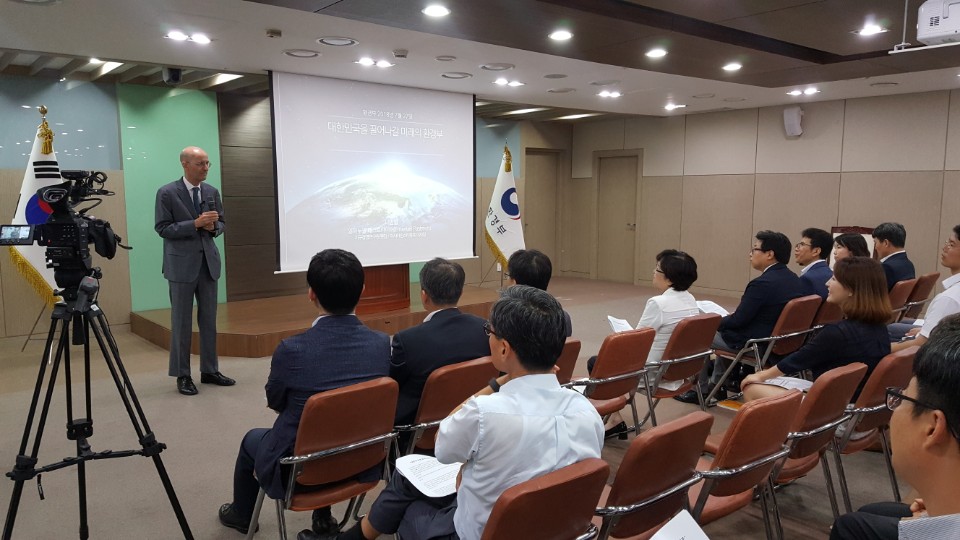
So it was quite a remarkable that I received an email on June 18 inviting me to speak to about 150 senior officials at the Ministry of the Environment about my proposal for a rethinking of the Korean economy, which I discussed in my Korean book “A Greater Korea which Koreans did not know about.”
Environment Minister Kim Eun-gyeong spent many years as an activist working on social and environmental issues, and she started her career in local government. I suspect she knew something of what it is like to fight for environmental justice in a Korean society obsessed with industrialization.
She read my recent book and thought that having a foreigner talk about larger environmental policy issues would be useful. I think it was one of the most meaningful talks I have given.
It was my first visit to the Ministry of the Environment in Sejong City. The trip itself reminded me of just how far we have to go to create an ecological Korea. After all, Sejong City does not have a train station.
We had to drive in an automobile across the countryside to get there, with the air conditioning cranked up, polluting the atmosphere and watching how the precious soil is being torn up, and the beautiful trees are being cut down, to make room for apartment complexes primarily aimed at promoting a wasteful lifestyle.
The Ministry of the Environment itself is sealed off in the snake-like government complex, a structure built with little concern for the long-term impact on the climate. The air conditioning was set so high that I felt very comfortable wearing a jacket and tie for my talk. The electricity most clearly was not generated by solar power.
But there were posters on the walls describing serious efforts to address environmental issues, even if the word “climate change” did not appear anywhere. I sensed that beneath the surface there were real stirrings for change among those who had suffered through years of half-baked environment policy.
I must confess that I felt a bit of trepidation about the event. My speech was extremely blunt and I suggested that there was profound danger in the industrialized society that had been held up as a primary symbol of success in Korea for so many years.
I proposed that we must eliminate imports of petroleum and coal, and also reduce imports of agricultural products (which goes against the entire free trade ideology that informs all government policy).
I proposed that corporations promoting fossil fuels should not be allowed to advertise on TV because their corporate support for broadcast had dangerously distorted reporting about climate change.
It was entirely possible that this speech would be highly controversial. But although there may have been real disagreement, I did not sense any hostility. I fact, I sensed a true enthusiasm about this honest dialog on climate change.
After my talk, an official asked me the question that is often posed at such events: “Why did you choose Korea when you could have lived in the United States or China or Japan?”
There are many ways I have answered this question. I suggested, humorously, that I did not come because I love K Pop, or kimchi or galbi, but rather that I was drawn to Korea’s traditions of good government and its emphasis on morality in politics and long-term sustainability in the economy in the past.
I have given this answer before, but as I spoke, a more accurate answer to the question came to mind.
The truth is that I would never be allowed to give this sort of a speech to the Ministry of the Environment in the Japan, or China, or especially in my own country’s Department of the Environment ― where even the discussion of climate change is forbidden.
The fact that my harsh, and even revolutionary, talk could be delivered in a highly formal manner to those actually engaged in policy, and not just to a marginal group of environmental activists, was nothing short of miraculous.
There had been zero effort made to vet my talk and zero hesitation about distributing copies of my talk to everyone present.
Equally amazing was the series of four talks for officers from all branches of the military that I gave over the last three weeks in a separate program. In that program as well I was free to speak about what I thought were the security issues of our age.
I discussed at length in front of lieutenants and colonels such emerging threats as climate change, the fragmentation of our society and the spread of an anti-intellectual culture.
This openness in Korea’s mainstream is the real reason that I have stayed here for 11 years. As wrong as Korean policies may be at times, there is always the potential for an honest debate at the highest levels.
But the struggle about climate change is just beginning in Korea. Awareness remains low even in the face of catastrophe.
The relationship between electricity and environment problems is unclear for most citizens. In the public mind, burning coal and oil for power is decoupled from the bizarre weather we encounter.
When I thought about the long struggle that lies before us, I was reminded of Buddhist philosopher Stephen Jenkinson’s comment about moral responsibility to respond to climate change. He said, “The question will not be so much how we succeed but rather how we will fail.” I felt at this talk at the Ministry of the Environment that at the minimum, I was no longer alone.
Read more

 <img
<img