“The New Colossus” and hope for an open society

On the “New Colossus”

Emanuel Pastreich

January 28, 2017

Fred Lang was so kind as to share Emma Lazarus’s poem “The New Colossus” this evening with me. I had been thinking about the decisions of the so-called “Trump Administration” to build walls around the United States and to start to block the immigration of people to the United States from Muslim nations. Fred picked exactly the right poem to give a glitter of hope.

This poem is inscribed on the base of the Statue of Liberty and has embodied a noble part of the American tradition for the last 150 years. Of course the racist and xenophobic tradition has also a long history in the United States, and the two strands of American culture have alternated since the Civil War.

One of the reasons that the Trump people are able to run over their opposition is that so many of the words that made the best of the United States have been detached from institutions and people. The words on the Statue of Liberty, or on the Capitol Building, have been reduced to mere words. Few today have fought or sacrificed for the constitution, the Statue of Liberty or other higher values for so long time. There are of course people suffering for the cause of freedom today, but they are almost invisible in the eyes of most people. The recent national prison strike was completely ignored by almost everyone I know in the United States.

Emma Lazarus was an American poet of German Jewish origins who took a deep interest in the sufferings of Jews in Eastern Europe. The title of her poem, “The New Colossus” suggests the contradictions of the United States. On the one hand, there was a confidence that something new and more humane could be achieved here. But of course “colossus” also suggests the pomp and arrogance of Rome, the imperial disease.

The New Colossus

 EMMA LAZARUS

Not like the brazen giant of Greek fame,

With conquering limbs astride from land to land;

Here at our sea-washed, sunset gates shall stand

A mighty woman with a torch, whose flame

Is the imprisoned lightning, and her name

Mother of Exiles. From her beacon-hand

Glows world-wide welcome; her mild eyes command

The air-bridged harbor that twin cities frame.

“Keep, ancient lands, your storied pomp!” cries she

With silent lips. “Give me your tired, your poor,

Your huddled masses yearning to breathe free,

The wretched refuse of your teeming shore.

Send these, the homeless, tempest-tost to me,

I lift my lamp beside the golden door!”

I cannot help thinking of Percy B. Shelley’s sonnet “Ozymandias” about imperial arrogance. In any case, today it seems as if Emma Lazarus’ poem is now up for grab—an opportunity for any one, any group, or any country who is ready to stand up for the huddled masses and offer hope to our torn world.

Emma Lazarus

“Nightfall”

For those who wish to understand the psychology of climate change denial and the process by which various interest groups conspire to suppress massive unpleasant truths, please read Issac Asimov’s 1941 classic “Nightfall.” The short story describes how the inhabitants try to suppress all discussion of an eclipse of all six suns that are visible from the planet. The eclipse creates complete chaos on the planet and the destruction of the civilization. But despite the efforts of one well-meaning figure, there is nothing that can be done to stop the denial, nor the eventual destruction.

‘My columns may have been a little rough,

but I gave you people the benefit of the

doubt every time. After all. This is
not the century to preach “The end of the
world is at hand” to Lagash. You have to
understand that people don’t believe the
Book of Revelations anymore, and it
annoys them to have scientists turn
about face and tell us the Cultists are right
after all — ‘

Isaac Asimov
“Nightfall”
1941

You can read the full text at:

https://www.uni.edu/morgans/astro/course/nightfall.pdf

Technology, human consciousness and climate change

I have spent a tremendous time working on this issue of climate change here and in the US over the last 15 years. Personally I am starting to think that somehow exponential technological change has hooked up with the brain stem, the reptile mind of humans and drawn into that emerging connected system human society at a level that is essentially invisible to individuals.

Therefore, although we all seem to be free, we are being marched to our own death. We are aware of this truth at a certain level, but because we have bought into this mechanized consumer society at a level below consciousness, we cannot shake it off through policy or through politics. The only hope would be to modify habits, but there is not much time left for that.
The reason we cannot step back is that the technology is helping to shut down our own self-preservation instincts and our ability to engage in long-term planning. How? It is sort of like rubbing the belly of an alligator. It is the weakness of humans. Certain patterns just draw us in.

The Asia Institute has emphasized from its foundation, the most important issue is the combination of exponential evolution of technology, the change in the climate and the change in international relations (how humans around the world interact with each other). As opposed to other think tanks who feed you lies and distractions.

The bane of “shrimpism” in Korea

What does Korea have to do in this year of crisis and challenge? Well, of course we can go back to the joke about the elephant:

——————–
Question:
“What do you do if you are an elephant stuck in quicksand?”
 
Answer:
 
“First, stop being an elephant!”
———–
 
All too true, but perhaps before anything else Korea must move beyond “Saewooism” (saeuism 새우이즘), the belief that Korea is just a weak victim of the actions of other powers. The term is translated into English as “shrimpism.” Of course it is true that Korea is profoundly influenced by other powers’ decisions. But this fact is so obvious that there is no reason to mention it. Rather it is a good use of Korean’s time to come up with honest and brave proposals for what can be done together.
 

Here is a proposal for a new flag for “shrimpism”

13864863-vintage-shrimp-seafood-crest-stock-vector-stamp

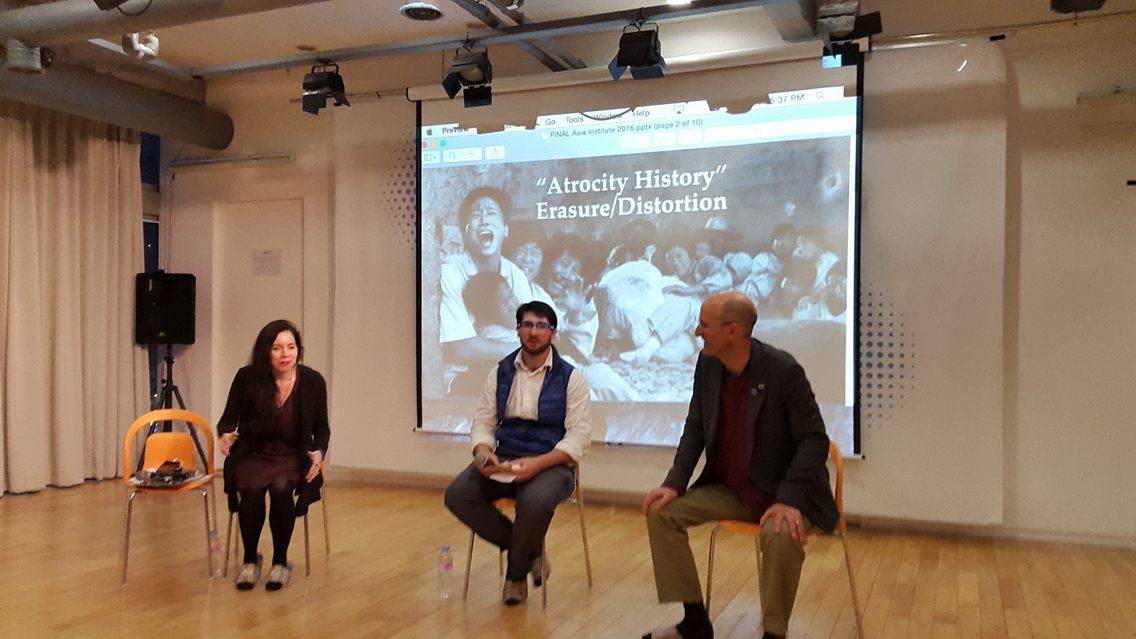
Two remarkable quotes cited by Hope May at tonight’s Asia Institute Seminar on peace, history and memory

Tonight’s seminar by Hope Elizabeth May brought together a collection of academics, diplomats, reporters and concerned citizens for a deeper consideration of what is necessary for true peace in Korea and in Northeast Asia. Dr. May focused on the tradition of peace making that dates back to the Hague Conference of 1907. The seminar suggested how the history of peace, and the tradition of “positive history” could inspire us to use our imaginations to come up with new solutions to today’s challenges.


hope


She Hope May professor of philosophy at Central Michigan University, cited two remarkable quotes.

“The world progresses, in the slow and halting manner in which it does progress, only in proportion to the moral energy exerted by the men and women living in it.”

Jane Addams

Nobel Peace Prize Winner

1931

“Souls interact across time and space. The decisions people make in a difficult hour, the principles they either abide by or abandon in moments of truth, have consequences not just for their own lives, but well beyond.”

Natan Saransky

Soviet dissident

Defining “Trumpism”

Please let me be the first to coin the word for politics and diplomacy “trumpism.”

Trumpism consists of doing something so far out of left field that it confuses your opponents and allows you to take control of the situation. Trump’s suggestion that he might meet the leader of North Korea, like his enthusiastic reaching out to Putin, is typical of this strategy. But I would like to say it is an extremely high-risk approach and is unlikely to be successful in the long run.

‘Trump may meet N. Korean leader soon’

Korea Times


Professors and teaching

As teachers we should be committed to conveying truth and

wisdom to our students. To give them facts to students and ask them to repeat them

is not teaching and it is not education.

You might say that a ritualistic approach to education is a disservice to

students because it suggests that there is no greater meaning to what they read and write than the numerical grade that they receive. In fact, we should teach in such a manner that it is clear to students that knowledge without

ethical commitment and action is like blood in the veins without a beating heart and breathing lungs.

climate-change-jpf

Nowhere is this problem more evident than in the case of climate change.

I talk about climate change in all my classes to some degree and I am increasing forcing myself to bring the topic up with people I meet.

Although that requires a certain degree of bravery.

More than a little. Two people whom I gave my “Stop Climate Change” pins to

then proceeded to leave them behind on the table when they left–never having put them on.

But I wonder whether a teacher who never speaks of the ethical responsibilities of the student is playing a role as a teacher.


Love and Consumer Culture

We cannot talk about sex and love without considering consumer culture. The explosion in the circulation of things since the industrial revolution, and especially over the last decade has made everything a target for consumption. Humans are no exception and we consume each other as products (saying to ourselves, as we are taught by the mass media, that it is “love”). But in fact we care much less about each other because we do not have the time or inclination.

Remember that the Romantic movement came with the industrial revolution. It was both an attempt to escape from the horror of what Walter Benjamin called “the age of mechanical reproduction” resulting from the industrial revolution and the “great transformation” remaking human society and also a product thereof. Ironically many efforts to find something human and natural that gives shelter from a world gone mad with consumption are themselves products of that trend. Starbucks is the perfect example. A cozy space that seems more human, more natural, closer to a world we wish existed. But Starbucks, or the I Phone are as much a product of that ruthless mechanical reproduction (and now mechanical consumption) as anything.

I have not seen much discussion of the linkage of the various disturbing trends in our society, in our politics, to the rate of technological change. But I would argue that if we cannot see that link, we cannot see anything at all.


Aldous Huxley and Climate Change


Quote from Aldous Huxley for the many insane people around us who look the way in the face of the doom of climate change.


“The real hopeless victims of mental illness are to be found among those who appear to be most normal. Many of them are normal because they are so well adjusted to our mode of existence, because their human voice has been silenced so early in their lives, that they do not even struggle or suffer or develop symptoms as the neurotic does. They are normal not in what may be called the absolute sense of the word; they are normal only in relation to a profoundly abnormal society. Their perfect adjustment to that abnormal society is a measure of their mental sickness. These millions of abnormally normal people, living without fuss in a society to which, if they were fully human beings, they ought not to be adjusted.”


Aldous Huxley

Brave New World Revisited

Hunger Strike to demand a response to climate change

I am thinking about launching a hunger strike to

demand that the government of Korea respond to the challenge of climate change

and present a concrete program for how it will transform the country rapidly

into the leading green nation in the world.

Bamboo-Forest-Theme-Park

I cannot launch such a hunger strike without a

concrete and clear demand and I would be much effective

if other people in Korea joined me.

Let me know what you think.

We can start in September.

There is not much time left.

Thanks

Emanuel