More on why we need to demand more proficiency in Korean language of internationals

More on why we need to demand more proficiency in Korean language of internationals

Emanuel Pastreich

February 8, 2012

There are several underlying factors behind the reluctance of Koreans to demand high proficiency in Korean from foreigners.

First, the Korean language is viewed primarily as an extension of Korean ethnic identity, and not as an object for objective investigation and evaluation.  Many Koreans think that ethnic Koreans should speak perfect Korean and foreigners are a bit odd if they speak any Korean at all. Most Koreans evaluate ability in

Read more

Is the world really becoming smaller?

It is a platitude that the world is growing smaller. Whether reading through Frances Cairncross’s “The Death of Distance” or Thomas Friedman’s “The World is Flat” one gets the impression that the growth of new technologies which link us together reduces distance between us and makes the world smaller, more connected.  Although it is hard to imagine how seven billion people could ever be a single group, a global village, there will be few objections if I say that “technology is making the world smaller” at a cocktail party.

But that assumption is not necessarily true. Let me make two different, related points. 

Read more

The Three Faces of Seoul

February 2, 2012

One striking aspect of Seoul is the contrasting aesthetics we find on every corner. The Beautiful Seoul Project that Eun Shil Park was so kind as to introduce me to has produced this remarkable “Seoul Time Lapse 2010” video which puts forth an image of Seoul so radically different from what most of us old timers are accustomed to, but quite powerful. I must say I am very much reminded of the Tokyo I knew back in 1991 & 1992.

Read more

William McKenzie: the first American to “go native” in Korea

William McKenzie: the first American to “go native” in Korea

I have spent much time thinking about my role in Korea and the significance of my work. Having lived in Korea now for almost five years, I realize that a critical issue in one’s success, in every action, is how one is perceived by Koreans, and that how Koreans perceive one it related to how one perceives oneself and one’s role.

In this age, there are increasing opportunities for internationals to play a role in Korea beyond the rather limited roles played by internationals in the previous generation. In fact, I meet internationals who come to Korea because they think there is greater opportunity here than in their own countries.

Read more

Presenting rural Korea to the World as the “Provence of Asia” (essay)

Presenting rural Korea to the World as the “Provence of Asia”

When I lived in Daejeon for four years, I was struck by the beauty of the surrounding landscape. The old hills covered with pine trees, the rivers and canals that surrounded luscious fields of rice were infinitely appealing. I found many delightful villages that produce unique agricultural products in the countryside. The older farmhouses were simple, but beautiful, reminding me of some of the farm houses I had seen as a child in Europe. In rural Korea, I felt, I had encountered something equivalent to Tuscany or Provence in Europe, an idyllic region which could attract tourists from around the world to enjoy its villages and its agricultural products.

Read more

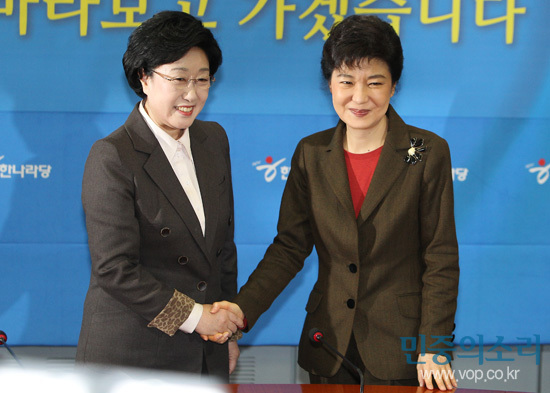
Symbolic Meeting of Park Geun Hye and Han Myung-sook

The remarkable emergence of women as the critical political force in Korea is best embodied by the meeting on January 17th, 2012, between Representative Park Geun-hye, chairwoman of the Grand National Party’s emergency committee, and Han Myeong-sook, chairwomen of the  Democratic United Party. Needless to say, it is the first time that the leaders of two major Korean parties are both women.

The meeting was filled with no small degree of irony. Park is the treasured daughter of the late President Park Chung-hee, well known for his efforts to suppress by any means his opponents. Han was one of the victims, spending two years in jail in 1979 for political reasons. Her husband spent 13 years in prison.

Read more

Korea’s Unique Tradition of Propriety: Godsend for the Network Society

Korea’s Unique Tradition of Propriety:  Godsend for the Network Society

Emanuel Pastreich

January 15, 2012

In this age the complex relations developing between individuals outside of the workplace or the family, whether those that develop through on-line communications within organizations, or those found in social networks such Facebook, LinkedIn and Twitter, are having a profound impact on our society. Connections between people from vastly different backgrounds, who serve at different levels within organizations, can subtly, or bluntly, influence policy.

Almost all actions within social networks are legal, but the practice can be

Read more

“The Importance of Women for the Future of Korea” (essay)

 I made this presentation at Korea’s Federation of Women’s Science and Technology Association’s “21st Century Women Leaders Forum.” I was invited by the chairman, Dr. Myungja Kim, who is a close friend. She served as the minister of the environment previously and has distinguished herself as one of the few scientists deeply engaged in the policy debate. I was the only man at the event and perhaps the only man to ever present at the forum. Most likely i was invited because of my recent article arguing that the next president of KAIST should be a woman.

Read more

Nano-Art and Bio-literature

November 18, 2010

Nano-Art and Bio-literature


We have worked with a variety of institutes on the question of “convergence” –a term so broad that it is sometimes unnerving. It so happens that I am meeting the Director of Convergence at KRISS tonight to discuss this topic. Much discussion of convergence in terms of the coming together of computers and communication devices (ICT) and also convergence between new fields: IT-bio & nano-bio. But Korea has conceived of “convergence” as applying to larger themes such as the marriage of technology and art and the new for potential spaces for expression thus generated. This last theme seemed secondary to me at first, but in fact, I have come to see it as perhaps the core for “technology convergence” in our age.


At first I thought about the whole matter of technology-art convergence humorously. I asked friends facetiously whether we would soon have “bio-literature” or “nano-painting.” It took me a while to comprehend the essential issue.

Art and literature allow us to conceive of what is happening to our world at the nano level and the macro level. How cells divide and how global networks evolve that span the world. In fact, the use of art, enhanced by the next generation of animation technology, is the best hope we have to help average people (which includes most policy makers) to understand how technology is changing our reality. Similarly, literature, the inspiring and entertaining description of our world, will give us the tools to comprehend what otherwise seems like an invisible process by which Moore’s Law is remaking our world. First one must be able to conceive of the process and then one can make informed decisions.


Alex Lee of Woosong University sent me today this link from the New York Times about the effort to animate the micro-nano level. It is just the start of a new field, but one that may eventually lead us to have clear images and special relations we can assign to processes that previously were wrapped in a mystery appropriate to the high priests of alchemy.


http://video.nytimes.com/video/2010/11/15/science/1248069334032/the-animators-of-life.html


The Inner Life of a Cell


http://www.youtube.com/watch?v=yz4lFeqJPdU


Vogue Archive: The Collapsing cost of information brings the past smack into the middle of the present

It is now becoming extremely cheap to input, reformat and process information. That situation makes it possible for Vogue Magazine to make accessible every single issue from its founding in 1892. That opens up to the casual viewer the whole range of Vogue’s history and allows for the appropriation and adaptation of images, words and ideas from a broad swath of history. See Vogue Archive

Read more