United Nations Academic Impact Seminar at Kyung Hee University

September 15, 2011

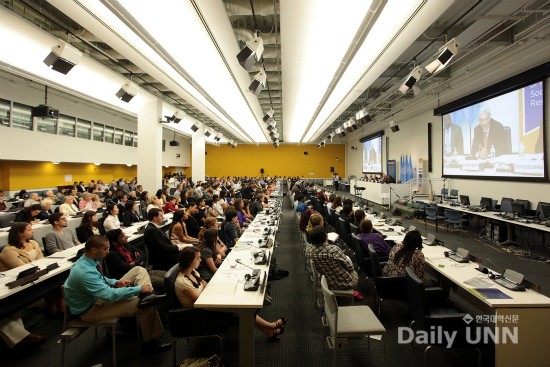
Kyung Hee University and the United Nations hosted a remarkable event entitled “Give Peace Another Chance” to commemorate the 30th anniversary of the establishment of the United Nations “Day of Peace.”  The “Day of Peace” was originally proposed by the founder of Kyung Hee University and it was most appropriate that the United Nations chose Kyung Hee University for this event.

The event, which included speeches, statements by students, an address by Secretary General Ban Ki Moon and music performances, was split between United Nations Headquarters in New York City and Kyung Hee Campus in Seoul. Both groups were linked up via the internet.

More than 3000 students from ten universities were involved. The event was focused on United Nations Academic Impact (UNAI) an innovative program to increase the global role of universities and the commitment of students to proactive participation in local and global affairs.


Academic Impact aligns institutions of higher education with the United Nations in actively supporting the then principles of the UN  in the areas of human rights, literacy, sustainability and conflict resolution. The Academic Impact also asks each participating college or university to actively demonstrate support of at least one of those principles each year.

Secretary General Ban Ki-Moon’s address to “Give Peace Another Chance” is available here.


Emanuel’s two books to be employed in US graduate schools

Both of Emanuel’s recently published books will be used in graduate courses in the United States this semester.

His book on the reception of  the Chinese vernacular in Japan, The Observable Mundane: Vernacular Chinese and the Emergence of a Literary Discourse on Popular Narrative in Edo Japan, will be assigned in the East Asian Studies graduate program at Princeton

Read more

Report “Strategies for Promoting Successful International Collaboration in Convergence Technologies” submitted to Seoul National University

The Interdisciplinary Studies Program at Humanitas College, Kyung Hee University, submitted to Seoul National University’s Advanced Institutes of Convergence Technology (AICT) a research report entitled “Strategies for Promoting Successful International Collaboration in Convergence Technologies: A Consideration of the Korean Bio-Medical Field” on September 1, 2011. This report was the culmination of Emanuel’s work over the summer including his discussions with University of Illinois, Yale University, MIT, RIKEN (Japan) and other institutes concerning effective strategies for international collaboration in convergence technology research.

The study was guided by Emanuel Pastreich, Eugene Pak, Ph.D.,  of SNU, AICT, and Vince Rubino of SEE GENE Incorporated. Michael Gehret, Associate Director of the Institute for Advanced Studies  and Richard Herman, Chancellor Emeritus of University of Illinois, Urbana-Champaign, participated in the study.

We hope to expand the study into a long-term program for facilitating international collaboration in the near future.


Teaching Korean Literature in English at Kyung Hee University

On Thursday, September 1, I gave my first lecture for a class on the novels of the Korean writer Park Jiwon for a class of undergraduates in the department of Korean Literature at Kyung Hee University. It was the first class ever at Kyung Hee University’s department of Korean literature that was explicitly designated for instruction in English and one of few such courses at Korean literature departments in Korea being taught in English.

The Ministry of Education, Science and Technology has recently pressed forward with new guidelines for increasing the use of English at Korean universities. Launching a course in English in the Korean literature department has great significance as Korean literature is perceived as the most immune to change and the most closely associated with concepts of cultural conservatism.

Read more

What’s This about a Foreigner Teaching Park Jiwon’s Novels?

This article by 임송이 describes the class for the Department of Korean Literature that I will be teaching next semester. The class is in English and concerns the novels of Park Jiwon, the 18th century writer whose novels I recently translated into English. This class is the first class taught in English in Kyung Hee University’s department of Korean literature and I do not know of any other universities teaching Korean literature in English, but to do so makes sense these days as there are an increasing number of foreign students in Korean literature departments. In graduate school foreigners outnumber Koreans.

By the way, I was interviewed at Korea University for a position in the department of Korean Literature in 2006, but at the time the department decided against hiring a foreigner. Times have changed, and we realize that teaching Korean is not just about some cruel globalization project, but a reality about the very nature of Korea. As Korea’s cultural power increases, we will see more such efforts to bring in internationals.

Read more

Life is a Matter of Direction, not Speed

Emanuel's book about life in Korea and the Future of Education

My new book, titled “Life is a Matter of Direction, not Speed” or in Korean “인생은 속도가 아니라 방향이다,” addresses the challenges for young people in Korea and around the world in the context of larger cultural forces and the evolution of education. In the book I also take time to describe my experiences in Korea and explain why I have settled down in this country.  It came out on July 20, 2011, and is published by Nomad Books.  Read on for a Korean-language excerpt.

Read more

Professor Doh Jung-il of Humanitas College

I wrote a few notes to introduce the rector of Humanitas College, where I am currently employed. Professor Doh Jung-il is a remarkable figure embodying the drive of the intelllectual to be engaged, and critical, in today’s society.  


Professor Doh Jung-il, Founding Rector

 Humanitas College, Kyung Hee University


Professor Doh Jung-il has emerged as one of the central public intellectuals arguing for the need for a new public sphere that is far broader than the classroom and intellectuals who are not afraid to address honestly the issues of our time. He has devoted his efforts to forming broad coalitions to support engagement in learning and volunteerism.   

Read more