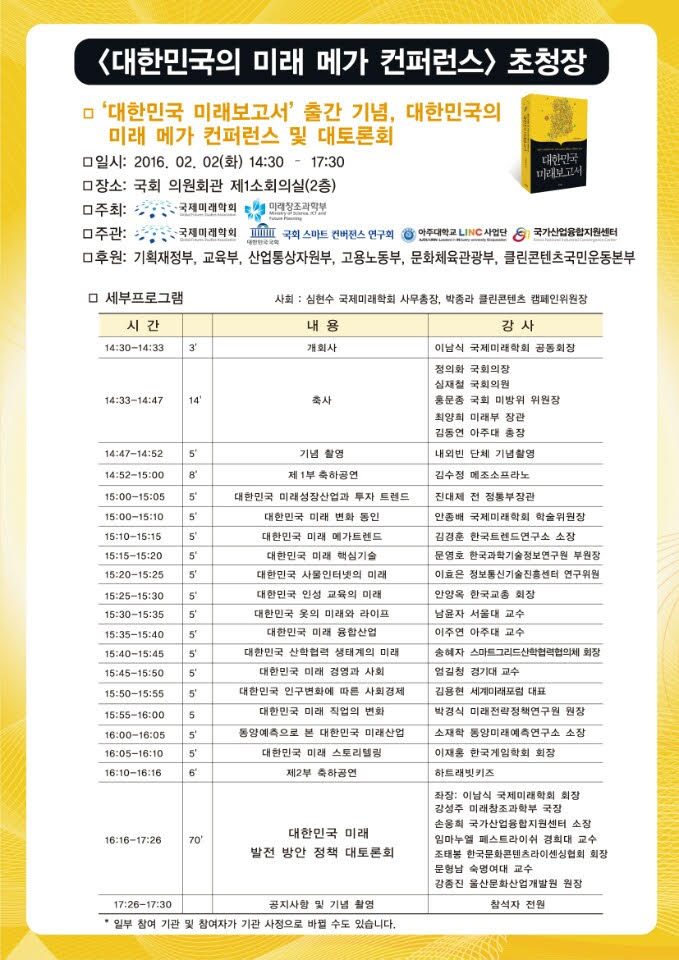
“대한민국 의 미래”
2016년 2월 2일 (화)
장소: 국회 의원회관 제1소회의실 2층
주최: 미래창조과학부
4:00-4:30
“대한민국 미래: 발전 방안 정책 대토론회”
좌장: 이남식 국제미래학회 회장
강성주 미래창조과학부 국장
손웅희 국가산업융합지원센터 소장
임마누엘 페스트라이쉬 경희대 교수
조태봉 한국문화콘텐츠라이센싱 협회 회장
문형남 숙명여대 교수
강종진 울산문화산업개발원 원장

강성주 미래창조과학부 국장
손웅희 국가산업융합지원센터 소장
임마누엘 페스트라이쉬 경희대 교수
조태봉 한국문화콘텐츠라이센싱 협회 회장
문형남 숙명여대 교수
강종진 울산문화산업개발원 원장
@
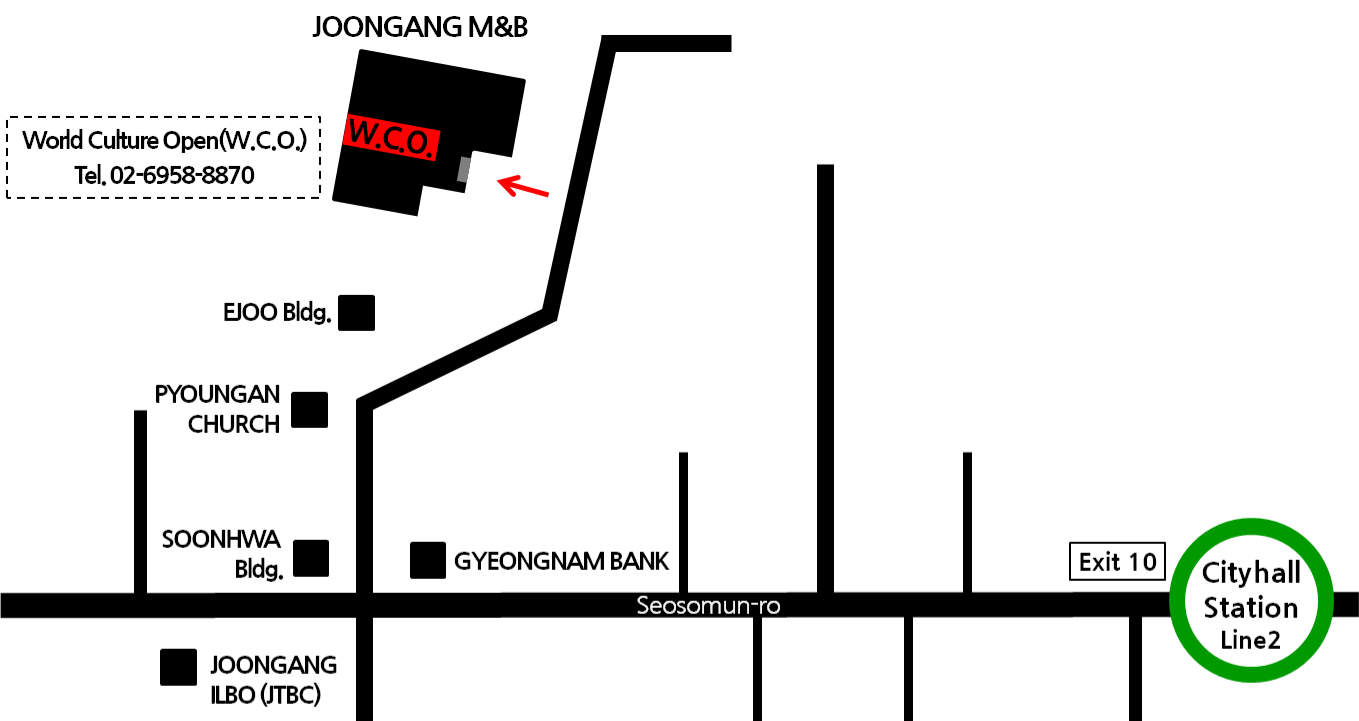
WCO Anguk
Conference Room (4th Floor)
SEE MAP BELOW
“Realistic approaches to surviving climate change: Searching for an ‘Atmosphere of Hope'”
Daniel discusses how this hyper-complex system that defines the Earth’s environment has already reached the point at which it can no longer return to its previous state. He discussed how humanity will need to make massive adjustments to live on a very different planet. Daniel will propose innovative ideas for a realistic response, with an emphasis on the recent work of Tim Flannery “Atmosphere of Hope: Searching for Solutions for the Climate Crisis.” He suggests approaches to survival that that avoid the serious risks of geo-engineering but at the same time demand serious commitments.
Daniel Garrett, senior associate at the Asia Institute, is a retired U.S. Department of State diplomat. His areas of expertise include human rights, trafficking in persons, Himalayan regional issues, climate change and international trans-boundary water issues. He is currently working to facilitate the accelerated emergence of innovative ideas and technologies that make it possible for human civilizations and their infrastructures to be seamlessly interwoven in a productive manner into the earth systems which sustain and support them.
The Asia Institute Seminar Series 2016
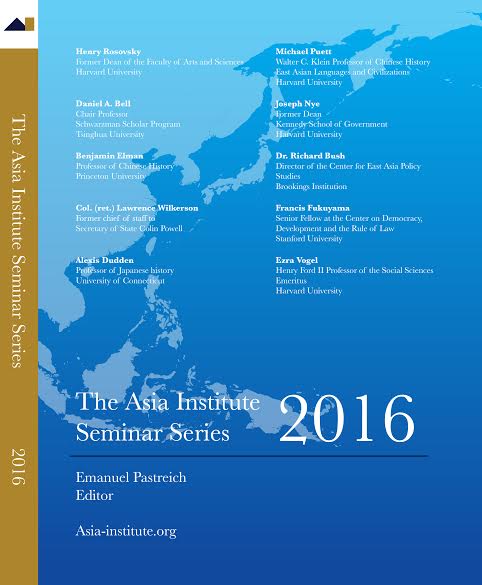
This collection of recent Asia Institute seminars on critical topics features some of the most important figures of our age. Please feel free to download a version from this page.
The Asia Institute Seminar Series
Rising tensions between China and Japan over territorial issues, combined with disputes over historical issues such as the Korean comfort women, have created a political environment that encourages military responses and confrontation. The recent nuclear test by North Korea has heightened the distrust to such a level that we can look forward to a massive arms race that will involve not only the nations of Northeast Asia, but possibly those of Southeast Asia as well.
Now is the moment for moral courage on the part of the United States. The United States, and specifically the Pacific Command, must step forward and engage in honest and practical dialog on security issues. It needs to suggest innovative, collaborative approaches to security problems, interacting with all the nations of the region in a transparent manner that encourages cooperation, not competition. We must make sure that security and defense policies are not rooted in an unimaginative and outdated Cold War conception of deterrence and containment, but rather are responses to emerging nontraditional threats.
The recent Paris Climate Conference (COP 21 Paris) has laid down concrete demands for a rapid shift to a low-carbon model for development that should serve as the basis for closer collaboration in military affairs between the United States, Japan, Korea and China, and ASEAN nations.
The Pacific Command should engage all members of the Asian community in a deep dialog about how the region’s militaries can transform military relations in the region. This transformation would take place through the military’s transitioning to play a leading role in mitigating and adapting to climate change, and it would create a new, regional, cooperative culture in the Pacific.
Interview with Dr. Bark Taeho (former minister of finance)
Professor
Seoul National University
Graduate School of International Studies
Review of the global economy in 2015 and prospects for 2016.
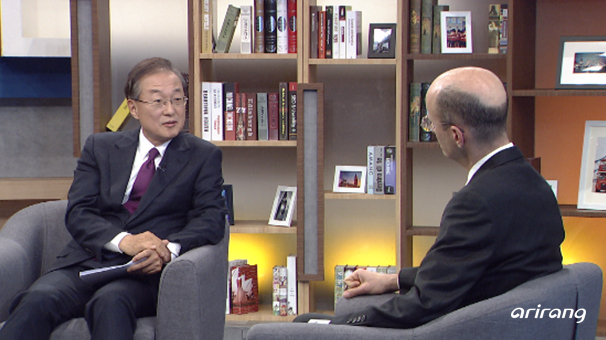
Part 1
http://www.youtube.com/watch?v=jJSv5gy4d2k
Part 2
http://www.youtube.com/watch?v=0inq6IJs0GQ
Part 3
http://www.youtube.com/watch?v=CfroU3x68eQ
Part 4
https://www.youtube.com/watch?v=UqScDDKY12Y
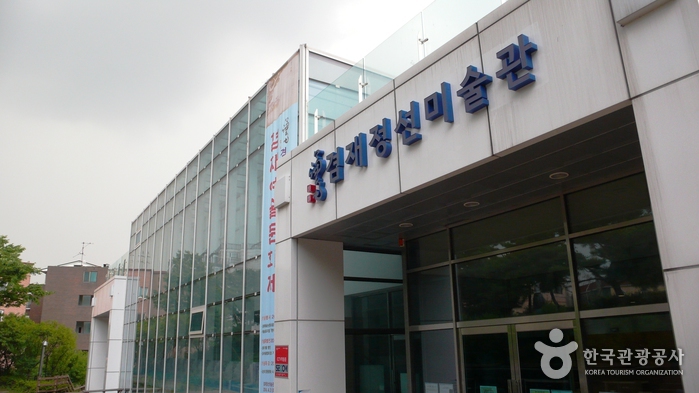
TAI Seminar
“Endless war, climate change and the refugee crisis”
November 22, 2015
The Asia Institute held a seminar today (November 22, 2015) on the topic of “Endless war, climate change and the refugee crisis” at WCO. The seminar was attended by about fifteen people and was one of the most thoughtful discussions of contemporary issues I have attended recently. The larger implications of the massive immigration to Europe we considered in depth and the seriousness of this situation for Korea was also explored.
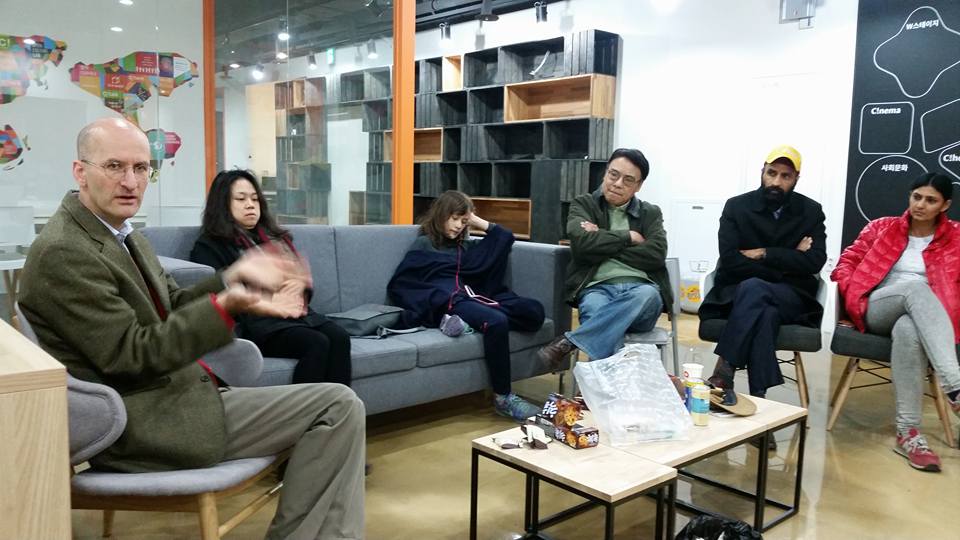
Dr. Lakhvinder Singh, a long term friend of the Asia Institute spoke of just how serious the problem of refugees and the endless wars going on has become and the relative ignorance that we find in Korea of the danger of losing the current economic situation that the country enjoys. He called on Korea to move beyond its indifference and promote a culture of peace aimed at the world saying that “Korea’s time has come.” Dr. Singh proposed that we start a peace movement here, and I asked him to organize regular seminars for us.
Yoojin Jung of the Asia Institute strived to maintain objectivity, asking that we be careful in our use of terms and avoid conflating the refugee crisis with the problem of climate change without more substantial research. Professor Choi Mulim of Seoul National University spoke at length about problems with Korean detachment from international issues and spoke forcefully about the need to move forward.
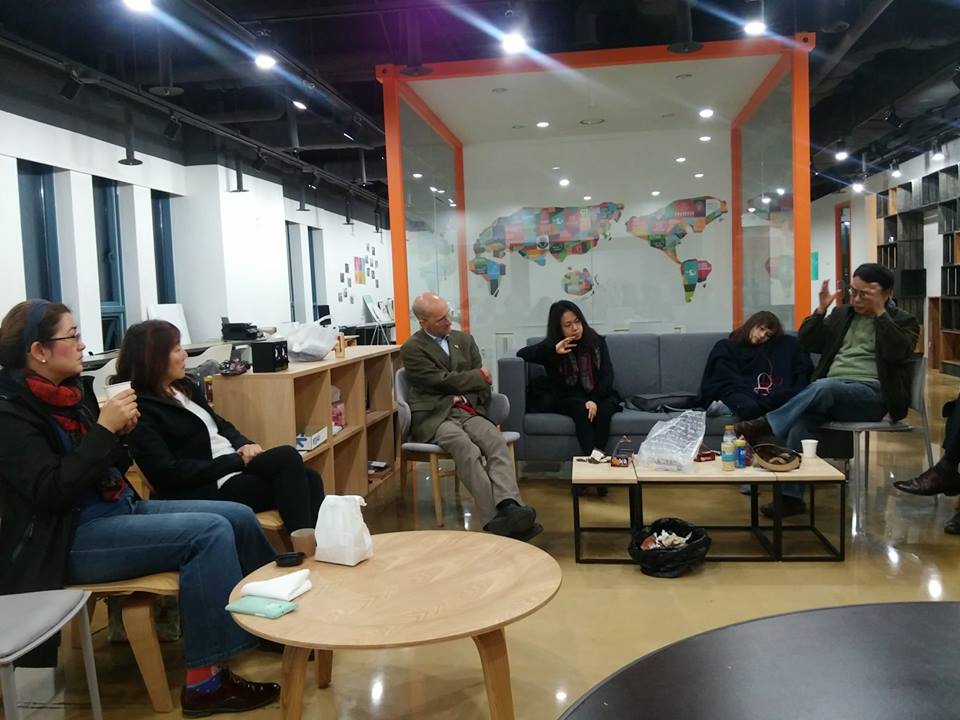
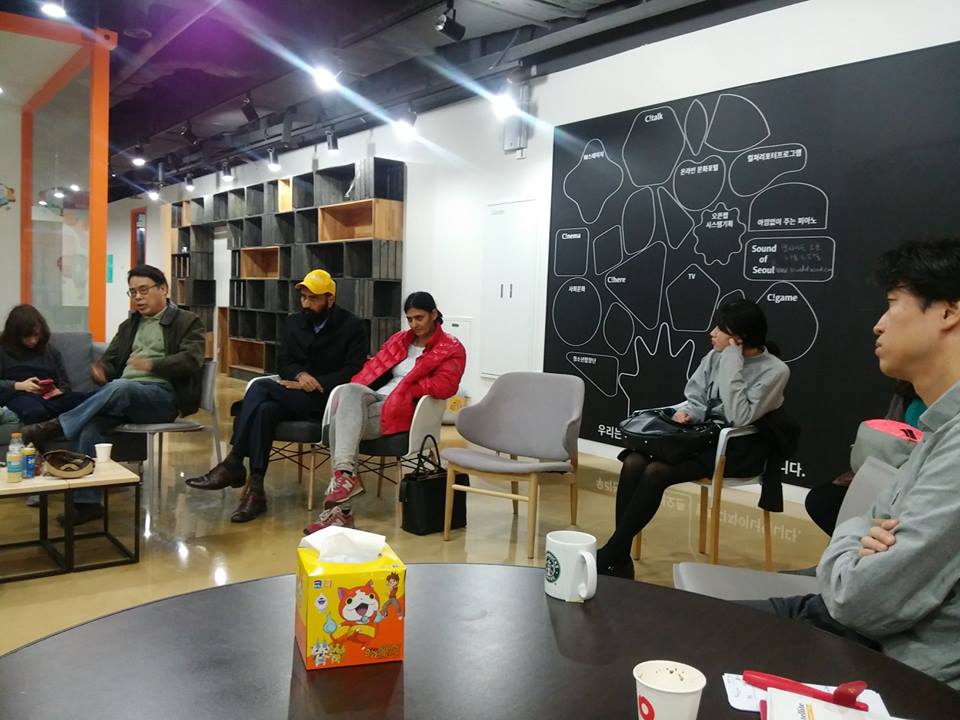
Dr. Seo Sangdae spoke about the serious risks for Europe of having such large numbers of people form an entirely different culture suddenly in their midst.
We were joined also by Pang Eunmi of the Asia Institute, Leslie Song, a political strategist from the United States, Sonja Glaeser, Professor Kim Hyungrul, chairman of the Asia Institute, and about six students from Sookmyung University who have been working on the issue of refugees with Professor Kim.

(SEE MAP)
The deadly combination of unlimited war and intensifying climate change has led to an unprecedented exodus of refugees into Europe that is causing enormous tensions. The situation may well get much worse in the months and years to come. What will we do in response to this unprecedented challenge in Korea, in Asia and around the world, and what innovative new approaches can we embrace?
Panel Chair: |
Kim Si-Seup (President, Institute of Practical Studies)김스습 이사장 실학박물관 |
| 2:00 | Don Baker (Professor, University of British Columbia)
돈 베이커 교수 브리티시컬럼비아대 아시아학과 “Finding Contentment through Composure and Harmony :Tasan’s Search for a Good Life through his Family and His Philosophy” |
| 2:45 | Emanuel Pastreich (Professor, Kyung Hee University)
임마누엘 페스트라이쉬 교수 경희대학교 국제대학 “Dasan’s views on the role of the Intellectual” |
| 3:15 | Park Seok-moo (Chairman, Dasan Research Institute)
박석무 이사장 다산연구소 “다산 정약용의 삶과 슬로라이프” “The Slow Life approach of Jeong Yak-yong” |
| 4:00 | Jung Min (Professor, Hanyang University)
정민 교수 한양대학교 국문과 다산의 증언첩을 통해 본 일상정취와 슬로라이프 “The Pleasures of Daily Life as recorded in Dasan’s ‘Word Gifts Cards’” |
| 4:40 | Kim Eonjung (Professor, Korea University)
김언종 교수 고려대학교 한문과 다산의 악연(惡緣) “The Misfortunes of Dasan” |
| Panelists: | |
| Hwang Kyung-sik (Emeritus Professor, Seoul National University)
황경식 교수 서울대학교 |
|
| Jo Jun-ho (researcher, Institute of Practical Studies)
조준호 연구원 실학박물관 |
Location:
“Climate change is not a fun party or something. And it is entirely unprecedented in human history. So it will require you to rethink everything. So if we have to be sacrificial lambs to say, “we are going to something that is unpopular.politically a mistake. Maybe we should have spent our time talking about North Korea’s nuclear program.” Well, that is the risk we will take.
Interview with “Korea and the World” about think tanks.
Think tanks have gained popularity worldwide for their role as policy advisers, and South Korea is no exception. Yet they provide research and advice to policy makers, critics have started to call into question their independence, integrity and usefulness. We spoke to one of these critics, Emanuel Pastreich, about the shortcomings and potential of think tanks.
Link to the interview: