“The Crisis in Education in Korea and the World” Asia Institute Seminar with Peter Hershock

“The Crisis in Education in Korea and the World” 

September 15, 2012

Dr. Peter Hershock
Director, Asian Studies Development Program
East-West Center
University of Hawaii, Manoa

Author of

Changing Education: Leadership, Innovation and Development in a Globalizing Asia Pacific

Emanuel Pastreich
Director
The Asia Institute


Peter Hershock:
Some of the problems we face in education are new, but many have a long history and we must consider more comprehensive changes that go beyond individual students and teachers if we want to make any headway. We have to find concrete ways of disentangling ourselves from the past, from assumptions about education that date back to the 16th century.
Emanuel Pastreich:
What exactly changed about education back in the 16th century that was the cause of problems in education today?
Peter Hershock:
How we school people today is for the most part a global system. That system may vary from place to place and its relationship with government, and with parents, also varies. The universal assumption is that education has to do with students moving through a curricula. This idea was framed originally by Peter

Read more

“Looking at Free Trade and Korea’s Position in a Globalized World ” Asia Institute Seminar with Mark Kingwell


“Looking at Free Trade and Korea’s Position in a Globalized World ”


Asia Institute Seminar with Mark Kingwell

May 10, 2012


Mark Kingwell

Professor

Department of Philosophy

University of Toronto


Emanuel Pastreich:

Free Trade agreements, especially with the United States, seem to raise very strong emotional responses in Korea. Koreans associate them with mad cow disease and undue influence of multinational corporations. And yet, oddly, trade agreements with Europe or India have not resulted in that degree of protest.

It seems many see trade liberalization, specifically the KORUS FTA with the United States, as opening the flood gates for influence by American multinational corporations and the import of unhealthy foodstuff. The import of American goods will put Koreans out of work and result in greater interference of the United States in Korea at the local level.

And yet, when it comes to trade, things are not exactly what many people think they are. Many Korean companies are themselves powerful multinationals and the balance of power between the United States and Korea, is far from obvious.

Koreans run around worrying that Americans will come in and just buy up valuable Korean companies and dominate the nation. But in fact, Korea is likely to invest far more in the United States than the United States could possibly invest in Korea over the next decade. If there is a problem in trade, it cannot be reduced to an America vs. Korea equation.


Mark Kingwell:

Some years ago, Canadians went through a similar debate concerning the North American Free Trade Agreement (NAFTA) with the United States and Mexico; but there are two significant differences between Canada’s relationship with the United States and Korea’s.  First, Canada is a resource-rich country. Our historical identity is as lumbermen and hewers of wood or drawers of water and will likely continue to determine our future, at least its immediate version, with respect to the rest of the world.  

Read more

“The Challenges of Korean Education in Historical Perspective” Asia Institute Seminar with Professor Michael Seth

Asia Institute Seminar

Interview of Michael Seth

 “The Challenges of Korean Education in Historical Perspective”

September 4, 2012


Speaker

Michael Seth

Professor

Department of History

James Madison University

Emanuel Pastreich:

Koreans are quite aware of the problems in Korean education, and yet they are having great trouble coming up with solutions to those problems.  Why is education reform so difficult?

Michael Seth:

KOreans put great emphasis on gaining and maintaining social status. Social status is not a feel-good luxury, but essential for one’s career and one’s livelihood, and that has been the case for  

Read more

“The Conditions for Engaging North Korea” Asia Institute Seminar with Jon Huntsman

“The Conditions for Engaging North Korea”

Asia Institute Seminar with Jon Huntsman

Former Governor of Utah & Republican candidate for President

9th April 2012


Jon Huntsman

American politician, businessman, and diplomat

Former United States Ambassador to the People’s Republic of China

Former Governor of Utah

Former Republican candidate for the 2012 Republican Presidential Primary


Emanuel Pastreich

Director

The Asia Institute

(Associate Professor, Kyung Hee University)

Emanuel Pastreich:

I wanted to ask you about the prospects for engagement with North Korea from your perspective as someone who has been intimately involved in the diplomatic debate concerning the future of North Korea. The question is not so much about the latest misdeed of North Korea, but rather about what the long-term prospects are. After all, if we want to solve the problem, we must move beyond the latest news cycle.

Many Koreans are confused because, on one hand there has been times of great efforts to engage with North Korea and these have been generally frustrated, and on the other hand there have been efforts to take a harder line towards North Korea at other times, and these efforts also, although they have been successful in some respects, haven’t resolved the problem either.  The question of what to do about North Korea has become a major issue in Korea today.  What do you think is the long term solution to this problem?

Jon Huntsman:

I am not sure we can find an easy answer when we are working with regime that is willing to put everything on the line in maintaining the status quo, in repressing its people with unprecedented cruelty and in saber rattling that sends tremors through the whole region.  I am one person who feels that nothing is going to happen in the short term with North Korea because we find ourselves in the middle of a transition right now and such political transitions always bring out unpredictable behavior from those in power.

Read more

“The Challenges and Opportunities in Korean Education” Asia Institute Seminar with Regina Murphy

Asia Institute Seminar 


Interview with Regina Murphy


“The Challenges and Opportunities in Korean Education”


October 1, 2012


Regina Murphy

Senior Lecturer

Education Department

St. Patrick’s College

Dublin City University

Dublin, Ireland


Emanuel Pastreich

Have you had any experience with Korea in the course of your research and your activities in education?

Regina Murphy

I was at a conference on arts education in Seoul that provided me the opportunity to learn a bit about how Korean education is approached, or at least something about the culture of those involved in education. I remember distinctly the extremely advanced audio-visual equipment that the conference centre employed and overall the Korean conference as one of the most technologically advanced and well-organized conference I have ever attended. Nevertheless, I received the distinct impression that the Koreans were not so interested in music and art education—my field of expertise.

Read more

Asia Institute Seminar with Dr. Vyjayanti Raghavan: “An Indian Perspective on the Korean Peninsula”

Asia Institute Seminar

June 2, 2012

“An Indian Perspective on the Korean Peninsula”

Dr. Vyjayanti  Raghavan

Associate Professor

Centre for Japanese, Korean and Northeast Asian Studies

Jawaharlal Nehru University


Emanuel Pastreich

How does the recent tension on the Korean Peninsula look from an Indian Perspective? India has obviously a profoundly different cultural tradition and historical experience. And yet we are quite aware of the fact that India has had any number of conflicts and disagreements over the last sixty years. After all, Pakistan and India were separated in 1947, the exact moment that the divisions between North and South Korea were forming.

Read more

Lecture on the future of Korean cities at JSB

I was invited to give a talk at JSB Incorporated, one of the most innovative companies in Seoul working on environmental design on August 30, 2012. I had a chance to speak at length with the CEO Choi Jaejung, a remarkable figure who is known for his love of art and the environment (both he and his wife are artists) and his open style of administration.

Read more

JSB도시환경 특강: “도시의 미래, 변화를 위한 방향은 무엇인가?”

2012년 8월 30일


명사 초대석

JSB도시환경

도시의 미래, 변화를 위한 방향은 무엇인가?”


경희대 후마니타스 칼리지 이만열 교수


급변하는 우리네 도시의 모습을 보면 미래 모습은 감히 상상조차 되지 않을 때가 있습니다. 그래서 이번 3/4분기 명사초대석에는 도시의 미래에 대해, 그 올바른 방향성에 대해 말씀해 주실 분을 모셨습니다.


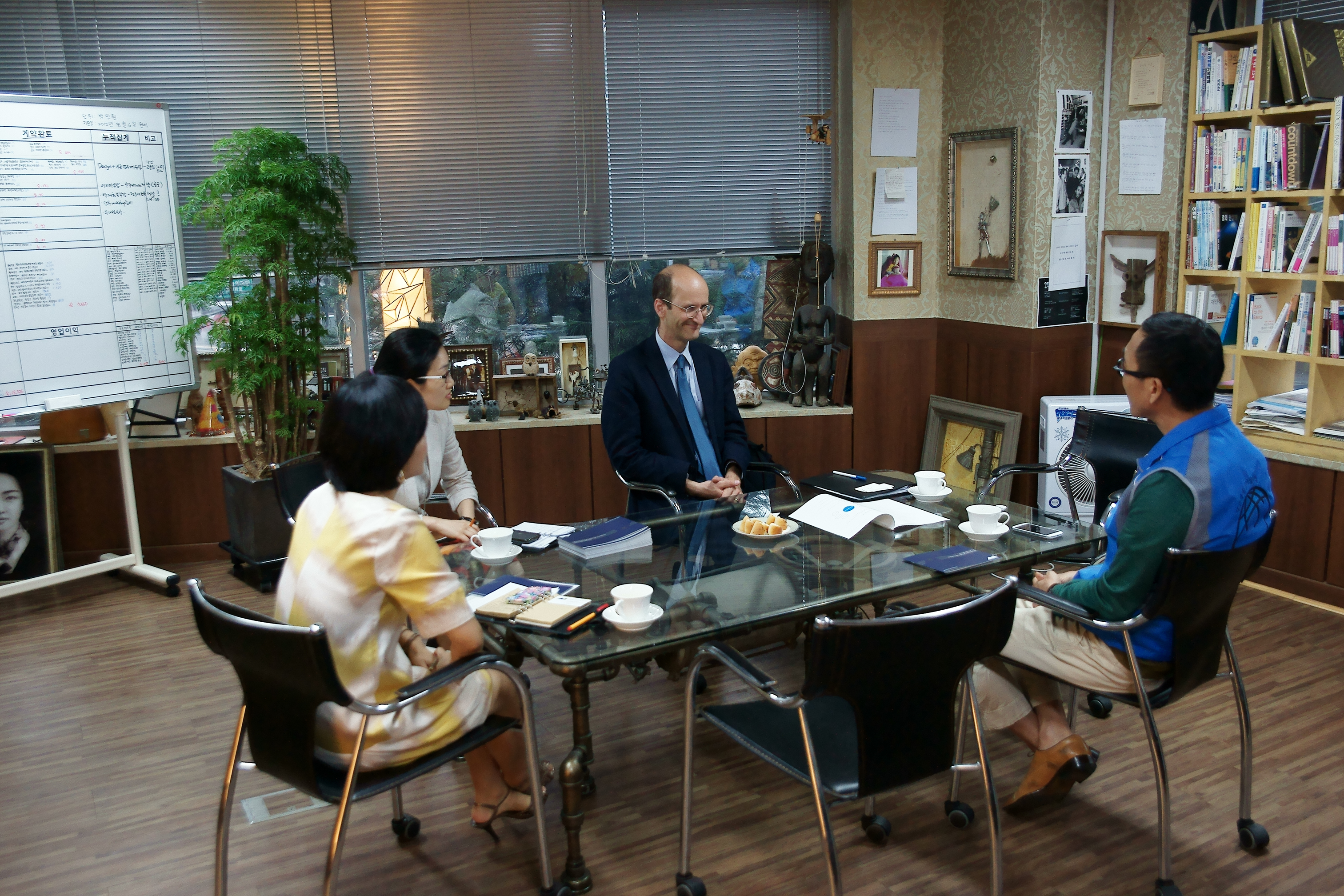
JSB도시환경 최재정 대표님 과 같이 말씀 나누는 순간

경희대 후마니타스 칼리지 이만열 교수님께서는 대만, 일본, 미국에서 유학하며 동아시아 언어와 문화에 대해 공부하셨고, 현재는 우송대학교 아시아연구소장을 겸직하며 도시의 생태·문화적 발전을 위해 다방면으로 힘쓰고 계십니다. 이번 명사초대석에서는 ‘도시의 미래, 변화를 위한 방향은 무엇인가?’라는 주제로 강의를 진행하셨습니다.

Read more

Emanuel’s talk on Networked science at the Asia Research Network’s summer seminar at Ashi no Ko in Japan

I presented a paper on Michael Nielsen’s new book: “Reinventing Discovery: The New Era of Networked Science” at the second annual summer seminar for young Asian researchers of the Asia Research Network. I have worked with the Asia Research Network informally for the last two years, but this was my first chance to see first-hand their work.

The Asia Research Network grew out of the collaboration between Professor Hara Masahiko at Riken (and Tokyo Institute of Technology) and Professor Haewon Lee of Hanyang University on nano materials. The joint research laboratory of Riken and Hanyang University in Seoul is the most significant example of sustained collaboration between Japan and Korea. Significantly, the Asia Research Network http://www.asianrn.org/ is growing rapidly and promises to be a platform for a new level of collaboration in Asia.

Read more