The Asia Institute Seminar The Fight to preserve our soil and our future: “Culture is our greatest asset”

The Asia Institute Seminar

The Fight to preserve our soil and our future: “Culture is our greatest asset”

December 20, 2012


With David Montgomery

Professor

Department of Earth and Space Sciences

University of Washington

Professor Montgomery, professor of geomorphology and topography at University of Washington and recipient of the MacArthur fellowship, has researched the impact of soil and water on civilizations over the last several thousand years. He has uncovered disturbing long-term implications of our current use of land that should cause everyone to stop and think. His book Dirt: The Erosion of Civilizations has garnered international attention for its succinct description of the value and fragility of soil, and argues that soil should be considered as a geostrategic resource. Once soil is gone, he suggests, it cannot be easily replaced, and the rate of the increase in the demand for food in the coming century will force us to consider the sustainability of agriculture to our lives.

Emanuel Pastreich

Why is it that desertification and the loss of soil does not get the attention it deserves at high-level discussions concerning the environment?

David Montgomery

Well, desertification does tend to be the forgotten issue. If we look at the areas of the world that are most venerable to climate change, there are three that immediately come to mind. One is coastal regions that are immediately impacted by rising sea levels. The second is the boreal regions where the frozen tundra that is now heating up and profoundly effecting the environment. That trend, combined with the melting of the icecaps will have deep implications for our climate. Both of these trends have received substantial attention. The third is the semi-arid regions around the world that get less attention but have the broadest impact for human settlements. Semi-arid regions are quite sensitive to climate shifts and also to even small changes in  [more] 


Centre for Women in Science, Engineering and Technology as a UNESCO Centre

The Asia Institute produces Proposal for Centre for Women in Science, Engineering and Technology as a UNESCO Category-II Centre

November 25, 2012

Emanuel Pastreich, working together with Joa Lee and the Centre for Women in Science, Engineering and Technology (WISET) prepared a proposal for the promotion of that centre to a UNESCO Category-II Centre. The report involved extensive research of policies for the encouragement of girls and women to pursue careers in the sciences that are being pursued around the world.

link to The Asia Institute note

“A new kind of scholar breaks ground in Korea” in Asia Times

The Asia Times

December 1, 2012


“A new kind of scholar breaks ground in Korea”
By Subadra Arvind

An American expat has found an odd niche in Seoul as a commentator on Korean culture, history and policy not for foreigners, but for Koreans. His name is Emanuel Pastreich, and he writes books in Korean and lectures to government and business leaders about how Korea can make full use of its remarkable assets from organic farming to traditional houses.

Pastreich is employed as a professor at Kyung Hee University and is the founder of The Asia Institute, a think tank based in Seoul. In his best-selling book, Scholars of the World Speak out about Korea, he interviewed leading intellectuals like Francis

Read more

The Problem of Introducing Korea Overseas (essay)

The Problem with how Korea is Perceived in the United States
Emanuel Pastreich
November 17, 2012

I worked at the Korean embassy in Washington D.C. for two years from 2005-2007. During that time I served as the editor-in-chief for the official magazine of the Ministry of Foreign Affairs online newspaper “Dynamic Korea” and also as the director of a think tank in the Korean Embassy, known as the “KORUS House,” that ran a very successful lecture series for diplomats, reporters, scholars and businessmen. The experience was tremendously exciting and I much enjoyed the time I spent in that wonderful little room on the fourth floor of the Culture center. There was a small window with a delightful view out over Rock Creek. It was my first time working with Koreans in a serious manner. At the time I was determined to help in the effort to make Korea better understood among policy makers in Washington D.C.

Read more

“The Moral Equivalent of War: Joining with our Chinese Neighbors to Stop the Spread of Deserts in Northeast Asia” by Ambassador Kwon Byung Hyun

This article by Ambassador Kown Byung Hyun, the founder of Future Forests, explains vividly the effort to get youth in both Korea and China involved in the enormous project of confronting the threat of desertification. Future Forests is a close partner of Asia Institute and this article presents quite well the important work that Ambassador Kwon has undertaken.


Ecocity Media

November 2, 2012

link to original article


The Moral Equivalent of War: Joining with our Chinese Neighbors to Stop the Spread of Deserts in Northeast Asia

By Ambassador Kwon Byung Hyun
Former South Korean ambassador to China
Founder & President Future Forest


It seems as if we are constantly preparing to fight the last war and completely unprepared for new challenges. But one needs only travel to the edge of the Kubuchi Desert in Inner Mongolia to see that mankind faces threats on an unprecedented scale that call our for our united action. We must use the full extent of our imagination to come up with solutions to this crisis through new global alliances that require us to completely rethink terms like “security” as we create a new civilization that can lead humans from the dark night of endless consumption to a hopeful future.

My engagement in the long-term effort to stop the spread of deserts in China started from a very distinct personal experience. When I arrived in Beijing in 1998 to serve as ambassador to China, I was greeted by the yellow dust storms. The gales that brought in the sand and dust were very powerful and it was no small shock to see Beijing’s skies preternaturally darkened. I received a phone call from my daughter the next day and she told that the Seoul sky had been covered by the same sandstorm that had blown over from China. I realized that she was talking about same storm I had just witnessed. That phone call awakened me to the crisis. I saw for the first time that we all confronted a common problem that transcends national boundaries. I saw clearly that the problem of the yellow dust I saw in Beijing was my problem, and my family’s problem. It was not just a problem for the Chinese to solve.

Read more

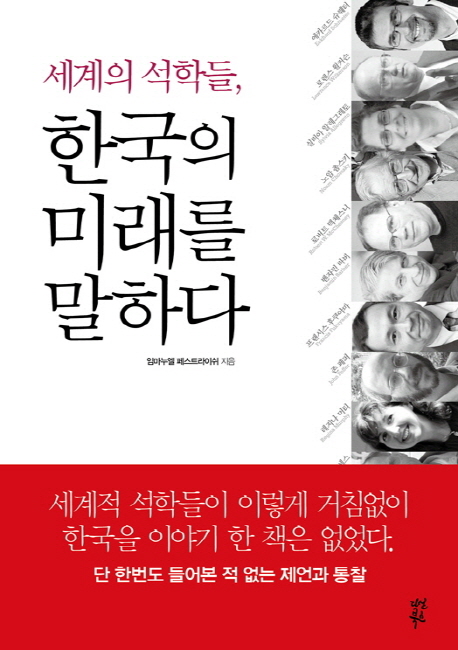
Scholars of the World Speak out about Korea’s Future from Dasan Books

Scholars of the World Speak out about Korea’s Future
Dasan Books
October, 2012
Edited by Emanuel Pastreich

Scholars of the World Speak out about Korea’s Future is a book in Korean language that presents the insights of distinguished scholars from around the world concerning contemporary issues in Korean politics, society and the economy. Released six weeks before the Korean national election, it treats issues such as education, social welfare, populism and North Korea that have been raised in the course of the campaign.
For the first time, a group of international experts present their views about the specifics of Korean society and the relationship of Korean domestic issues to larger global trends. Emanuel Pastreich, associate professor at Kyung Hee University and director of the Asia Institute, interviewed Benjamin Barber, Noam Chomsky, Francis Fukuyama, Lawrence Wilkerson and other important figures in an effort to give Korean readers an insights into how the problems they are faced are linked to larger global trends.

Read more

Upcoming Asia Institute Seminar: “Approaches to the Resolution of Conflict The Role of the Global Civil Society in Constructing a Peaceful Community” November 2, 2012


GCS and Asia Institute

International Peace Seminar to Commemorate

The 31st Anniversary of the UN International Day of Peace


Friday, November 2

10 AM – 12 PM


Topic:

“Approaches to the Resolution of Conflict

The Role of the Global Civil Society in Constructing a Peaceful Community”


The world faces a remarkable number of conflicts today that call for a global effort to bring about long-term resolution.  GCS (Global Common Society) and the Asia Institute have undertaken a concerted effort to identify effective strategies for engaging a variety of stakeholders through work with NGOs and educational institutions to lay the foundations for long-term engagement.  In commemoration of the 31st Anniversary of the UN International Day of Peace, GCS and the Asia Institute will hold a seminar to discuss how the global civil society create the precedents for a global culture that promotes peace.

Introductory remarks: Mr. Charles Cho, Executive Director of GCS

Moderator: Mr. Charles Cho, Executive Director of GCS

Speaker:

Emanuel Pastreich

Director of the Asia Institute

“The Problem with Islands: Strategies for addressing the Sengak-Diaoyu Islands Issue through Education and NGO cooperation”

Speaker:

Baeksoon Lee

Director-General

Ministry of Foreign Affairs and Trade

“Korea’s role in promoting peace”

Speaker:

Lakhvinder Singh, Ph.D.

President of the Indo-Korea Policy Forum

“India’s innovations in encouraging peace and conflict resolution”

Date: Friday, November 2


Time: 10 AM – 12 PM


Location:


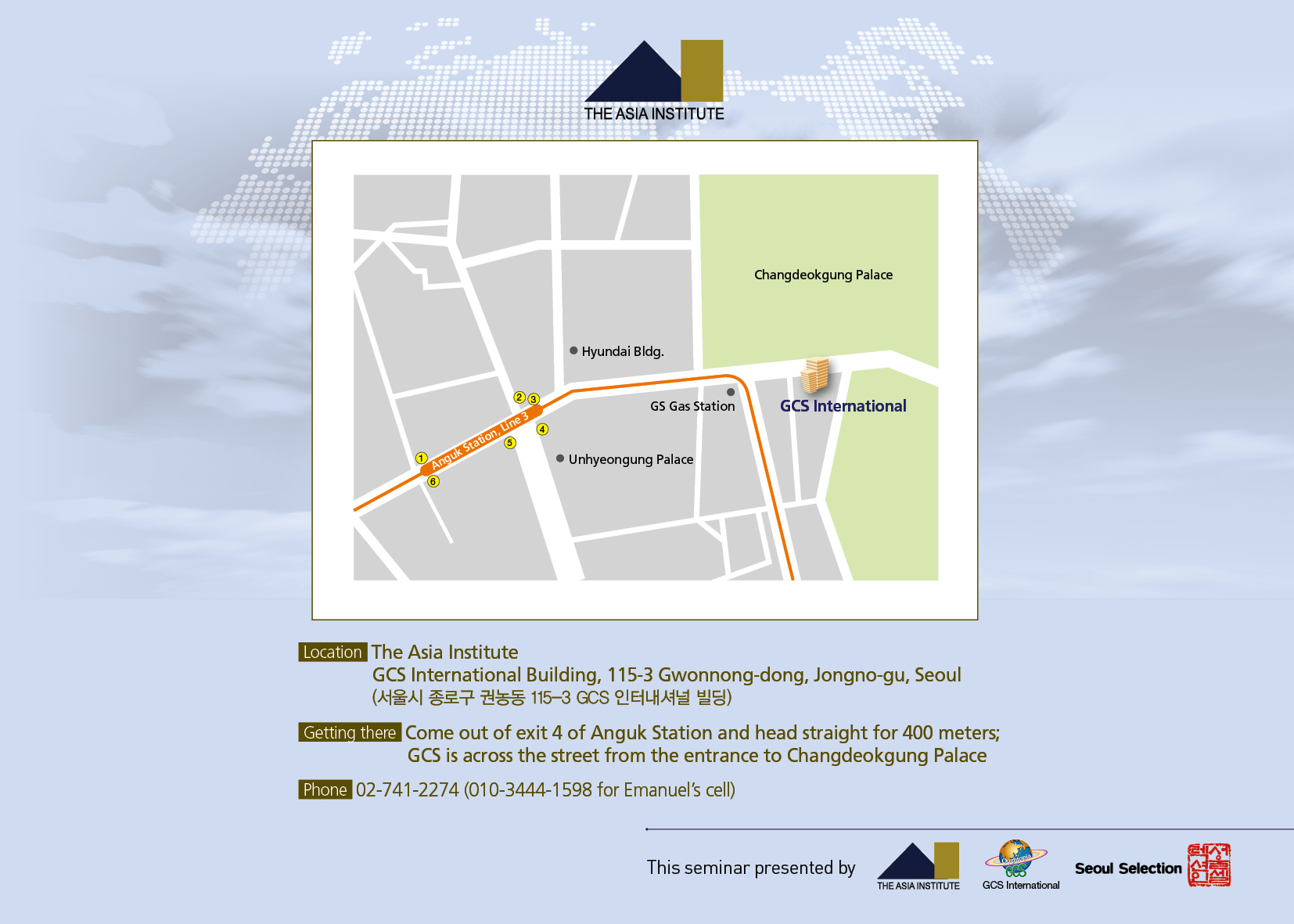
The Asia Institute and GCS International Headquarters

GCS International Building

115-3 Gwonnong-dong, Jongno-gu, Seoul

02 741 2274