End of the Republic and the beginning of the empire

The time has come for people to start to get over their shock and assess the United States as what it has become, not what we want it to be.

You may have noticed that despite all the noise in the media, not a single a politician has drafted articles of impeachment against Donald Trump, despite multiple illegal actions.

They are not doing anything at all. Congress is just a show. No action. The congress has become an institution like the Queen of England, an elegant historical relic.

And the State Department, which once played such an important role, now has been permanently stripped of ambassadors, and lies there like a castrated gazelle.

What has happened? Well, the great scholar Chalmers Johnson predicted all this a long time ago. He said it was the end of the Republic and the beginning of the empire.  He predicted exactly this.


The problem is not really about Trump at all:


Chalmers Johnson wrote:


The collapse of the Roman republic in 27 BC has significance today for the United States, which took many of its key political principles from its ancient predecessor. Separation of powers, checks and balances, government in accordance with constitutional law, a toleration of slavery, fixed terms in office, all these ideas were influenced by Roman precedents. John Adams and his son John Quincy Adams often read the great Roman political philosopher Cicero and spoke of him as an inspiration to them. Alexander Hamilton, James Madison, and John Jay, authors of the Federalist Papers, writing in favor of ratification of the Constitution signed their articles with the name Publius Valerius Publicola, the first consul of the Roman republic.

The Roman republic, however, failed to adjust to the unintended consequences of its imperialism, leading to a drastic alteration in its form of government. The militarism that inescapably accompanied Rome’s imperial projects slowly undermined its constitution as well as the very considerable political and human rights its citizens enjoyed. The American republic, of course, has not yet collapsed; it is just under considerable strain as the imperial presidency — and its supporting military legions — undermine Congress and the courts. However, the Roman outcome — turning over power to an autocracy backed by military force and welcomed by ordinary citizens because it seemed to bring stability — suggests what might happen in the years after Bush and his neoconservatives are thrown out of office.

Read more

“Letter to Ban Ki-Moon from the midst of the gathering darkness” (Kyunghyang Shinmun January 26, 2017)

 Kyunghyang Shinmun

“Letter to Ban Ki-Moon from the midst of the gathering darkness”

January 26, 2017


Emanuel Pastreich

I know that many have approached you about the possibility of your serving as president of Korea after the anticipated impeachment of President Park. You have a unique set of skills and a broad range of friends in the international community that would serve you well. Today, you are surrounded by people asking for your help in this moment of tremendous uncertainty in Korea. But I hope that you have a moment to step back from the crowd and contemplate your role in history now that you have become such a critical figure.

There are several people out there who are entirely capable of serving as the president of the Republic of Korea. But there is an even more critical job, and you are the only one who is qualified to play that role as the former Secretary General of the United Nations.

Last week Donald Trump was sworn in as the president of the United States, someone who has openly opposed a commitment to universal standards on human rights and who has taken as a central advisor John Bolton, a man who is committed to taking the entire United Nations system apart. In addition, President Trump has nominated for secretary of state Rex Tillerton,  the former CEO of EXXON, , a man who has no interest in the response to climate change and who has advocated that the United States move to stop all Chinese actions in the South China Seas—an act that many experts think could lead to nuclear war.

The scale of the geopolitical crisis today cannot be overstated and Korea, located at the center of Northeast Asia, with close ties to both the United States and to China, will be one of the first victims of such a new cold war, or hot war. Korea needs you, and your network, to start an entirely original and powerful initiative that will offer an alternative to military conflict, get the focus back to climate change, and set the foundations for long term solution to address this crisis head using a coalition of the committed throughout the region.

Read more

Asia Today

The Korea that can say “No”

 January 27, 2017

Emanuel Pastreich


Back in the 1989 the Japanese conservative politician Ishihara Shintaro wrote a best seller entitled The Japan that can say “No” in which he argued that Japan was punching beneath its weight. He imagined a self-confident Japan that was capable of refusing unreasonable demands from the United States and maintained a healthy equal relationship.

Ishihara is a cynical right-wing politician, but there is something of real relevance for the Republic of Korea today in his words.

The rise of the Trump administration means that Korea must be able to say “no.”

Members of Trump administration has made hostile statements about China that are so out of line with American policy, and so provocative, that Korea cannot have anything to do with its actions.

Read more

“Peer-to-Peer Science: The Century-Long Challenge to Respond to Fukushima” (Foreign Policy in Focus September 3, 2013)

Foreign Policy in Focus

“Peer-to-Peer Science: The Century-Long Challenge to Respond to Fukushima”

September 3, 2013.

Emanuel Pastreich

(with Layne Hartsell)


More than two years after an earthquake and tsunami wreaked havoc on a Japanese power plant, the Fukushima nuclear disaster is one of the most serious threats to public health in the Asia-Pacific, and the worst case of nuclear contamination the world has ever seen. Radiation continues to leak from the crippled Fukushima Daiichi site into groundwater, threatening to contaminate the entire Pacific Ocean. The cleanup will require an unprecedented global effort.

Initially, the leaked radioactive materials consisted of cesium-137 and 134, and to a lesser degree iodine-131. Of these, the real long-term threat comes from cesium-137, which is easily absorbed into bodily tissue—and its half-life of 30 years means it will be a threat for decades to come. Recent measurements indicate that escaping water also has increasing levels of strontium-90, a far more dangerous radioactive material than cesium. Strontium-90 mimics calcium and is readily absorbed into the bones of humans and animals.

The Tokyo Electric Power Company (TEPCO) recently announced that it lacks the expertise to effectively control the flow of radiation into groundwater and seawater and is seeking help from the Japanese government. TEPCO has proposed setting up a subterranean barrier around the plant by freezing the ground, thereby preventing radioactive water from eventually leaking into the ocean—an approach that has never before been attempted in a case of massive radiation leakage. TEPCO has also proposed erecting additional walls now that the existing wall has been overwhelmed by the approximately 400 tons per day of water flowing into the power plant.

But even if these proposals were to succeed, they would not constitute a long-term solution.

A New Space Race

Solving the Fukushima Daiichi crisis needs to be considered a challenge akin to putting a person on the moon in the 1960s. This complex technological feat will require focused attention and the concentration of tremendous resources over decades. But this time the effort must be international, as the situation potentially puts the health of hundreds of millions at risk. The long-term solution to this crisis deserves at least as much attention from government and industry as do nuclear proliferation, terrorism, the economy, and crime.

To solve the Fukushima Daiichi problem will require enlisting the best and the brightest to come up with a long-term plan to be implemented over the next century. Experts from around the world need to contribute their insights and ideas. They should come from diverse fields—engineering, biology, demographics, agriculture, philosophy, history, art, urban design, and more. They will need to work together at multiple levels to develop a comprehensive assessment of how to rebuild communities, resettle people, control the leakage of radiation, dispose safely of the contaminated water and soil, and contain the radiation. They will also need to find ways to completely dismantle the damaged reactor, although that challenge may require technologies not available until decades from now.

Such a plan will require the development of unprecedented technologies, such as robots that can function in highly radioactive environments. This project might capture the imagination of innovators in the robotics world and give a civilian application to existing military technology. Improved robot technology would prevent the tragic scenes of old people and others volunteering to enter into the reactors at the risk of their own wellbeing.

The Fukushima disaster is a crisis for all of humanity, but it is a crisis that can serve as an opportunity to construct global networks for unprecedented collaboration. Groups or teams aided by sophisticated computer technology can start to break down into workable pieces the immense problems resulting from the ongoing spillage. Then experts can come back with the best recommendations and a concrete plan for action. The effort can draw on the precedents of the Intergovernmental Panel on Climate Change, but it must go far further.

In his book Reinventing Discovery: The New Era of Networked Science, Michael Nielsen describes principles of networked science that can be applied on an unprecedented scale. The breakthroughs that come from this effort can also be used for other long-term programs such as the cleanup of the BP Deepwater Horizon oil spill in the Gulf of Mexico or the global response to climate change. The collaborative research regarding Fukushima should take place on a very large scale, larger than the sequencing of the human genome or the maintenance of the Large Hadron Collider.

Finally, there is an opportunity to entirely reinvent the field of public diplomacy in response to this crisis. Public diplomacy can move from a somewhat ambiguous effort by national governments to repackage their messaging to a serious forum for debate and action on international issues. As public diplomacy matures through the experience of Fukushima, we can devise new strategies for bringing together hundreds of thousands of people around the world to respond to mutual threats. Taking a clue from networked science, public diplomacy could serve as a platform for serious, long-term international collaboration on critical topics such as poverty, renewable energy, and pollution control.

Similarly, this crisis could serve as the impetus to make social networking do what it was supposed to do: help people combine their expertise to solve common problems. Social media could be used not as a means of exchanging photographs of lattes and overfed cats, but rather as an effective means of assessing the accuracy of information, exchanging opinions between experts, forming a general consensus, and enabling civil society to participate directly in governance. With the introduction into the social media platform of adequate peer review—such as that advocated by the Peer-to-Peer Foundation (P2P)—social media can play a central role in addressing the Fukushima crisis and responding to it. As a leader in the P2P movement, Michel Bauwens, suggests in an email, “peers are already converging in their use of knowledge around the world, even in manufacturing at the level of computers, cars, and heavy equipment.”

Here we may find the answer to the Fukushima conundrum: open the problem up to the whole world.

Peer-to-Peer Science

Making Fukushima a global project that seriously engages both experts and common citizens in the millions, or tens of millions, could give some hope to the world after two and a half years of lies, half-truths, and concerted efforts to avoid responsibility on the part of the Japanese government and international institutions. If concerned citizens in all countries were to pore through the data and offer their suggestions online, there could be a new level of transparency in the decision-making process and a flourishing of invaluable insights.

There is no reason why detailed information on radiation emissions and the state of the reactors should not be publicly available in enough detail to satisfy the curiosity of a trained nuclear engineer. If the question of what to do next comes down to the consensus of millions of concerned citizens engaged in trying to solve the problem, we will have a strong alternative to the secrecy that has dominated so far. Could our cooperation on the solution to Fukushima be an imperative to move beyond the existing barriers to our collective intelligence posed by national borders, corporate ownership, and intellectual property concerns?

A project to classify stars throughout the university has demonstrated that if tasks are carefully broken up, it is possible for laypeople to play a critical role in solving technical problems. In the case of Galaxy Zoo, anyone who is interested can qualify to go online and classify different kinds of stars situated in distant galaxies and enter the information into a database. It’s all part of a massive effort to expand our knowledge of the universe, which has been immensely successful and demonstrated that there are aspects of scientific analysis that does not require a Ph.D. In the case of Fukushima, if an ordinary person examines satellite photographs online every day, he or she can become more adept than a professor in identifying unusual flows carrying radioactive materials. There is a massive amount of information that requires analysis related to Fukushima, and at present most of it goes virtually unanalyzed.

An effective response to Fukushima needs to accommodate both general and specific perspectives. It will initially require a careful and sophisticated setting of priorities. We can then set up convergence groups that, aided by advanced computation and careful efforts at multidisciplinary integration, could respond to crises and challenges with great effectiveness. Convergence groups can also serve as a bridge between the expert and the layperson, encouraging a critical continuing education about science and society.

Responding to Fukushima is as much about educating ordinary people about science as it is about gathering together highly paid experts. It is useless for experts to come up with novel solutions if they cannot implement them. But implementation can only come about if the population as a whole has a deeper understanding of the issues. Large-scale networked science efforts that are inclusive will make sure that no segments of society are left out.

If the familiar players (NGOs, central governments, corporations, and financial institutions) are unable to address the unprecedented crises facing humanity, we must find ways to build social networks, not only as a means to come up with innovative concepts, but also to promote and implement the resulting solutions. That process includes pressuring institutions to act. We need to use true innovation to pave the way to an effective application of science and technology to the needs of civil society. There is no better place to start than the I

Read more

“소비주의•퇴폐주의, 현대인은 수치심을 잃어버렸다” (아시아튜데이 2017년 1월 16일)

아시아튜데이

“소비주의•퇴폐주의, 현대인은 수치심을 잃어버렸다”

2017년 1월 16일

임마누엘 페스트라이쉬


대부분의 한국인들은 주자학 전통이 내세우는 엄격한 개인의 도덕적 규범, 교육의 역할에 대한 확증, 그리고 공직에 대한 헌신이 20세기 한국의 근대화를 가로막았고, 창조성을 억압하여 융통성 없는 남성중심의 가부장 사회가 되는데 일조했다고 여긴다. 이 또한 조선 후기에 유입되어 강점기 시대에 변질된 주자학 전통의 일부일 수 있다. 그러나 현재 한국이 가진 장점 중 많은 부분이 주자학 전통에서 비롯되었다는 것을 보여주는 사례가 많이 있다. 특히 세종대왕에서 다산 정약용에 이르기까지 대한민국이 훌륭한 인재를 배출할 수 있었던 배경에는 올바른 거버넌스 (governance, 조직 운용)와 교육, 그리고 도덕적 책무감이 있었다.

주자학은 중국 송나라(1127-1279) 시대의 학자 주희 (1130-1200) 가 설립한 철학 체계를 이르는 말로, 이는 이후 중국과 조선 왕조 건국의 기반이 됐다. 주자학은 형이상학과 인식학을 합성한 접근법으로, 자연세계와 통치 세계 그리고 윤리 영역을 포용하는 세계관을 창조하기 위해 초기 유교의 가르침과 불교의 형이상학적 용어를 결합한 것이다. 주자학의 세계관은 실질적으로 조선시대(1392-1911)에 행해진 거의 모든 정규교육의 토대가 됐다.

어쩌면 지난 100년 동안 동아시아의 가장 큰 실패는 현시대 정책과 거버넌스, 교육, 도덕성과 법에 대한 논의를 위대한 주자학 전통에 비추어 재해석할 수 없었던 우리의 무능에 있었다고도 볼 수 있다. 주자학 자체가 역사교과서의 몇 줄에 불과할 정도로 대한민국에서 일반적인 교육을 받은 이들에게 크게 노출이 되지 않다 보니 주자학 전통은 한국의 근대화를 가로막고 우리가 서구화되고 발전된 환경을 위해 극복해야만 하는 엄격하고 유연하지 못한 유교적 사회질서로 연관되곤 한다

이 잘못된 믿음은 근대화의 ‘실패’가 조선이 일제의 식민지가 된 주된 원인이자 주자학 전통이 한국의 최대약점으로 여겨지는 한국에서 막강한 힘을 발휘하곤 한다. 주된 내용은 주자학 전통이었던 추상적 이론과 원칙, 그리고 조상들의 가르침에 대한 맹목적 충성에 사로잡힌 양반들의 실수로 한국은 서구문물을 받아들이지 못하고, 이는 곧 근대화 실패의 계기가 되었다는 것이다.

조선시대 양반은 주자학 전통이라는 모호한 학문으로부터 만들어진 자아와 사회에 대한 추상적 이론과 비현실적인 사고에 사로잡혀있었다고 주장되고 있다. 즉, 양반들은 ‘덕’과 ‘효’에 대한 주자학의 고지식한 추상적 관념에만 관심을 기울였을 뿐, 더 이상 국가를 다스리는데 필요한 노하우나 국민들의 삶을 개선하는데 필요한 기술에 관심을 두지 않고 실용학문의 중요성을 간과했습니다. 그들은 종일 책을 읽으며 사회에는 전혀 기여하지 않았다는 것이다. 그리고 그들로 인해 한국은 근대화에 뒤쳐졌으며 안타깝게도 일제강점기 이후에야 서구과학이 도입되고 실질적인 국가성장을 시작할 수 있었다는 것이다.

이런 잘못된 믿음은 ‘서양의 문화와 기관, 즉 17세기 유럽에서부터 이어져온 거버넌스의 배경철학, 윤리, 그리고 과학과 논리에 대한 접근방식이 곧 우월한 전통이자 근대성의 유일무이한 조상이며, 문명화로 향하는 필수적이고 긍정적인 단계이다’라는 가정이 뒷받침한다. 이 주장은 (18세기 이후) 기계공학이나 (19세기 이후) 의학분야의 경우 어느 정도 근거가 있다고는 하지만 전반적으로 한중일 3국은 18세기 이전에 훨씬 더 복잡미묘한 공공 분야가 있었으며 유럽보다 훨씬 더 평화롭고 훌륭하게 광범위한 분야의 지식인을 정책과정에 참여시켰다. 또한 문해력에 대한 가치가 더 높았고 19세기 이전 문맹률은 유럽보다 동아시아가 더 높았다.

오늘날의 문제와 맞서다

오늘날 우리가 맞서야 하는 문제는 오히려 주자학 전통에서 발견한 소중한 지혜를 오늘날의 사회, 즉 소비와 충동적인 욕망으로 얼룩진 지속불가능하고 근시안적이며 인간의 공통된 미래에 대한 비전이 없는 사회에 적용하는 것이다. 이 일은 오늘날 냉엄한 현실의 두 가지 문제점으로 더 시급해지고 있다.

첫 번째 문제는 서양 전통의 도덕적 와해다. 만약 서양의 고급기술과 정교한 관리기관이 문화제도에 대해 아시아 수준으로 심도 있게 재고했더라면, 오늘날의 환경은 완전히 달랐을 것이다.

서방이 만들어낸 극단적 보수주의는 문화나 과학 또는 윤리적 규범에 관심을 두고 있지 않으며, 비합리적이며 반과학적이다. 이 새로운 문화를 가장 잘 드러내는 대표적인 예가 미국의 도널드 트럼프 행정부와 거버넌스를 하기 위한 이들의 근시안적이고 본능에 호소하는 저속한 접근방식이다. 오히려 서구문명은 점점 급진적인 소비문화와 세계전쟁, 그리고 더 진부하고 추상적인 표현문화와 가까워지고 있다. 학교에서 우리는 19세기에 한중일이 근대화에 실패했고 프랑스와 영국, 독일은 급속도로 성장했다고 배웠지만 현재 서구 문명은 아시아에 비해 더 의문스럽고 잔인하고 야만적이다.

지속가능성과 환경보전을 강조하며 미래를 생각하는 새로운 문명의 가능성은 오히려 아시아에서 찾을 수 있다. 그리고 무엇보다 주자학 전통에서 유념, 윤리와 거버넌스가 가장 정교하게 결합돼 있다.

우리는 재해석된 주자학 전통이 현대 정치에 막대한 피해를 입힌 오늘날의 위태로운 거버넌스와 극단주의를 해결할 수 있는 공무원심사제도를 통해 거버넌스에 대한 새로운 접근방식을 제안하여 서방 사회가 활력을 찾을 수 있는 세상을 상상해볼 수 있다.

현대 사회는 정신적 황폐에 빠져있다. 우리가 살고 있는 공간은 영혼에 공허함을 주어 우리를 생각 없는 소비주의로 이끈다. 이 극심한 위기는 우리가 하는 사회개혁의 노력을 위축시키고 불가피하게 끔찍한 모순을 낳게 하고 있다. 그 이유는 우리는 사회정책에 관하여 단지 기술적이고 관료적인 해결책을 제시할 수 있을 뿐, 정신적인 문제를 해결할 수는 없기 때문이다. 안타깝게도 오늘날 관리와 거버넌스에 대한 논의는 진부한 ‘혁신’과 ‘리더십’에 대한 이야기로 되어있고, 이는 현실과 관련이 없고 이 시대의 심리적, 정신적 문제를 해결할 수도 없다.

주자학은 정신적 계발에 초점을 맞추고 있으나 종교가 아닌 거버넌스와 실질적 행정 문제를 다룬다. 이것이 현 시대에 필요한 이유는 방종하고 세속적인 근대종교를 멀리할 수 있기 때문이다. 주자학은 배타적이지 않다. (타 종교나 철학적 신념을 버릴 것을 강요하지 않는다). 오히려 오늘날 잘못 분리되어 있는 실천과 정신적인 인식, 개인 윤리와 훌륭한 정부를 하나로 화합하고 있다. 이러한 전통은 우리 시대에 꼭 필요한 측면이다. 이는 우리가 반드시 우리 삶에 미치는 사회 변화의 심적, 정신적 영향을 해결하기 위해 노력해야 하기 때문이다. 하지만 현대사회의 다양성으로 인해 논쟁이 종교적으로 치닫지 않게 해야 한다.

주자학 전통은 거버넌스 뿐만 아니라 도덕성의 문제와 직접적으로 연관된 인간 경험의 심적, 정신적 측면에 대한 보다 솔직한 논의에 대한 가능성을 열어준다. 주자학은 거버넌스 또는 인간 관계가 단순히 효율성이나 재주의 문제가 아닌 정부를 운영하고, 가계를 운영하고, 사회관계가 발전하는 방식으로 보기 때문에 항상 윤리적인 문제이자 한 체제의 구성원 모두가 서로에게 하는 약속을 수반하게 된다. 유교 체제에서 일방적인 행동은 없다.

주자학 전통은 우리 사회를 변화시키고 있는 급속한 기술의 발전에 적용할 수 있는 여러 가치가 깃들어 있다. 우리는 기술이 얼마나 세상을 변화시켰는지조차 모르고 있다. 왜냐하면 기술의 진화는 우리가 인지하는 방식 그 자체에 영향을 미치고 기술은 사회의 기초적인 부분에 영향을 미치기 때문에 그것을 느끼지 못할 뿐이다. 세상을 효과적으로 이해하려면 모든 현상의 밑바탕이 되는 원리의 형이상학을 인식해야 한다. 주자학 전통은 어쩌면, 비록 필자가 이 문제에 대해 심도 있게 다뤄보진 않았지만, 인류사회가 기술 진화에 적절히 대처하고 인류사회의 미래를 위한 다른 어떤 전통보다 높은 차원의 장기적 계획수립에 필요한 체계를 포함하고 있을지도 모른다.

우리가 텔레비전과 인터넷에서 재현되는 시각적 이미지가 눈에 보이지 않는 기본 원칙이나 형이상학적 존재보다 점점 더 많은 중요성과 영향력을 행사하는 시대, 이른바 디지털 시대에 살고 있다. 우리는 피상적인 이해만으로 세상을 인식하는 함정에 갇혀 있으며 우리의 인식지평은 디지털 혁명으로 인해 2차원적인 세계가 되어가고 있다. 이런 우리에게 가장 부족한 것은 눈으로 보는 모든 현상 뒤에 있는 형이상학 존재를 가늠하는 지혜다.

주자학 전통은 현대사회의 이런 결함을 짚어 효과적으로 다루고 있다. 눈에 보이는 사물 반대편에 서서 세상이 돌아가는 근본원칙을 파악하는 것, 바로 이것이 오늘날 우리가 절대적으로 필요하다. 겉모습이 절대적인 시대에서 통찰력은 아주 중요하다.

분명히 주자학 전통은 우리가 세상을 인식하는 방식에 대한 추상적이고 형이상학적 분석함과 동시에 우리의 몸과 마음을 단련하여 한 차원 더 높은 깨우침을 얻을 수 있는 해결책을 제시한다. 기술의 진화는 현실세계의 이미지를 혼란 시켜 현대 사회를 혼돈에 빠뜨렸고 우리는 추상적인 원칙 대신 보여지는 이미지에 치우치는 안 좋은 습관을 만들게 됐다. 우리가 전례 없는 문제들에 대응할 수 있는 새로운 원칙과 정책을 만들고자 한다면 주자학 전통은 우리에게 쉽게 적용할 수 있는 가르침을 많이 전해 줄 수 있다.

퇴폐주의의 도전 

진실을 직면하자. 현대 사회가 직면한 가장 큰 위협은 테러리즘도 아니고 경제 침체도 아니며 특정 정치인들의 행동도 아니다. 최대 위협은 바로 우리 문화에 확산된 퇴폐주의다. 오늘날 개인은 국가의 미래에 대해 별로 염려하지 않는다. 현대인은 음식, 음주, 성적 쾌락, 휴가와 스포츠를 무분별하게 탐닉한다. 삶의 목표는 순간적인 쾌락이 되어버렸고 희생이란 가치는 잊혀졌다. 이것이 전형적인 퇴폐주의다.

안타깝게도, 시장 수요를 창출하기 위한 잘못된 노력의 일환으로, 우리는 인간의 원시적인 욕구를 불러일으켰고 젊은이들에게 욕망을 멋진 경험으로 위장했다. 우리는 전통적 유교사상이 주장하는 합리성과 자제력, 그리고 마음가짐을 한 마리의 풀어놓은 짐승으로 대체했다.

텔레비전 속 사람들은 아무 생각 없이 입안으로 많은 음식을 꾸역꾸역 먹어대고 있고, 수많은 광고에는 불과 20년 전만 하더라도 포르노그래피로 금지되었을 만한 야한 옷을 입은 여자들이 나온다.

이는 제품을 판매하는 전략일 수 있지만, 모든 분야의 거버넌스를 저해하는 도의의 퇴폐를 불러일으킨다. 결과적으로 정책은 국가의 복지나 안보 또는 가치를 위한 것이 아니라 단순히 금정적 풍요와 권력을 모으기 위한 기회로 변질됐다.

만약 사회 전체가 이 퇴폐주의에 빠진 것이라면, 이 문제가 경제 정책이나 기술 정책으로 해결할 수 없다는 것을 인지해야 한다. 이 부분에서도 주자학 전통은 우리에게 많은 가르침을 줄 수 있다. 문화와 건강한 습관을 되찾을 수 있는 방법과 퇴폐의 성격과 그 치료법에 대해서도 많이 쓰여있다. 무엇보다 주자학 전통이 강조하는 것은 도덕적 행동의 원동력인 수치심(shame)의 중요성이다. 수치심을 상실한 것이 현대 사회의 비극이었다.

전통적 사회에서 특정 행동은, 이를테면 노부모를 유기하는 행위 등을 수치스럽고 잘못된 것으로 여겨졌다. 도덕적 명령은 내면화되었지만 수치심으로 형태화됐다. 유교의 가르침에 “군자필신기독야”라는 말이 있습니다. “군자는 혼자 있을 때에도 반드시 신중하게 행동한다 ”는 뜻이다. 윤리는 남이 지켜보든 아니든 자신이 스스로 지켜야 하는 것이다.

수치심이라는 전통적 감각을 잃어버린 사람들은 자녀를 잘 돌보고 직장에서 주어진 업무를 다하는 것이 도덕적인 태도라고 생각한다. 이들은 자신이나 혹은 주변인들의 행동이 사회 전반에 어떤 윤리적 의미가 있는지 고민할 필요가 없다고 생각한다.

그래서 주자학은 우리의 부서진 교육체제에 많은 것을 전해줄 수 있다. 교육은 산업이 되어 더 이상 배움에 대한 가치가 없어졌으며, 지식의 정신적, 영적 측면은 탐구할 수 없게 됐다. 오히려 학위는 직업을 찾기 위해 필요한 전제조건으로 전락했고 아이들이 받는 교육은 단지 추상적인 ‘노동력’의 가치를 높이는 수단이 됐다.

그러나 주자학에서는 교육자체가 스승과 제자 모두에게 도덕적인 행위로 보고 있다. 스승은 제품을 제공하는 것이 아닐 뿐더러 미래의 노동력을 최대로 향상시켜주는 것도 아니다. 이 과정에는 스승과 제자간의 평생 갈 수 있는 유대관계가 필요하다. 가르침과 배움의 모든 측면은 주자학 전통에서 ‘존경’이라는 영적 의미가 담겨있다. 배우는 행위는 해석의 공동체를 만들었고 그 공동체 속에서 윤리적 거버넌스에 대한 합의를 이룰 수 있었다. 이는 안타깝게도 오늘날 우리 사회에 부족한 측면이기도 하다.


인식과 환경 

마지막으로, 주자학 전통은 분별없는 소비문화에 많은 가르침을 줄 수 있다. 제품을 소비하거나 자연을 파괴하지 않고 적극적인 삶을 살 수 있는 길을 제시한다. 유학자가 어떻게 살았는지 상상해보자. 그는 책을 읽고 편지와 에세이를 썼다. 고전을 다시 써보며 그 글의 뉘앙스를 잘 이해하려 노력했다. 그는 매우 적은 생활용품만을 사용했고 매우 절제된 태도를 유지했다. 그는 표면적인 의미가 아닌 근본원리에 대해 관심을 가졌으므로 그가 읽는 책 속에서 무한한 깊이와 삶의 의미를 찾을 수 있었다.

아마도 오늘날 국제사회가 직면한 가장 중요한 도전은 선진국에서 엄청나게 낭비되고 있는 천연자원을 줄이는 일일 것이다. 우리는 더 좋은 차를 소유하고 싶은 욕구, 더 큰 집에 살고 싶은 욕구, 음식을 과하게 먹고 싶은 욕구를 넘어서야 한다. 우리는 ‘과소비는 행복의 준다’는 믿음아래 끊임없이 소비하고 있다. 그리고 이러한 소비는 환경에 치명적인 영향을 미치고 있으며 인류의 미래를 위협하고 있다.

몇 권의 책에서 깊은 깨달음을 찾아내는 유학자 모델은 소비문화의 위기와 그에 따른 기후 변화를 겪고 이는 오늘날 우리에게 굉장히 매력적으로 다가온다. 지구 환경의 엄청난 피해는 소비문화의 정점을 찍고 있는 선진국들로부터 온다. 우리가 소비를 급격하게 줄이지 않는다면 아이들에게 지속 가능한 환경을 물려줄 수 없을 것이다.

환경 파괴의 또 다른 요인은 끊임없이 변화하는 디지털 표현의 시대에서 인과관계라는 행동간의 연관관계를 인지 못하게 된 점이다. 더 이상 우리는 매일 하는 일과 세상에서 일어나는 일과의 관계를 명확히 볼 수 없게 됐다. 심지어 서로 관련이 종종 이 부분을 잊곤 한다.

우리는 카페에 앉아있을 때에도 일회용 컵에 커피를 마시며 이것이 환경에 어떤 영향을 미치는 지 전혀 생각하지 못한다. 그리고는 카페 종업원을 건방지고 무례한 태도로 대하면서 이런 태도가 우리 문화를 타락시킨다는 것을 자각하지 못한다.

우리는 찬란한 유교전통의 최고점으로 돌아가서 우리가 하는 모든 행위가 궁극적으로 도덕적인 행위임을 인식해야 한다. 책을 읽고, 식사를 하고, 친구와 이야기를 하는 이 모든 행동은 사회에 긍정적인 영향을 줄 수 있다.

우리가 삶의 도덕적 의미를 다시 찾을 수 있을 때에 비로소 건전한 정치 문화를 만들어낼 수 있다. 인간 본성을 바꿀 수는 없지만, 수준 높은 윤리적 행동을 모든 삶에 적용하는 문화를 재정립하는 방식으로 정치인들에게 압력을 가할 수 있을 것이다.

Read more

“Words of Warning and Encouragement to South Korean Student Protesters” (Foreign Policy in Focus January 9, 2017)

Foreign Policy in Focus

“Words of Warning and Encouragement to South Korean Student Protestors”

January 9, 2017

Emanuel Pastreich

(with Ku Yae-lin)

Dear Student Protesters:

We are deeply inspired to see all of you – college students, high school students, and even middle school students – gathered in Gwanghwamun Square in Seoul, candles in hands, waving your hand-crafted posters. It is a noble action for the citizen to take to the street and demand the rule of law and insist on accountability. That so many young people have taken to the streets suggests an awaking of political consciousness in Korea that is heartening.

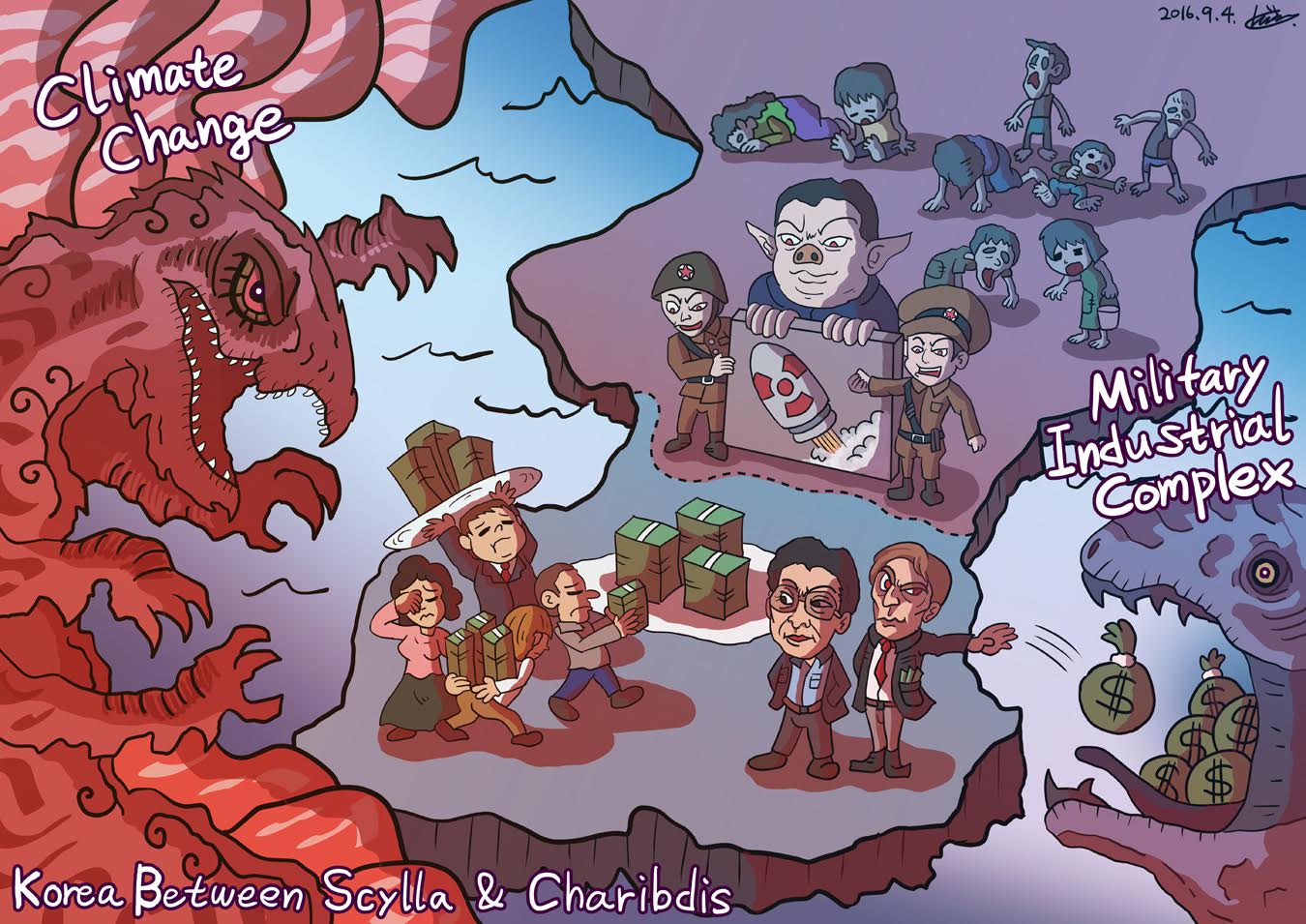
climate-change-and-mic

The media has praised you for the peaceful manner by which you have carried out your protests, going as far as to suggest that Korea is now a model for democracy.

But do not assume that this ordeal is over now that prosecutors are grilling President Park Geun-hye’s buddies like Choi Soon-sil in the impeachment proceedings.

It is entirely possible that this ordeal is only beginning.

Learning from History 

It is critical that you remember the last time that a Korean president resigned –on April 26, 1960. Rhee Syng-man was forced to step down as president of the Republic of Korea after massive strikes by students, joined by concerned citizens. The students rejoiced in their victory and imagined that a democratic government would soon be set up. But for all of their bravery, the students who led those protests had few connections within government and no solid plans for how Korea should be governed, or what policies to promote.

They did not anticipate that the power vacuum created after the government was completely discredited would encourage others to seek power. Korea careened dangerously forward and Prime Minister Chang Myon engaged in political games without a clear vision. The result was that a savvy young military officer named Park Chung-hee helped to organize disgruntled members of the military and seized power in May 16, 1961, crippling the democratic process in Korea for decades.

Also recall the promise of the Seoul Spring of 1980, which ended in political fragmentation when “The Three Kims,” (Kim Dae-jung, Kim Young-sam, and Kim Jong-pil) drifted apart, leaving space for General Chun Doo-hwan to take control and rule with brutality.

And that trick was repeated in 1987 when the Three Kims were, again, unable to unite and the Army General Roh Tae-woo took power. If you read history, you will know that too many demonstrations have failed in Korea because the leaders bickered, creating an opportunity for political opportunists.

Korea has come a long way since then, but it would be naïve to assume that such a risk no longer exists. Removing President Park Geun-hye from power is only the first step as we try to disentangle politicians and chaebols (conglomerates). But removing her from power should not be the final goal.

Korea’s economy is deeply dependent on revenue from trade and is unable to produce its own food or energy. It is guaranteed to suffer a major economic downturn next year. Already we can see the signs of collapse in shipping, ship building, and steel production – even if the media politely tries to hide these facts from you.

The only plan the government has is to sprinkle your tax dollars as a stimulus package on those teetering industries in the hope of creating some sort of magical recovery. They will fail miserably. Korea has not even started to develop new industries to replace the fossil-fuel dependent industries at the core of the economy and you are not demanding that it should anywhere in your demonstrations.

Korea will be squeezed between an irritated China, which is rapidly cutting back on economic interactions in retaliation for the agreement to deploy the THAAD anti-missile system, and a Trump administration that has promised to crack down on Korea by imposing tariffs across the board. The new administration is planning to take on China first and foremost, but has Korea in its sites.

As a result, under the direct fire of Commerce Secretary Wilbur Ross, US Trade Secretary Robert Lighthizer trade advisor and Peter Navarro, the entire free trade system that your parents assumed was as natural as the sun rising in the East and setting in the West is in danger of collapse very quickly.

Perhaps you are thinking that if President Park steps down, the THAAD disaster will then be undone. But the Trump administration has every intention of trying to force Korea into an alliance with the United States and Japan to confront China, and it’s unlikely to use a subtle approach. How far might theTrump administration go to try and install a conservative regime in South Korea? Well, Trump has surrounded himself with hardliners who intend to confront China militarily. His new Secretary of Defense James Mattis is postulating China as a direct threat to the United States and his advisor for trade Peter Navarro, author of the sensationalist book Death by China, blames all of America’s ills on a Chinese conspiracy of unfair trade.

THAAD was after all only part of a massive set of purchases of US weapons systems including drones, helicopters, and other items that made South Korea the biggest purchaser of US weapons for the first time in 2014 at $7.8 billion. As the U.S. economy worsens, the promotion of such massive arms deals with South Korea will become only more important for Americans.

The Errors of the Educational System

There is no doubt that you are sincere and committed to improving Korea, but you have been cheated by the educational system in Korea. The humanities have been stripped from the high school and college curriculum and you found yourselves forced to take boring management, economics and accounting courses. Although Samsung may want business majors with no big dreams for Korea’s future, good government and a healthy society requires students who read political philosophy, history, and literature and understand at a deep level human nature and the frailty of human institutions.

The humanities are absolutely required to come to grips with this level of political chaos. You need to read Plato and Confucius, Weber and Marx if you want to start understanding how you set up a government with a balance of powers, how you encourage a responsible citizenry, and how you avoid the dangers of tyranny which can appear in a multitude of guises.

Your management classes, which focus entirely on process, have done nothing to prepare you for this crisis. In fact, your predecessors in 1960, or for that matter in 1979 or in 1987, were far better prepared in terms of their understanding of philosophy and ethics and the strategies for building a healthy society than you are. They were well read, and wrote well, in the age before standardized tests. They suffered tremendous setbacks, but ultimately they were able to put together two administrations (Kim Dae-Jung and Roh Moo-hyun) that strived to take Korea in a different direction.

After your candlelight vigils, do you gather to discuss political reforms and the nature of governance? Do you argue late into the night with other students about how to bring democracy to Korea and how to serve the needs of the people? Are you scribbling notes in the corners of your copy of de Tocqueville’s Democracy on America or Hobbes’ Leviathan? Only if thousands, hundreds of thousands, of young people are active in building up their own competency in the principles of politics and governance, mastering the details of policy, do we have any chance of avoiding being fooled yet again by the politicians.

And be wary of social media that keeps telling you how great you are. Much of the popular media, like Ohmynews and Pressian in Korea, has become so commercialized that it has lost their edge over the last decade. Reporters are more concerned with getting your attention (and bringing in revenue) than with presenting in-depth, accurate reporting. That means that articles scream out for your attention but give you little in the way of real details about how things really work, or real solutions as to how you can fix these problems. Long-term institutional problems are all but absent from those writings.

Mass media and digitalized content and social networks have created a window for you to see the incompetence and corruption in the administration. But the same media studiously avoids discussing the creeping corruption that infects every aspect of Korean society, including many progressive institutions. Getting you caught up in the 24-hour reporting about Choi Soon-sil means you will be distracted, unable to apprehend that the problem lies not in individuals but in economic, social, environmental, and diplomatic challenges that leave Korea immensely vulnerable.

Think about it. The popular media, progressive or conservative, gives almost no details about the actual content of laws passed and their impact on your lives. No description of the structure of the institutions that receive funding from the government and enforce its laws. We are unable to tell whether policies actually work, or even if they are implemented, because we do know in detail what the policies are.

Do not expect much from politicians. Their job is to stay in power, not to help you. If politicians think that helping you will allow them to stay in power they will modify their behavior. The problem is not so much politicians as it is us. There is an old saying: “People do not want leaders; they want miracle makers.” That is to say, so often people wrongly assume that they will elect someone and that person will then solve their problems. That will never happen. Only if you keep after politicians day and night will you see change. If you are looking for a leader, just look in the mirror.

The Air Around You


Did you notice how terrible the air quality in Seoul’s Gwanghwamun Square was while you were protesting? The Park administration has done away with regulations and sent all the inspectors home who are supposed to inspect factories and punish those who pollute. Those factories are now emitting dangerous chemicals pumping micro particles into the air that will give a significant number of you cancer, or other serious diseases, over the next 20 years. That domestic smog combines with pollution that wafts over from China to form a noxious potion. And yet, although air pollution in China is worse than in Korea, China is at least making massive investments in solar and wind power and will make tremendous progress over the next decade. Korea is the worst in the OECD in the use of renewable energy, and it is increasing coal power at a time when the rest of the world is getting rid of it.

Yet, in your protests, clean air is not among your top 20 demands. Actually, for many out there the only demand is that Park Geun-hye step down. Do you even have 20 demands?

Did you notice how unseasonably warm the weather in December was? The brutal reality is that it has never been that warm in December in Seoul. There is nothing mysterious about this fact. Thousands of scientists have explained in detail how the emissions from fossil fuels, and our destruction of the environment, are creating an ecological nightmare that will take millennia to undo.

Climate change will turn Korea into a desert. Already massive deserts are sweeping towards to Beijing, and arid land is spreading in North Korea. Rising oceans are guaranteed to put most of Busan and Incheon completely underwater in the near future. The politicians are not talking about this crisis—but neither are you!

And there are so many other issues, from our over-dependence on technology to the collapse of families and communities in this hyper-competitive culture we have built.

What Can You Do?


You have the power to change Korea and the world, and we are counting on you. But please realize that this project is not a matter of showing up for a few protests. It will be a tremendous struggle over decades. Pace yourself.

You must move beyond the fierce competitiveness that your high school held up as a virtue and realize that only if you work together with your peers, if you support each other and build a caring community, can we have change.

You need to think flexibly: to get outside the box and look at the world as it is, not as your parents, or the corporate media want you to see it. You must break out of the outdated ideology of industrialization and consumption and create, through your actions, a sustainable and cooperative society. Nobody will do this for you.

You must teach yourselves because the system has failed to teach you. Listen to all politicians with skepticism, even if the media labels them as “progressive.” Judge them based on what they do, not based on what they say, or on what authority figures say they are. For that matter, do not assume that a particular economic system can be labeled simply as good or evil, or that foreign countries are forever enemies, or forever friends.

Millennials, you have been misled by the commercial media and by your seniors into thinking that if you just followed the rules and studied you would get a good job and live a prosperous and carefree life. It was a fiction.

You may not be able to vote yet, but you can start to change this society with every single action you take. The leader of this country is you. The presidents and CEOs will never do anything to put Korea on the right track unless you demand it. Write down your plan and get to work. You are capable of convincing average Koreans that investing in youth is the way to develop Korea.

If passionate grassroots movements force politicians to hold to their words, we will start to see progress. As the old phrase goes, “don’t get mad; organize!” Nothing could be truer for Korean youth. The protests so far have not led youth to organize in the way they did in the 1960s, 1970s, or 1980s.

You need to think long-term about what sort of a society we want to build. Your elders failed because they were complacent and stopped paying close attention to politics. They were drunk with the myth that Korea had become an advanced country.

You are different from the CEOs and politicians being shuttled around in limousines. You are the true leader of Korea. Have the bravery, the imagination, and the confidence to go forward and change Korea!

Read more

“Meeting the Great Data Challenge: The Case for a Constitution of Information” in Global Asia (January 2017)

GLOBAL ASIA

JANUARY 2017
global-asia

FEATURE STORY:

Meeting the Great Data Challenge:

The Case for a Constitution of Information

Meeting the Great Data Challenge

The Case for a Constitution of Information


Global Asia

Winter, 2016


Emanuel Pastreich

The w o r l d has been rocked in recent weeks by reports of rampant fake news stories circulating through social media that have the potential to completely disrupt the political process and undermine the international standards for transparency and accountability that we have come to take for granted. So serious has the problem become that Face – book has proposed a new system to identify doubt ful news reports and tag them for readers, as well as to limit the circulation of such stories. However, in the case of Facebook, the third party assigned to confirm the accuracy of reports is a fact-checking network established by Poynter, a nonprofit school for journalism in St. Petersburg, Florida, in collaboration with ABC News, Politifact, Fact Check, Snopes and the Associated Press.

But is Poynter’s “fact checking network” the best place for Facebook, or anyone else, to turn for a determination of what is accurate? After all, many of those media organizations have themselves been caught passing questionable stories in the build up to the Iraq War and other recent incidents. All this comes on top of the divisive dispute concerning the massive hacking of the emails of the Democratic National Committee in the United States by Wikileaks, an act which has been attributed to Russian intelligence as part of explicit Russian interference in the 2016 presidential election. Assuring that information in the media is accurate, or that email is secure, is no longer a personal issue.

False information, in increasingly realistic formats, can be profoundly disruptive to the international order. Moreover, the exponential evolution of technology suggests that these current crises are but part of a far more serious transformation of our society that we have yet to address directly. We will face devastating existential questions in the years ahead as human civilization enters a potentially catastrophic transformation driven not by the foibles of man, but rather by the exponential increase in our capability to gather, store, share, alter and fabricate information of every form, coupled with a sharp drop in the cost of doing so. Such basic issues as how we determine what is true and what is real, who controls institutions and organizations, and what has intellectual and spiritual significance for us will become increasingly problematic.

In the case of the US, the emerging challenge cannot be solved simply by updating the Electronic Communications Privacy Act of 1986 to meet the demands of the present day;1 it will require a rethinking of our society and culture and new, unprecedented, institutions.


A change in human life itself

The International Data Corporation (IDC) estimates that there were at least 4.4 zettabytes (4.4 trillion gigabytes) of digital data in 2013 and that the total will rise to an astounding 44 zettabytes by 2020.2 The explosion in the amount of information circulating in the world, and the increase in the ease with which that information can be obtained or altered, will change every aspect of our lives, from education and governance to friendship and kinship, to the very nature of human experience. We need a comprehensive response to the information revolution that not only proposes innovative ways to employ new technologies in a positive manner, but also addresses the serious, unprecedented challenges that they present for us. The ease with which information of every form can now be reproduced and altered is an epistemological, ontological and governmental challenge for us.

Let us concentrate on the issue of governance here. The manipulability of information is increasing in all aspects of life, but the constitutions — whether in the US or elsewhere — on which we base our laws and our government has little to say about information, and nothing to say about the transformative wave sweeping through society as a result. Moreover, we have trouble grasping the seriousness of the information crisis because it alters the very lens through which we perceive the world.

If we rely on the Internet to tell us how the world changes, for example, we are blind to how the Internet itself is evolving and how that evolution impacts human relations. For that matter, given that our very thought patterns are molded over time by the manner in which we receive information, we may come to see information that is presented online as more reliable than our direct perceptions of the physical world. The information revolution has the potential to dramatically change human awareness of the world and inhibit our ability to make decisions if we are surrounded with convincing data whose reliability we cannot confirm. These challenges call out for a direct and systematic response.

There are a range of piecemeal solutions to the crisis being undertaken around the world. The changes, however, are so fundamental that they call out for a systematic response. We need to hold an international constitutional convention through which we can draft a legally binding global “constitution of information” that will address the fundamental problems created by the information revolution and set down clear guidelines for how we can control the terrible cultural and institutional fluidity created by this information revolution.

The process of identifying the problems born of the massive shift in the nature of information, and suggesting workable solutions will be complex, but the issue calls out for an entirely new universe of administration and jurisprudence regarding the control, use and abuse of information. As the American writer and novelist James Baldwin once wrote, “Not everything that is faced can be changed. But nothing can be changed until it is faced.”

An information constitution


The changes cannot be dealt with through mere extensions of the US Constitution or the existing legal code, nor can it be left to intelligence agencies, communications companies, congressional committees or international organizations that were not designed to handle the convergence of issues related to increased computational power, but end up formulating information policy by default.

We must bravely set out to build a consensus in the US, and around the world, about the basic definition of information, how information should be controlled and maintained, and what the long-term implications of the shifting nature of information will be for humanity. We should then launch a constitutional convention and draft a document that sets forth a new set of laws and responsible agencies for assessing the accuracy of information and addressing its misuse.

Those who may object to such a constitution of information as a dangerous form of centralized authority likely to encourage further abuse are not fully aware of the difficulty of the problems we face. The abuse of information has already reached epic proportions, and we are just at the beginning of an exponential increase. There should be no misunderstanding: I am not suggesting a totalitarian Ministry of Truth that undermines a world of free exchange between individuals. Rather, I am proposing a system that will bring accountability, institutional order and transparency to the institutions and companies that already engage in the control, collection, and alteration of information.

Failure to establish a constitution of information will not assure preservation of an Arcadian utopia, but rather encourage the emergence of even greater fields of information collection and manipulation entirely beyond the purview of any institution. The result will be increasing manipulation of human society by dark and invisible forces for which no set of regulations has been established — that is already largely the case.

The constitution of information, in whatever form it may take, is the only way to start addressing the hidden forces in our society that tug at our institutional chains. Drafting a constitution is not merely a matter of putting pen to paper. The process requires the animation of that document in the form of living institutions with budgets and mandates. It is not my intention to spell out the full parameters of such a constitution of information and the institutions that it would support, because a constitution of information can only be successful if it engages living institutions and corporations in a complex and painful process of deal-making and compromises that, like the American Constitutional Convention of 1787, is guided at a higher level by certain idealistic principles.

The ultimate form of such a constitution cannot be predicted or determined in advance, and to present a version in advance here would be counterproductive. We can, however, identify some of the key challenges and the issues that would be involved in drafting such a constitution of information.

Threats posed by the Information Revolution

The ineluctable increase of computational power in recent years has simplified the transmission, modification, creation and destruction of massive amounts of information, rendering all information fluid, mutable and potentially unreliable. The rate at which information can be rapidly and effectively manipulated is enhanced by an exponential rise in the capacity of computers.

Following Moore’s Law, which suggests that the number of microprocessors that can be placed on a chip will double every 18 months, the capacity of computers continues to increase dramatically, whereas human institutions change only very slowly.3 That gap between technological change and the evolution of human civilization has reached an extreme, all the more dangerous because so many people have trouble grasping the nature of the challenge and blame the abuse of information on the dishonesty of individuals or groups rather than on the technological change itself.

The cost for surveillance of electronic communications, for keeping track of the whereabouts of people and for documenting every aspect of human and non-human interaction, is dropping so rapidly that what was the exclusive domain of supercomputers at the National Security Agency a decade ago is now entirely possible for developing countries, and will soon be in the hands of individuals.

In 10 years, when vastly increased computational power will mean that a modified laptop computer can track billions of people with considerable resolution, and that capability is combined with autonomous drones, we will need a new legal framework to respond in a systematic manner to the use and abuse of information at all levels of society.

If we start to plan the institutions that we will need, we can avoid the greatest threat: the invisible manipulation of information without accountability. As the cost of collecting information becomes inexpensive, it is becoming easier to collect and sort massive amounts of data about individuals and groups and to extract from that information relevant detail about their lives and activities.

Seemingly insignificant data taken from garbage, e-mails and photographs can now be easily combined and systematically analyzed to essentially give as much information about individuals as a government might obtain from wiretapping — although emerging technology makes the process easier to implement and harder to detect. Increasingly smaller devices can take photographs of people and places over time with great ease, and that data can be combined and sorted so as to obtain extremely accurate descriptions of the daily lives of individuals — who they are and what they do.

Such information can be combined with other information to provide complete profiles of people that go beyond what the individuals know about themselves. As cameras are combined with mini-drones in the years to come, the range of possible surveillance will increase dramatically. Global regulations will be an absolute must for the simple reason that it will be impossible to stop the gathering of this form of big data. In the not-too-distant future, it will be possible to fabricate cheaply not only texts and data, but all forms of photographs, recordings and videos with such a level of verisimilitude that fictional artifacts indistinguishable from their historically accurate counterparts will compete for our attention. Currently, existing processing power can be combined with intermediate user-level computer skills to effectively alter information, whether still-frame images using programs like Photoshop or videos using Final Cut Pro.

Digital information platforms for photographs and videos are extremely susceptible to alteration and the problem will get far worse. It will be possible for individuals to create convincing documentation, photos or videos, in which any event involving any individual is vividly portrayed in an authentic manner. It will be increasingly easy for any number of factions and interest groups to make up materials that document their perspectives, creating political and systemic chaos. Rules stipulating what is true, and what is not, will no longer be an option when we reach that point. Of course, the authority of an organization to make a call as to what information is true brings with it incredible risks of abuse. Nevertheless, although there will be great risk in enabling a group to make binding determinations concerning what is authentic (and there will clearly be a political element to truth as long as humans rule society), the danger posed by inaction is far worse.

What is reality?

When fabricated images and movies can no longer be distinguished from reality by the observer and computers can easily create new content, it will be possible to continue these fabrications over time, thereby creating convincing alternative realities with considerable mimetic depth. At that point, the ability to create convincing images and videos will merge with the next generation of virtual reality technologies to further confuse the issue of what is real. We will see the emergence of virtual worlds that appear at least as real as the one that we inhabit.

If some event becomes a consistent reality in those virtual worlds, it may be difficult, if not impossible, for people to comprehend that the event never actually “happened,” thereby opening the door for massive manipulation of politics and ultimately of history. Once we have complex virtual realities that present a physical landscape with almost as much depth as the real world, and the characters have elaborate histories and memories of events over decades and form populations of millions of anatomically distinct virtual people, the potential for confusion will be tremendous. It will no longer be clear what reality has authority, and many political and legal issues will be unsolvable.

But that is only half of the problem. These virtual worlds are already extending into social networks. An increasing number of people on Facebook are not actual people at all, but characters and avatars created by third parties. As computers grow more powerful, it will be possible to create thousands, then hundreds of thousands, of individuals on social networks who have complex personal histories and personalities.

These virtual people will be able to engage human partners in compelling conversations that pass the Turing Test — the inability of humans to distinguish answers to the same question given to them by machines and people. And, because these virtual people can write messages and Skype 24 hours a day, and customize their messages to what the individual finds interesting, they can be more attractive than human “friends” and have the potential to seriously distort our very concept of society and reality. There will be a concrete and practical need for a set of codes and laws to regulate such an environment.


The rise of fake truth

Over time, virtual reality may end up seeming much more real and convincing to people who are accustomed to it than actual reality. That issue is particularly relevant when it comes to the next generation, who will be exposed to virtual reality from infancy.

Yet, virtual reality is fundamentally different from the real world. For example, virtual reality is not subject to the same laws of causality. The relations between events can be altered with ease in virtual reality, and epistemological assumptions from the concrete world do not hold. Virtual reality can muddle such basic concepts as responsibility and guilt, or the relationship of self and society. It will be possible in the not-too-distant future to convince people of something using faulty or irrational logic whose only basis is in virtual reality. This fact has profound implications for every aspect of law and institutional functionality. And if falsehoods are continued in virtual reality — which seems to represent reality accurately — over time in a systematic way, interpretations of even common-sense assumptions about life and society will diverge, bringing everything into question.

As virtual reality expands its influence, we will have to make sure that certain principles are upheld even in virtual space, to assure that it does not create chaos in our very conception of the public sphere. That process, I hold, cannot be governed in the legal system that we have at present.

New institutions will have to be developed. The dangers of increasingly unverifiable information are perhaps a greater threat than even terrorism. While the idea of individuals or groups setting off “dirty bombs” is certainly frightening, imagine a world in which the polity can never be sure whether anything they see/read/hear is true or not. This threat is at least as significant as surveillance operations, but has received far less attention. The time has come for us to formulate the institutional foundation that will define and maintain firm parameters for the use, alteration and retention of information on a global scale.

You are being watched

We live in a money-based economy, but the information revolution is altering the nature of money itself right before our eyes. Money has gone from an analog system that was once restricted to the amount of gold a government possessed to a digital system in which the only limitation on the amount of money represented in computers is the tolerance for risk on the part of the players involved and the ability of national and international institutions to monitor the system.

In any case, the mechanisms are now in place to alter the amount of currency, or for that matter many other items such as commodities or stocks, without any effective global oversight. The value of money and the quantity in circulation can be altered with increasing ease, and current safeguards are clearly insufficient. The problem willgrow worse as computational power, and the number of players who can engage in complex manipulations of money, increases.

Then there is the explosion in the field of drones and robots, devices of increasingly small size that can conduct detailed surveillance and that increasingly are capable of military action and other forms of interference in human society. The US had no armed drones and no robots when it entered Afghanistan, but it has now more than 8,000 drones in the air and more than 12,000 robots on the ground.

The number of drones and robots will continue to increase rapidly and they are increasingly being used in the US and around the world without regard for borders. As the technology becomes cheaper, we will see more tiny drones and robots that can operate outside of any legal framework. They will be used to collect information, but they can also be hacked and serve as portals for the distortion and manipulation of information at every level.

Moreover, drones and robots have the potential to carry out acts of destruction and other criminal activities whose source can be hidden because of ambiguities over control and agency. For this reason, the rapidly emerging world of drones and robots deserves to be treated at great length within the constitution of information.


Drafting the Constitution of Information

The constitution of information could become an internationally recognized, legally binding document that lays down rules for maintaining the accuracy of information and protecting it from abuse. It could also set down the parameters for institutions charged with maintaining long-term records of accurate information against which other data can be checked, thereby serving as the equivalent of an atomic clock for exact reference in an age of considerable confusion.

The ability to certify the integrity of information is an issue that is of an order of magnitude more serious than the intellectual property issues on which most international lawyers focus today, and deserves to be identified as a field entirely in itself — with a constitution of its own that serves as the basis for all future debate and argument.

This challenge of drafting a constitution of information requires a new approach and a bottom-up design in order to sufficiently address the gamut of complex, interconnected issues found in transnational spaces like that in which digital information exists. The governance systems for information are simply not sufficient, and overhauling them to meet the standards necessary would be much more work and much less effective than designing and implementing an entirely new, functional system, which the constitution of information represents. Moreover, the rate of technological change will require a system that can be updated and made relevant while at the same time safeguarding against it being captured by vested interests or made irrelevant. A possible model for the constitution of information can be found in the “Freedom of Information” section of the new Icelandic constitution drafted in 2011.

The Constitutional Council engaged in a broad debate with citizens and organizations throughout the country about the content of the new constitution, which described in detail mechanisms required for government transparency and public accessibility that are far more aligned with the demands of today than other similar documents.5 It would be meaningless, however, to merely put forth a model, international constitution of information without the process of drafting it because without the buy-in of institutions and individuals in its formulation, the constitution would not have the authority necessary for it to be accepted and to function. The process of debate and compromise that would determine the contours of that constitution would endow it with social and political significance, and, like the US Constitution of 1787, it would become the core for governance.

For that matter, the degree to which the content of the constitution of information would be legally enforceable would have to be part of the discussion held at the convention.

Constitutional convention

To respond to this global challenge, we should call a constitutional convention in which a series of basic principles and enforceable regulations would be put forward that are agreed upon by major institutions responsible for policy — including national governments and supranational organizations and multinational corporations, research institutions, intelligence agencies, NGOs, and a variety of representatives from other organizations.

Deciding who to invite and how will be difficult, but it should not be a stumbling block. The US Constitution has proven quite effective over the last few centuries even though it was drafted by a group that was not representative of the population of North America at the time.

Although democratic process is essential to good government, there are moments in history in which we confront deeper ontological and epistemological questions that cannot be addressed by elections or referendums and require a select group of individuals like Benjamin Franklin, Thomas Jefferson and Alexander Hamilton. At the same time, the constitutional convention cannot be merely a gathering of wise individuals, but will have to involve those directly engaged in the information economy and information policy.

That process of drafting a constitution will involve the definition of key concepts, the establishment of the legal and social limits of the constitution’s authority, the formulation of a system for evaluating the use and misuse of information and policy suggestions that respond to abuses of information on a global scale. The text of this constitution of information should be carefully drafted with a literary sense of language so that it will outlive the specifics of the moment and with a clear historic vision and unmistakable idealism that will inspire future generations, just as the US Constitution continues to inspire Americans.

This constitution cannot be a flat bureaucratic rehashing of existing policies on privacy and security. We must be aware of the dangers involved in trying to determine what is and is not reliable information as we draft the constitution of information. It is essential to set up a workable system for assuring the integrity of information, but multiple safeguards, and checks and balances will be necessary. There should be no assumptions as to what the constitution of information would ultimately be, but only the requirement that it should be binding and that the process of drafting it should be cautious but honest.

Private versus public

Following David Brin’s argument in his book The Transparent Society, 6 one essential assumption should be that privacy will be extremely difficult, if not impossible, to protect in the current environment. We must accept, paradoxically, that much information must be made “public” in some sense in order to preserve its integrity and its privacy. That is to say that the process of rigorously protecting privacy is not sufficient, granted the overwhelming changes that will take place in the years to come.

Brin draws heavily on Steve Mann’s concept of sousveillance, a process through which ordinary people could observe the actions of the rich and powerful so as to counter the power of the state or the corporation to observe the individual.The basic assumption behind sousveillance is that there is no means of arresting the development of technologies for surveillance and that those with wealth and power will be able to deploy such technologies more effectively than ordinary citizens. Therefore, the only possible response to increased surveillance is to create a system of mutual monitoring to assure symmetry, if not privacy.

Although the constitution of information does not assume that a system that allows the ordinary citizen to monitor the actions of those in power is necessary, the importance of creating information systems that monitor all information in a 360-degree manner should be seriously considered as part of a constitution of information. The one motive for a constitution of information is to undo the destructive process of designating information as classified and blocking off reciprocity and accountability on a massive scale.

We must assure that multiple parties are involved in that process of controlling information so as to assure its accuracy and limit its abuse. In order to achieve the goal of assuring accuracy, transparency and accountability on a global scale, but avoiding massive institutional abuse of the power over information that is granted, we must create a system for monitoring information with a balance of powers at the center. Brin suggests a rather primitive system in which the ruled balance out the power of rulers through an equivalent system for observing and monitoring that works from below. I am skeptical that such a system will work unless we create large and powerful institutions within government (or the private sector) itself that have a functional need to check the power of other institutions.

Perhaps it is possible to establish a complex balance of powers wherein information is monitored and abuses can be controlled, or punished, according to a meticulous, painfully negotiated agreement between stakeholders. It could be that ultimately information would be governed by three branches of government, something like the legislative, executive and judicial systems that has served well for many constitution-based governments.

Accuracy assurance

The need to assure accuracy may ultimately be more essential than the need to protect privacy. The general acceptance of inaccurate descriptions of a state of affairs, or of individuals, is profoundly damaging and cannot be easily rectified. For this reason, I suggest as part of the three branches of government, that a “three keys” system for the management of information be adopted. That is to say that sensitive information will be accessible — otherwise we cannot assure that information will be accurate — but that information can only be accessed when three keys representing the three branches of government are presented.

That process would assure that accountability can be maintained, because three institutions whose interests are not necessarily aligned must be present to access that information. Systems for the gathering, analysis and control of information on a massive scale have already reached a high level of sophistication. What is sadly lacking is a larger vision of how information should be treated for the sake of our society.

Most responses to the information revolution have been extremely myopic, dwelling on the abuse of information by corporations or intelligence agencies without considering the structural and technological background of those abuses. To merely attribute the misuse of information to a lack of human virtue is to miss the profound shifts sweeping through society today.

The constitution of information will be fundamentally different than most constitutions in that it must contain both rigidity, in terms of holding all parties to the same standards, and also considerable flexibility, in that it can readily adapt to new situations resulting from rapid technological change. The rate at which information can be stored and manipulated will continue to increase and new horizons and issues will emerge, perhaps more quickly than expected. For this reason, the constitution of information cannot be overly static and must derive much of its power from its vision.


The representative system

We can imagine a legislative body to represent all the elements of the information community engaged in the regulation of the traffic and the quality of information as well as individuals and non-governmental organizations (NGOs). It would be a mistake to assume that the organizations represented in that “legislature” would necessarily be nation states according to the United Nations formulation of global governance.

The limits of the nation state concept with regards to information policy are increasingly obvious, and this constitutional convention could serve as an opportunity to address the massive institutional changes that have taken place over the past 50 years. It would be more meaningful, in my opinion, to make the members companies, organizations, networks, local governments — a broad range of organizations that make the actual decisions concerning the creation, distribution and reception of information.

That part of the information security system would only be “legislative” in a conceptual sense. It would not necessarily have meetings or be composed of elected or appointed representatives. In fact, if we consider the fact that the actual physical meetings of government legislatures around the world are mostly rituals, we can sense that the whole concept of the legislative process requires much modification. The executive branch of the new information accuracy system would be charged with administering the policies based on the legislative branch’s policies. It would implement rules concerning information to preserve its integrity and prevent its misuse.

The details of how information policy is carried out would be determined at the constitutional convention. The executive would be checked not only by the legislative branch but also by a judicial branch. The judicial branch would be responsible for formulating interpretations of the constitution with regards to an ever-changing environment for information, and for assessing the appropriateness of actions taken by the executive and legislative branches.

The terms “executive,” “legislative” and “judicial” are meant more as placeholders in this initial discussion, not actual concrete descriptions of the institutions to be established. The functioning of these units would be profoundly different from branches of current local and national governments, or even international organizations like the United Nations. If anything, the constitution of information will be a step forward towards a new approach to governance in general.


Vision needed

It would be irresponsible and rash to draft an “off the shelf” constitution of information that could be readily applied around the world to respond to the complex situation of information today. Although I accept that initial proposals for a constitution of information may be dismissed as irrelevant and wrong-headed, I assert that as we enter an unprecedented age of information and most of the assumptions that undergirded our previous governance systems based on physical geography and discrete domestic economies will be overturned, there will be a critical demand for new systems to address this crisis.

This initial foray can help to formulate the problems to be addressed and the format in which to do so in advance.

In order to effectively govern a new space that exists outside of our current governance systems (or in the interstices between systems), we must make new rules that can effectively govern that space and work to defend transparency and accuracy in the perfect storm born of the circulation and alteration of information. If information exists in a transnational or global space and affects people at that scale, then the governing institutions responsible for its regulation need to be transnational or global. If unprecedented changes are required, then so be it.

If all records for hundreds of years exist online, then it will be entirely possible, as suggested in Margaret Atwood’s 1985 novel The Handmaid’s Tale, to alter all information in a single moment if there is not a constitution of information. But the solution must involve designing the institutions that will be used to govern information, thus bringing an inspiring vision to what we are doing. We must give a philosophical foundation for the regulation of information and open up new horizons for human society while appealing to our better angels.

Oddly, many assume that the world of policy must consist of turgid and mind-numbing documents in the specialized terminology of economists. But history also has moments such as the drafting of the US Constitution during which a small group of visionary individuals managed create an inspiring new vision of what is possible. That is what we need today with regard to information. To propose such an approach is not a misguided modern version of Neo-Platonism, but a chance to seize the initiative and put forth a vision in the face of ineluctable change, rather than just a response.
“The importance of eating local” (JoongAng Daily December 26, 2016)

JoongAng Daily

“The importance of eating local”

December 26, 2016

Emanuel Pastreich


I was invited to a meeting with a certain governor last month at which a group of experts discussed the province’s efforts to develop technology. The group assembled around a vast table spoke at great length about biotechnology and nanotechnology and unveiled their plans to encourage start-up firms.

But in the midst of all that pie-in-the-sky talk, I could not stop looking at the snacks that were offered up for us to eat.

In front of each person at the meeting stood a plastic bowl piled high with chocolates, cookies and candies, all covered in brightly colored plastic wrapping. There was absolutely nothing that I was tempted to eat.

That was not all. Although the entire event was a promotion for the province, there was not a single product among those snacks that was actually produced there.

I have no doubt that if asked, the participants at the meeting would have much preferred a snack made from the fruits or grains of the region, something with some distinctive flavors that would affirm that this province had its own traditions and cuisine. I know that Korea has a wide range of traditional crackers, dried fruits, cakes and nuts that would have been perfect for a snack and that would have also supported the local farmers.

But after some eight years working with local government in Korea I can say with confidence that it is rare that local foods find their way through the barriers of logistics to actually make it to the table for such events. In fact, the food you get in the governor’s office is more likely to be the product of a big food producer rather than a local supplier.

But the problem is more one of what is provided, rather than by whom. I have found, increasingly, that every time I enter a convenience store I am confronted with shelves lined with processed foods: chocolate bars, potato chips, crackers and instant ramen high in sodium and saturated fat. None of these choices offers nutritional value and there are rarely any vegetables or fruits to be found.

Our youth are exposed to processed foods, and even encouraged to eat them, without any awareness of the negative impact they will have on their health. Those products are not food at all, and do not compare with the nutritious foodstuffs produced by local farmers. Many medical experts recommend against such processed foods in light of increasing evidence of linkage of foods high in sugar with diabetes and even Alzheimer’s disease. We can already see the results of diets based on high sugar content. According to materials released by the National Health Insurance Service, the number of people under 18 receiving treatment for diabetes has increased by 31 percent over the last decade. According to an study the number of obese Koreans was 4.2 percent of the entire population in 2012, up from 2.5 percent in 2002.

During a recent trip to Japan I was impressed by how much more fresh fruits and vegetables were available at convenience stores — often supplied by local farms. Korea can do better and provide our citizens with truly healthy meals based on Korea’s long tradition of nutritious food. Moreover, requiring that the food available at local convenience stores be produced organically and locally is a good way to assure healthy diets and stimulate the local economy.

What is food? To start with, it is not something you make in a manner that encourages people to buy more of it regardless of its lack of nutritious value. Making sure that food is healthy, and teaching citizens good eating habits, is much more important than building yet another skyscraper or launching the latest smart phone.

The health of our children is as important as anything and we cannot sacrifice it for any short term profit to be derived from encouraging impulsive eating. If anything, we should encourage people to eat slowly and show appreciation for the farmers who produce our food, for the earth that nourishes us, and for the need for a constant harmony between the world of man and of nature.

Although it may offend the sensitivities of some, I think that the government has the right, and the responsibility, to step in and to regulate what food is available to our citizens so as to assure that it is healthy. It is entirely appropriate for the government to set regulations that limit the amount of processed food that is displayed in front of inexperienced young people, and set standards for what kinds of products are available. If it is not food, it should not be getting undue attention.

I hear all the time that food is the most important part of Korean culture, but I fear we are letting that treasure slip away.

“Turn Korean media upside down” (JoongAng Daily December 5, 2016)


JoongAng Daily

“Turn Korean media upside down”

December 5, 2016


Emanuel Pastreich


One thing is clear: The inability of the Korean media to anticipate even the possibility of a Trump victory will be remembered as a tremendous intelligence failure that has left the great halls of journalistic pomp looking distinctly shabby.

Don’t tell me that the United States media also got it wrong. Major newspapers in the United States continuously wrote about a Clinton victory, even trying to make that scenario seem more likely by using the terminology “probability of a Clinton victory” (92%) instead of percent of people who intend to vote for Clinton. But sloppy journalism is America’s problem, it does not have to be Korea’s problem

Many informed Americans were aware of the bias in the mainstream media during the election, and knew about the unprofessional decision of reporters to coordinate with the Clinton camp concerning their reporting, and about the donations to the Clinton campaign by media companies.

Months of unfavorable news about Clinton had done tremendous damage to her credibility with voters.

But the Korean media repeated the headlines of the mainstream U.S. media and readers assumed the election was already decided.

Although Korea has one of the most educated populations in the world, and numerous reporters who are extremely fluent in English, the rules of Korean media meant that almost none of those reporters consulted the large number of journals, blogs and other thoughtful reporting in the United States that suggested that the election might be close.

For that matter, if Korean foreign correspondents had talked with working class people in America they would have discovered that minorities were unenthusiastic about Clinton and that many whites were enthusiastic about Trump. But foreign correspondents will never meet ordinary Americans at the pompous events held at Washington think tanks.

Korean reporters, unlike Korean manufacturers of smartphones or of container ships, do not have as their goal being the best in the world; they work hard, but their newspapers are dedicated to digesting quickly and summarizing the news available from foreign news agencies, not in developing the domestic capacity to create entirely original and distinctly Korean perspectives on news and global affairs for both domestic and global consumption.

That is a terrible shame because Korea clearly has all the assets needed to be a leader in journalism. Korea has an educated population with many near-native speakers of English, Chinese and Japanese and there are an incredible number of PhDs in diverse fields. As a nation not encumbered with the tradition of imperialism that warps media reporting so often, Korea is well positioned to build a new journalistic tradition of its own, with roots in Korea’s own culture, rather than copying content from abroad.

Part of the process requires giving up all politesse. Foreign correspondents are not there just to make friends with the powerful and to play golf, American politicians, officials, and lawyers must be subject to tough unrelenting questions to get to the bottom of things. So also reporters must avoid being seduced by carefully crafted articles written in an authoritative tone that are meant to be misleading.

Journalists must read broadly from different sources and then use their imagination. To be a good journalist, one must first imagine five or six scenarios that could explain what is happening in politics. One then inspects the facts carefully and slowly eliminates those scenarios that do not hold up — as did Sherlock Homes. That process will get you close to the truth. But if one does not use one’s imagination to postulate what might be, one will quickly fall into the trap of limiting oneself to the scenarios which are offered up by interested parties.

Newspapers should hold up an ideal of the pursuit of truth with the intention of providing practical information for the general reader that will help him to make informed decisions. As such, the media is critical for the nation from the perspective of the ordinary man as a means to assure we have an educated public that can make informed decisions within a democratic system. Reporters should feel a deep responsibility to make complex issues accessible in an original manner.

Media has become a market in recent years, but it does not have to be. The sooner Korea snaps out of that haze, the faster it will be able to objectively judge its own interests and serve as a global leader.

At first readers may be put off by writing that actually locates issues in their historical context and makes proposals for long-term solutions. But over time, I believe, we can lead the public back to responsible politics, get them to stop being consumers and become engaged citizens.

Korea will face tremendous challenges in the years ahead that will require us to pull together as a nation and to make informed decisions.

This is the moment for a deep commitment to journalism of the very highest standards.

“「中国の夢」:欧米化?それとも新しい道を開く?” (ハフィントンポスト 2016年 11月 23日)

ハフィントンポスト

“「中国の夢」:欧米化?それとも新しい道を開く?”

2016年 11月 23日

エマニュエル・パストリッチ 


最近、会議のため南京へ行くことになった。あの有名な「夫子廟」へ連れて行ってほしいと案内係の学生さんにお願いした。南京は初めてなので、下町の昔ながらの喫茶店でお茶を飲みながらのんびりしたいと思った。

今回南京に来たのは初めてだったが、明の時代まで「金陵」と呼ばれた「南京」のことはよく研究していた。東京大学とハーバード大学で中学文学を勉強したとき、南京を舞台にした詩集をたくさん読んだ。十七世紀の散文雑記で描かれた秦淮河のきれいな景色に印象深く、大学で小説『紅楼夢』を読んだときも、十八世紀の南京の軒を連ねる邸宅が何度も頭に浮かんでいた。

しかし、賑やかな街を歩いて昔の金陵の風貌を探そうとした私の努力は無駄だった。夫子廟辺りは昔の建物が既に取り壊され、ファーストフード店や洋服屋の入っているつまらないコンクリート造建物が立ち並んでいる。確かに上質なお茶を売っている店も何軒かあるが、そこで売られている食べ物やお土産はバンコク、ロサンゼルスのとほぼ変わらない。結局、南京製のものには一つも出会わなかった。詩人、小説家どころか、匠、職人の姿までいつの間にか消えていた。

夫子廟のなかも昔の風貌がなくなった。石壁や土壁の代わりにコンクリートの壁が溢れている。大工さんの腕が悪く、壁と床のつなぎ目がいい加減に仕上げられていた。置かれた家具の作りが悪く、壁に掛けられた絵画があり溢れたものばかりだった。

あの日、南京ではパリのノートルダム大聖堂や日本奈良の東大寺で拝見したような心を動かされる歴史の跡には出会えなかった。南京の過去はすべての中国人が勉強しなければならないとある本の中で読んだ気がしたが、街中を歩いてみたら、その華やかな歴史文化は今の南京とほぼ関わりなくなったように思われる。

案内係の学生さんのおかげで昔風の喫茶店が見つかった。喫茶店を出たとき、悲しい気持ちで胸がいっぱいになった。中国の歴史伝統が次から次へと消えていく。これは文化大革命のせいではなく、消費文化の激しい成長が招いた結果と言っても過言ではない。そしてこの悲しさは確実で深いものだった。

しかし最も悲しいのは、古代中国は持続可能な有機農業によって世界一のシステムを作り出し、国の複雑な官僚制度を支え、多くの人々を養えてきたにも関わらず、その素晴らしい有機農業の伝統が捨てられてしまった。アメリカ農学者フランクリン・ハイラム・キング(F• H• King)がその著書『東アジア四千年の永続農業-中国・朝鮮・日本』(Farmers of Forty Centuries, or Permanent agriculture in China, Korea, and Japan)で、東アジアは確実な永続農業のモデルを作り出しており、アメリカはそれを導入すべきと呼びかけている。一方、中国は致命的な化学肥料と農薬を取り入れたせいで、農業は持続可能なものでなくなった。古代中国の農業文明の素晴らしい知恵が最も必要とされた今、その跡取りが見つからない。

また、消費社会の残酷な価値観の反面、中国人の素朴、節約、親孝行、謙遜の人柄がとても魅力的に思われるが、これらの美徳を求めに中国にきたら、あなたはきっとがっかりするだろう。


米化の夢


欧米文化が受けている悪い影響を減らし、そのあり方を求めるために、多くの欧米人が中国に訪れてくる。同じ目的で、アメリカ社会を支える制度を蝕んでいる物質主義と軍国主義に絶望感を持つ私は、中国文学を勉強することになった。中国の儒学、仏学及び道学思想は、人間のすべてを金銭で評価するアメリカに新しい基準を提供している。

Read more