세월호 사건을 계기로 한국 정치 시스템의 변화를 위한 대대적인 압박이 가해지고 있다. 그러나 한국 사회의 구조적 문제를 정부기관 개편으로 해결하려는 태도는 비현실적으로 보인다. 적지 않은 이들이 정부의 이런 움직임에 대해 뭔가 실제로 변화가 일어나고 있는 듯이 국민을 안심시키려는 의도가 아닐까 의심한다.
전방위로 펼쳐지는 정부의 신속한 조치는 일시적인 만족을 가져다줄지 모른다. 그러나 분명한 사실은 장관 교체나 정부조직 개편, 또는 세월호 사태에 직접 관련된 몇 명을 처벌한다고 해서 앞으로 그런 사건이 일어나지 않으리란 보장이 없다는 점이다.
Emanuel speaks about cooperation in East Asia for “Young Ambassadors”
August 6, 2014
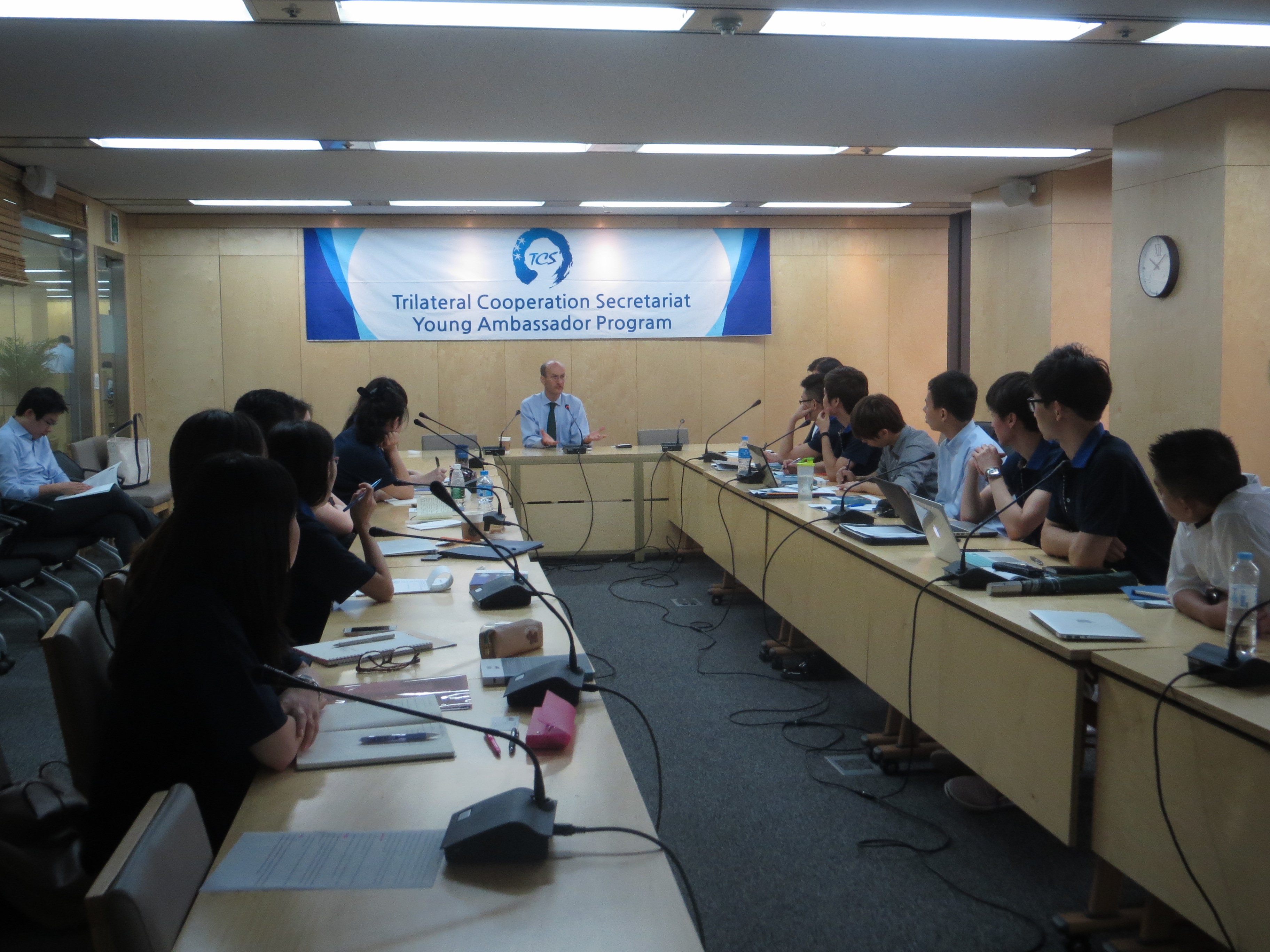
Emanuel led a discussion at the Trilateral Cooperation Secretariat (for cooperation between China, Japan and Korea) on Wednesday, August 6 (2014) on the topic of regional cooperation in East Asia. The discussion involved the members of this year’s Young Ambassador Program. Each year, a group of fifteen outstanding youth from China, Japan and Korea with a deep commitment to improving relations between the nations and promoting meaningful integration are selected for a four day program of activities and lectures by the Trilateral Cooperation Secretariat. As the only organization run jointly by the governments of China, Japan and Korea, the Secretariat plays a critical role in facilitating greater understanding and cooperation.
Emanuel leads students from China, Japan and Korea in a discussion of cooperation in East Asia at the Young Ambassadors Program at the Trilateral Cooperation Secretariat in Seoul.
Emanuel talked about the challenges of globalization and its causes, focusing on the impact of technology on globalization and addressing directly the completely unprecedented challenges of climate change and digitization that we face. He discussed with the students the effectiveness of current mechanisms for international cooperation in East Asia. The students, in turn, made concrete proposals for new approaches to the promotion of substantial cooperation and offered their opinions of existing institutions.
The seminar was also an opportunity to introduce Emanuel’s new book “Searching for Truth on Both Sides of the Ocean” (跨海求真),a book that raises a variety of mechanisms for promoting international cooperation in East Asia.
“What is the Ukraine conflict about? It’s about climate change!”
Emanuel Pastreich
August 3, 2014
Many theories have been advanced concerning the growing conflict between the United States and Russia over the future status of Ukraine. The American media is hyping up the confrontation between the West and Russia as fast as it can. Many of those articles use the classic term “the West” in a most disingenuous manner. The media suggests that somehow the entirety of the enlightened world, all those who grew up in the tradition of Plato and Voltaire, are fed up with Russia and its undemocratic and expansionist moves. But there is plenty of evidence that the actual populations of European nations, regardless of what the bigwigs at NATO say, have little sympathy for this dangerous project of confrontation.
But among the many articles on the situation in Russia, or in Gaza, oddly the impact of climate change on policy related to Russia is completely overlooked. Although we cannot produce a “smoking gun,” there is plenty of circumstantial evidence that suggests that pushing Russia to the edge of war is inseparable from the life and death struggle within the security apparatus itself to avoid taking climate change seriously.