“Six Months After Korea’s West Coast Oil Spill” (article translated by Emanuel Pastreich)

I translated this article about the Taean oil spill on behalf of a friend who works at Eco-Horizon Institute (Saengtae Jipyeong) as part of my efforts on the critical issue of what to do in the aftermath of this ecological disaster.

The Taean spill blends together in my mind with Hurricane Katherina, the Deep Horizon oil spill and the Fukushima disaster. All are examples of ecological disasters, the biggest security challenge we face today. I must say that most of the security budget we spend is not much use for responding to these terrible threats, and that their frequency seems to be increasing.

Six Months After Korea’s West Coast Oil Spill – Need exists for new effort to stave off a social and ecological disaster

August 8, 2008
By Seung-hwa Lee
(translated by Emanuel Pastreich)

A horrific collision between a crane and an oil tanker off the coast of Korea’s Taean Peninsula last December resulted in over 10,000 tons of crude oil being dumped into ocean just off the coast of one of Asia’s most important marine preserves. The striking coastline where pristine waves crashed on rugged rocks was transformed into a sea of oozing black goop.

The animals and plants of the coast were not the only ones devastated. The residents of Taean have found themselves in a life and death struggle for economic and psychological survival. A dark shadow hangs over their lives and has driven some to despair.

Now that the summer season has returned, there is much talk in the Korean media about the reopening of the beaches and the miracle of the Taean recovery. After all, when over a million people from all over Korea came to help clean the coast of oil in the months after the spill many predicted a quick return to normal. But although the beaches may appear clean, traces of oil can still be found.

The roads once packed with tourists during the summer have little traffic. And the generations of families whose livelihood depended on fishing or tourism wonder what they should do. They watch the bills pile up, getting into unpleasant fights about possible compensation money.

http://english.ohmynews.com/articleview/article_view.asp?menu=c10400&no=383335&rel_no=1

Emanuel’s proposal for a festival at Taean for Children (August, 2008)

The terrible Taean Oil Spill of December, 2007 caused such damage to the eastern coast of Korea that many were demoralized. Fishermen found themselves suddenly without a livelihood. That spill took place at the time I worked as advisor to the governor of Chungnam Province.

Of all the work I did with the province of Chungnam, I think the response to the oil spill was the most meaningful. I visited the headquarters for the clean up site, helped clean the tar on the beach and spoke with both residents and members of the local government team in charge. It was an opportunity to help coordinate the international response. But it was my visits to local elementary schools that made the deepest impression on me. Here were these children struggling to understand how their parents suddenly no longer had work as fishermen. They were gripped by an  invisible threat hovered over their communities. The teachers were quite frank about the psychological stress.

I worked with several people at the local level to make up this proposal for an international children’s festival that would bring new hope to the children. Here are versions in Korean, English and Japanese. Ultimately, there was just too much sensitivity about the oil spill and we could not actually hold it, but there were several figures in local government who did their best at the time.

 “The Delicate Little World of Taean”

A Festival for Children of Art & Music Celebrating the Environment

July, 2008

[proposal]

Emanuel Pastreich

A thick oozing sheet has coated the pristine coast of Taean in Korea since December of 2007, transforming once spotless beaches into a black crust lining a sea of death.

As the shock of Korea’s worst oil spill sinks in, we are forced to think about the terrible consequences of our dependence on oilnot only for the fishermen of Taean, but for the entire world.

We think about such matters most of all when we watch our children. After all, the implications of oil, from creeping pollution to climate change, gather like dark clouds on the horizon, dark clouds that we are fearful to speak of with our young ones.

The only way forward is to create a sustainable world.

To do that, we must change culture itself, and we can only achieve that goal if we first turn to our children and offer them a vision of how the world could be.

Delicate Little World of Taean (English)

Delicate Little World of Taean (Japanese)

Delicate Little World of Taean (Korean)

“The Fukushima Disaster Opens New Prospects for Cooperation in Northeast Asia” (Markku Heiskanen)

This article by Asia Institute Senior Associate Markku Heiskanen on NAPSNET sums up well many of the topics we have been discussing at Asia Institute and dovetails well with my upcoming article.

The Fukushima Disaster Opens New Prospects for Cooperation in Northeast Asia
By James Goodby & Markku Heiskanen

June 28, 2011

I. Introduction

James Goodby, former American ambassador to Finland and Markku Heiskanen, former Finnish diplomat and Senior Associate of The Asia Institute in Daejeon, South Korea, write that “[t]he nuclear disaster at the Fukushima nuclear plant in Japan has dramatically demonstrated the interdependence between the countries of Northeast Asia. This crisis poses a palpable threat to Northeast Asia, and is not an issue of military conflict, but rather of environmental pollution, as radioactive materials spread across national frontiers. It is an example of a number of transnational issues that can be addressed effectively only through cooperative actions.”

The views expressed in this article are those of the author and do not necessarily reflect the official policy or position of the Nautilus Institute. Readers should note that Nautilus seeks a diversity of views and opinions on significant topics in order to identify common ground.

II. Article by James Goodby & Markku Heiskanen

-The Fukushima Disaster Opens New Prospects for Cooperation in Northeast Asia
By James Goodby & Markku Heiskanen

Read this report online at:
http://www.nautilus.org/publications/essays/napsnet/forum/Goodby_Heiskanen_Fukushima%20

The nuclear disaster at the Fukushima nuclear plant in Japan has dramatically demonstrated the interdependence between the countries of Northeast Asia. This crisis poses a palpable threat to Northeast Asia, and is not an issue of military conflict, but rather of environmental pollution as radioactive materials spread across national frontiers. It is an example of a number of transnational issues that can be addressed effectively only through cooperative actions. It is hard to find any positive thing to be said about this disaster except to express the hope that this common threat can rally Northeast Asia to recognize that degradation of the environment is an immediate threat. If it can lead the nations of Northeast Asia to divert more of their budgets to non-traditional threats, it could be a unique gift presented by this crisis.

The massive release of radioactive material is a serious threat with implications for all of us and requires renewed examination of nuclear safety globally, not just in Japan.

The countries in Northeast Asia are heavily dependent on nuclear power. China already has 13 power reactors and 25 more are being built. Others are planned. In Japan there are 50 main reactors. There are 21 nuclear reactors in South Korea. North Korea has one. Given this concentration of reactors in areas where earthquakes and other natural disasters have happened fairly frequently, it would be prudent to consider whether additional safety measures are called for.

The full support of the entire international community is needed to address nuclear reactor safety. Top experts from around the world should be mobilized to discuss how radioactivity from damaged reactors can best be contained. International research teams should work around the clock to develop new systems to prevent and respond to similar crises.

We need full funding support to quickly make the solutions proposed viable. There are two possible avenues for progress in this area: one is the Nuclear Security Summit scheduled to meet in Seoul in 2012; the other is to proceed within the framework offered by the Six-party Talks.

This process should and can be started without delay in Northeast Asia. The six-party talks, aimed since 2003 at solving the North Korean nuclear issue, offers a ready-made forum for such a regional conference in Northeast Asia with the participation of Japan, China, North and South Korea, Russia and the United States. There is a specific working group on economy and energy ready to tackle this issue. European expertise could be utilized in the process. If those talks are not reinstated soon, a forum might be found within the framework of preparatory work for the Seoul Nuclear Security Summit.

Although the main target in the talks should be urgent development of a regional energy safety system, in the longer run what should emerge is a fully developed regional energy system. The ultimate goal should be a Northeast Asia Energy Development Organization including all the countries of the region. This proposal, and how to realize it, could be discussed in the run-up to the Seoul Summit. The President of South Korea already has suggested that North Korea participate in the Seoul Conference. It would be natural to invite North Korean energy experts to participate in the preparatory talks if an item such as is suggested here were on the agenda.

A version of such an organization was established in 1995 as the Korean Peninsula Energy Development Organization (KEDO), in which the EU also participated, to fulfill the 1994 US-DPRK Agreed Framework. It was founded by Japan, South Korea and the United States. KEDO was terminated in 2006 after evidence of uranium enrichment activities in North Korea was revealed. Finland was the first general member of KEDO.
A new and more comprehensive energy organization should include China, Russia, Japan, the United States, the ROK and the DPRK. The EU might also participate in some fashion. The mandate should be to promote energy security and safety in Northeast Asia and contribute to economic development. It should have a standing secretariat; broad oversight should be provided by a Council of Ministers. The European Atomic Energy Community’s charter suggests some relevant missions.

The provision of nuclear fuel services could be multilateralized within this framework, allowing the sharing of both North and South Korea in the ownership and the output of one or more nuclear fuel service facilities in China, Russia, and Japan. The condition must be, of course, that the DPRK re-commits to the Non-Proliferation Treaty (NPT), including its status as a non-nuclear weapon state. And that means a confirmed dismantling of its nuclear weapons program.

The European post-war experience of the European Coal and Steel Community (ECSC), founded in 1951, has lessons which may be useful in the present situation. The insight of French Foreign Minister Robert Schuman and his intellectual collaborator, Jean Monnet, was that if Franco-German production of coal and steel were placed under a common High Authority, it would plant the seeds of peace between Germany and France. Today’s European Union traces its origins to Schuman’s declaration of May 9, 1950, celebrated today as “Europe Day”.

We can turn the disaster in Japan into a process towards a new era of peace and security in Northeast Asia.

http://www.nautilus.org/publications/essays/napsnet/forum/Goodby_Heiskanen_Fukushima%20
Plastic Surgery in Seoul (part 2)

I am not sure exactly what is going on, but plastic surgery means more than a bit of surgery in Korea these days. First, plastic surgery does not seem to be that optional anymore. The more attractive you are, the more likely you are to think you need it to be even more attractive. Just about all girls are under pressure to do so, and an increasing number of boys.

Moreover, it is increasingly an international business, bringing in people from around the world into Seoul. There are now plastic surgery complexes in Shinsa and Apgujeong, the heart of Gangnam, that are a combination of ritzy cafe, hotel, hospital and amusement park. People sip cafe lattes, flirt and lounge around between bouts with the knife. The “plastic surgery” total experience is not to be missed. And materials and advertisements are found everywhere in Chinese and Japanese. In fact, many of those working at the clinics speak Chinese and Japanese.

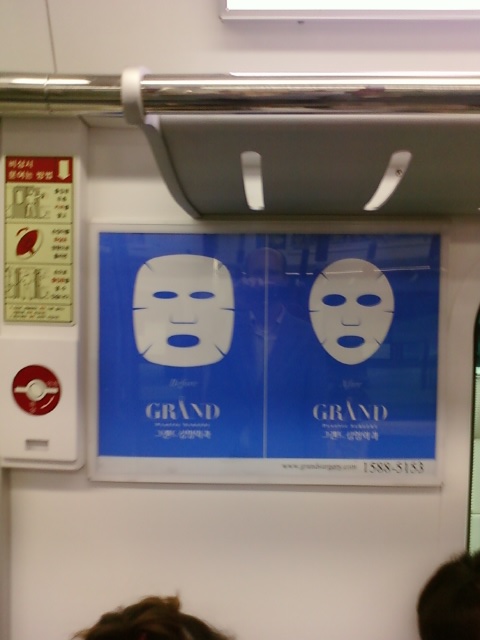
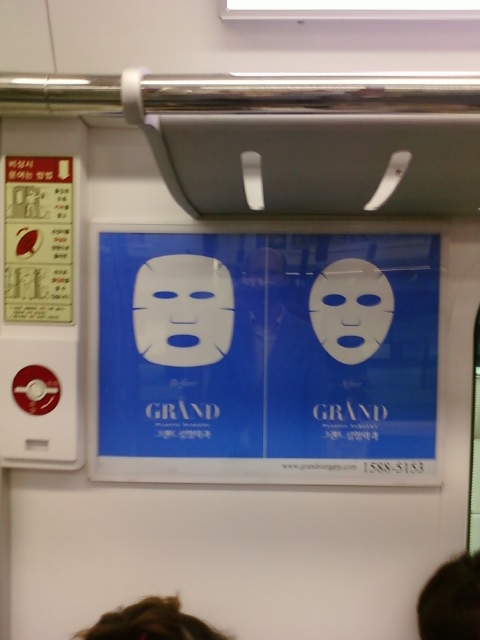
The first advertisement featured here shows two somewhat abstract faces. One is the before and the other the “after” picture. It is not hard to understand what is represented, but the interesting point is how much it looks like some sort of an online game.

Young people tend to see, by analogy, their own bodies as somehow akin to the possible forms you can select in a video game. Look at this example from the popular kids game “Bubble Fighter” as an example.

The player picks what body type and characteristics he or she wants. So also with games for young girls in which one picks dresses and facial and body types. In an odd way, the consumer selection motif is being carried over to the body itself. As if the virtual reality on line were spilling over into daily quotidian life.

Of course the result is an illusion, for much in plastic surgery creates more serious problems in later life. We have a strange combination of a virtual on-line culture where the most recent event cancels out everything before with an unprecedented life expectancy that suggests most people will live much longer than they ever imagined.

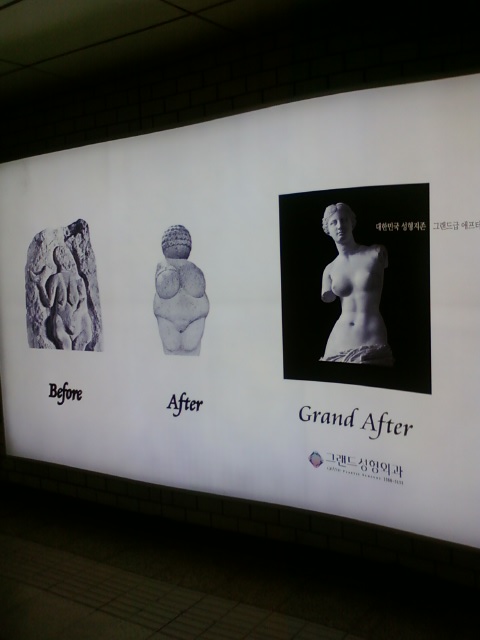
The second advertisement is more artistic, following the general conflation between plastic surgery are art (the blending of the natural and artificial) that we see in East Asia. Compared with the United States, the cultural context for plastic surgery quite elevated. it is a topic that is discussed openly and which becomes a topic for real artistic expression–part of a high cultural and social register.

I know that in the technology convergence field, and “medical tourism” field, plastic surgery is seen as a growth industry for Korea. The assumption is that the IT component, the ability to employ advanced technology for the manipulation of information will give Korea the advantage over Thailand and other places strong in the field.

This ad starts out on the left with a cave painting suggesting a more primitive culture (and of course implying that some societies are more “primitive”). The central image is the famed Venus of Willendorf, also “primitive” but at the same time erotic. And the crescendo is the Venus de Milo. The evolution of the human body through technological modification is mapped on a pattern of increasing artistic sophistication. The reference is entirely Western.

We could almost say that the concept of the avatar from gaming has been carried over to the individual’s body, or maybe even the metaphor of the robot has been carried over. Suddenly, the body as an extension of technology, of customized technology, the blending of the carbon-based and silicon-based systems.