Seoul: “Paradise sans Poubelle”

Seoul is without doubt increasing its sophistication with astonishing speed. Yet there are a few points that just do not make sense to the expat enjoying life in this city.

For example, why do the police not ticket the delivery men on motorcycles who rush around causing such chaos, and in many cases kill or cripple small children? it would not be hard to raise the bar and protect us all. Almost every time a man on a motorcycle approaches me on a sidewalk I say to him “This is not the road!” (길이 아닙니다!). And in almost every case he responds “Sorry.” Why? Because he knows what he is doing  is wrong.
All we need is for police to start ticketing seriously and this threat to everyone will rapidly disappear–and Korea will shine.

What is fascinating is that the bar is being raised by Seoul local government, Seoul Metro and many other public facilities, but for some reason we just do not manage to do so for those awful delivery men. We have safety doors on the subway platform for a level of safety you will not find many places in the world, but out on the sidewalk, watch out!

And then there is the issue of trashcans.

Korean facilities are increasingly sophisticated and increasingly public architecture and landscaping is improving. At the same time, Seoul parks and streets are littered with trash. Cigarette butts, bottles, wrappers from ice cream bars, beer cans and cardboard. The problem is two-fold. First, Seoul simply does not have any trash cans. People are willing to put up with trash on the ground rather than insisting on trashcans. Planners do not make trashcans a priority.

The decision is a serious mistake.

At the same time, I see extremely educated Koreans simply throw garbage on the ground while walking. Many Korean kids grow up thinking that is just naturalto toss wrappers on the ground. The trend is most disturbing. Sometimes I think the cause may lie with a misinterpretation of “democratization.” Koreans were so happy to escape from the repressive environment of Korea under the strongman Park Chong Hee that being able to just do anything was mistaken for political freedom. President Park may have had many flaws, but when it came to green zones in urban spaces and strict rules for citizens, he was right on the money.

By the way, smaller cities like Gyeongju and Jinju (and many other towns) are as clean, or cleaner, than Japan, so the problem is in part a Seoul problem.

Finally, I want to note that so many food products, bread, kimbap, rice cakes, everything are being wrapped up. More than was true even three years ago.

I almost never see a Korean say he or she does not need a plastic bag when offered one. And very few Koreans bring a cloth bag with them when they shop. Let us hope we see progress on this front going forward.
“DMZs Seen and Unseen” (Talk)

Emanuel Pastreich

April, 2003

Program in Arms Control, Disarmament and International Security

University of Illinois, Urbana-Champaign

DMZs Seen and Unseen;

The Real Challenges of Security and Culture in the 21st Century

We often think of North Korea, or Taiwan, as the last remaining traces of a cold war order that stand on the edge of collapse. We imagine that both problems may be resolved in the next decade, or perhaps even sooner, as economic forces overwhelm military and ideological conventions. Yet I would posit that we are perhaps being misled by our own preconceptions. How can it be that as tensions increase in the United States media and more spending for the military is approved in the Blue House that those on the street in Seoul seem to feel quite at ease with the current process of economic integration between North and South Korea, and an unprecedented group of South Koreans civilians have taken off for a ceremony in Pyongyang? How do we reconcile these divergent events? How can tensions mount between Japanand North Korea(or even South Koreaand Japan) at the same time that economic integration between North Koreaand China, Japanand South Koreacontinues unabated?  Part of the situation derives from misunderstandings. Part of the situation derives from the unique challenge of a   cultural and technological nature posed by the 21st century.

Pastreich on North Korea ACDIS 2003

Anti Nuclear Graffiti in Seoul

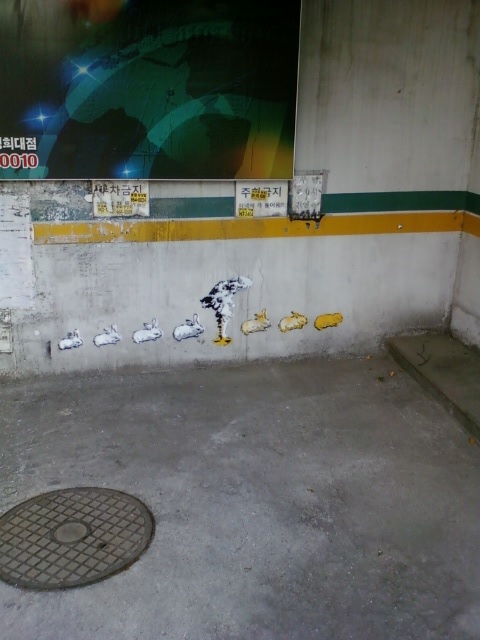
This cryptic anti-nuclear graffiti is showing up around Seoul, spay painted on walls by an anonymous activist. The reference to a fabled, perhaps apocryphal, tale of a rabbit born in the Fukushima region which had no ears is clear. I had not seen this sort of politically-charged street art around Korea anytime in recent memory.

Alternative Instruction Program at Daeseong Middle School, Gochang, Korea

Alternative Instruction Program at Daeseong Middle School, Gochang, Korea


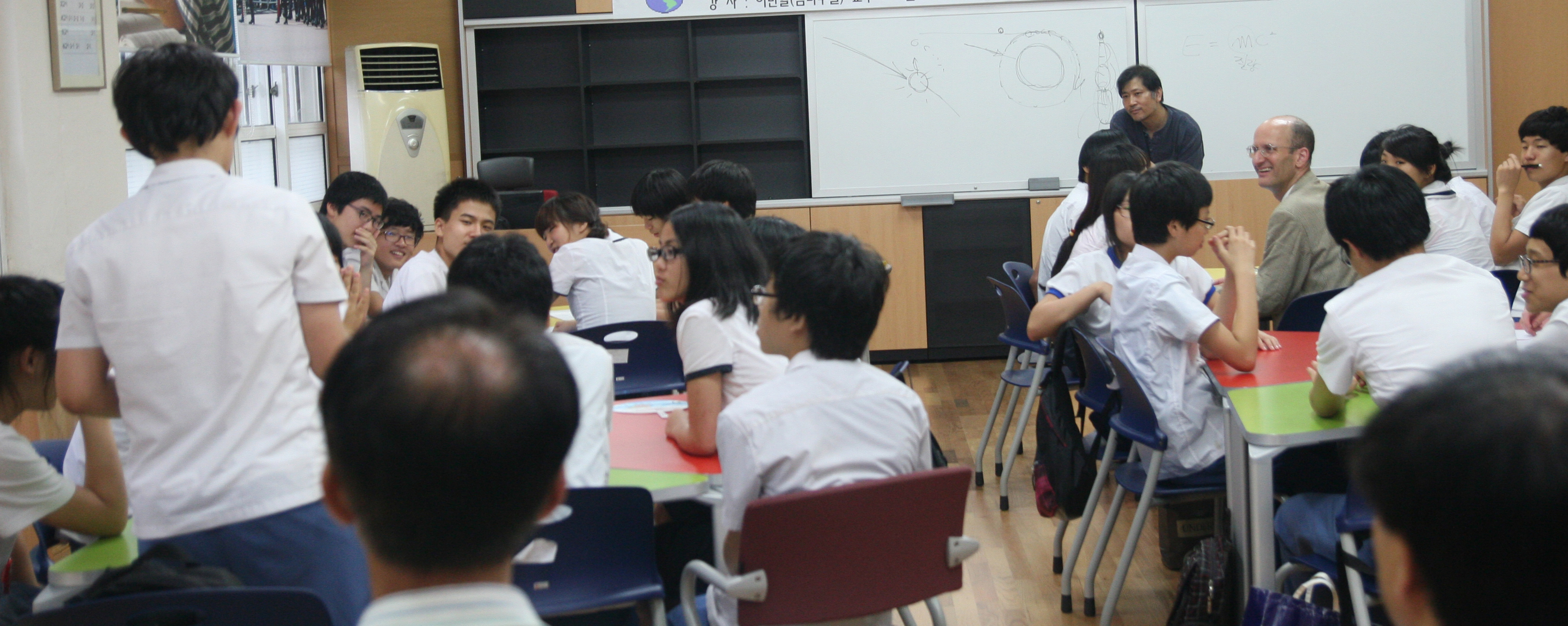
My close friend Gosan, with whom I have been working with on an alternative education project for the last six months, invited me to participate in one of his classes at Daeseong Middle School in Gochang, Korea. I travelled down yesterday and attended Gosan’s alternative class last night. There were about 25 students who had decided to use the time that they would normally devote to homework to attend this one hour class at six PM. First, The enthusiasm was palpable.


Gosan talked about the manner in which we assess problems and how we can make use of the knowledge we have to solve problems with which we are confronted. He broke the students into small groups of five or six (I was seated with one group) to discuss the topic.

 Gosan explained at length the principles of physics that the student had covered in their class. He then posed a rather unexpected challenge:

Read more

“The Korean Peninsula and the Struggle between World Powers” (talk)

ICAS Winter Symposium

Humanity, Peace and Security

Dirksen Building SD-226  B

Washington D.C.

12:30-4:30 pm

February 24, 2005

The Korean Peninsula and the Struggle between World Powers

100 Years after the Taft-Katsura Agreement and the Portsmouth Treaty

Opening Remarks

Any serious attempt to achieve a lasting and effective resolution to the economic and security issues of the Korean peninsula must perforce address the perceptions and beliefs of the Korean people themselves. Unfortunately, we Americans find ourselves making decisions regarding the future of the Korean peninsula without any sense of the historical context surrounding the present standoff with North Korea. Nor do we grasp the historical events long before the present day that have determined Korean attitudes towards the United States. This paper does not focus on the negotiations with North Korea that have gone on since 1994. Rather it considers the decisive first encounters between the United States and Korea in the nineteenth and early twentieth century and goes on to present a comparison between the geo-political issues critical in the present day and those critical one hundred years ago in the hope that some larger issues normally not treated in an analysis of security issues may be broached.


Pastreich ICAS Talk Feb. 17, 2005

“Impending Changes on the Korean Peninsula and the Future of U.S.-Korean Relations” (Talk)

Joint Annual Conference 2007

ICKS-KAUPA


Impending Changes on the Korean Peninsula and the Future of U.S.-Korean Relations


East-West Center

Joint Annual Conference 2007 of ICKS-KAUPA

June 28, 2007

Emanuel Pastreich


“The Change in Paradigm for US-Asia Relations:

A Socio-cultural Perspective”


The New Challenges we face today in East Asia

For all the talk of the nuclear programs of North Korea and the threat of terrorism we have been severely distracted from the equally serious threats that we face in East Asia which are growing daily and may well eclipse all other concerns in the years to come. The need to rethink our paradigm for security in East Asia is a pressing issue for all of us. Nevertheless, the well-established models and assumptions about what the very term “East Asia” means, based on a familiar nation-state paradigm, obscure more than they illuminate. We must put forth a new model for how individuals, organizations, societies and economies function today that takes into account the impact of economic and technological linkage, the results of a run-away consumer society, and the threat of environmental and atmospheric degradation.

We need to give serious thought to the shifts within the basic relations between individuals, corporations, states and non-government players. That does not mean that nation states have disappeared, but rather that the relationship between the elements of which they consist has been fundamentally altered. Moreover, those alterations are so profound as to be essentially invisible to most observers. If we were to create a map based upon where exactly where products are manufactured, how they are distributed and where they are consumed, it would be an accurate description of how the global economy works, but would be entirely alien to almost all observers. By the same token, the patterns by which pollution spreads through the oceans and the atmosphere, the consequences of over-fishing, the impact of climate change on agriculture and the pressures of population growth are equally as obscure as they are critical.


New Security Concerns in Asia Pastreich East West Center 2007


“Social Impacts of the Taean Oil Spill: An International Perspective” (guest report)

Senior associate of the Asia Institute Charlie Wolf produced this thoughtful report on the Taean Oil Spill and its larger implications which I think fits in nicely with my previous postings.

Charlie Wolf


Social Impact Assessment Center

(senior associate of the Asia Institute)

“Social Impacts of the Taean Oil Spill: An International Perspective”


Presented at the Taean International Environment Forum

“Lessons Learnt from the Taean Oil Spill & Marine Conservation”


Held at Anmyundo, Taean, Chungnam Province, Korea,


8 December 2008.


Taean Oil Spill Wolf Report