A Different Republic of Korea
that only Koreans don’t know
A Harvard Ph.D.’s Views on Korea’s Potential
“한국인만 모르는 다른 대한민국:
버드 박사가 본 한국의 가능성”
이십일세기 북스
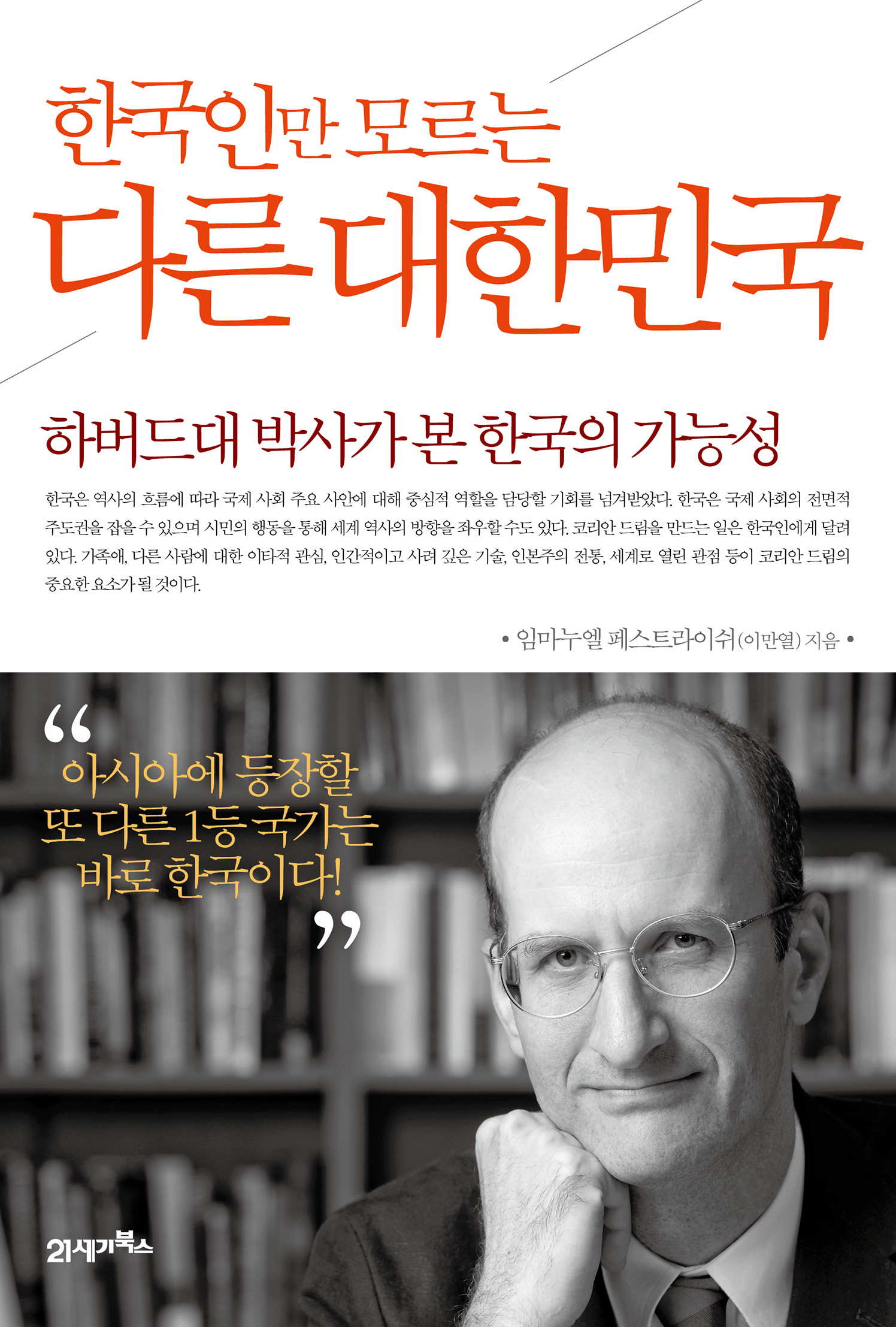
“한국인만 모르는 다른 대한민국:
버드 박사가 본 한국의 가능성”
이십일세기 북스
Neo-Confucian Learning in Korea
The Forgotten Origins of Modernity and the Platform for the Future
Emanuel Pastreich
August 10, 2013
There is a powerful myth that dominates Korean society today, one which severely undermines Korea’s cultural potential because it labels a tremendous chunk of the Korean cultural tradition as irrelevant, making it seem as if the intellectual achievements of Korean intellectuals before the twentieth century was misguided. You can find this argument in high school textbooks, or even in the introductions written in English for foreigners about Korean culture.
The myth concerns Korea’s intellectual tradition and the importance of the Neo-Confucian tradition in Korea. Neo-Confucianism is a general term for the philosophical system codified by the Southern Song Dynasty (1127–1279) scholar Zhu Xi (1130-1200) which formed the basis for much of the state ideologies of later dynasties in China and Korea. Neo-Confucianism was a synthetic approach to epistemology that combined early Confucian teachings with metaphysical terms developed in Buddhism to create an overarching world view that embraced the natural world, governance and ethics.
The Neo-Confucian vision of the world as a moral whole in which the scholar had the most privileged position by access to the Confucian classics became the basis for literally all formal education in the Joseon Dynasty (1392–1911). As Korea strove to modernize in the 20th century, during the colonial occupation by Japan, a myth about Neo-Confucianism took root that remains powerful to this day.
The myth goes something like this:

10 Magazine Book Club
Hosted by Barry Welsh
Saturday, September 14th 2013
Speakers:
Emanuel Pastreich
professor at Kyunghee University and director of the Asia Institute
&
Ogan Gurel
A director at the Samsung Advanced Institute of Technology
A visiting professor at SKKU’s Advanced Institute for Health Sciences and Technology,
“A Florence for the New Renaissance:
Seoul as a Mecca for the Creative Class in the 21st Century”
“It was not that long ago that the only internationals you would find wandering around Seoul were missionaries, English teachers and GIs. But that has changed radically over the last few years, with the best and brightest of the creative class flocking to Seoul as the new-found cluster for culture, business, technology and education. What is it about Seoul that makes is a leading contender for the global city, like Florence at the dawn of the Renaissance? What are the blue oceans for internationals looking for unique opportunities? How does Seoul stack up against Singapore, Seoul, Shanghai and Hong Kong? This talk will engage an informed and motivated audience in a frank and inspiring discussion about the true potential for Seoul and what we need to do to make Seoul realize its full potential.”
The second half of the session will be a question and answer session with the audience in which we can ask both guests about their work and experiences of Korea.
Korea Joongang Daily
August 8, 2013
“Revive ‘Green Growth’ Movement”
Koreans dream of a day in the future when they will be leaders – when Koreans will set trends for the world and hobnob with the rich and powerful. But the truth of the matter is that Korea is already a leader for the world, a country frequently benchmarked by the developing world, and increasingly the developed world as well, for its outstanding infrastructure, advanced research facilities and excellent governance.
Korea has gained such popularity as a model for the developing world in part because of the Korean Wave and Korea’s remarkable cultural vitality. But the more important factor is Korea’s unique position as a nation situated between the developed and the developing world.
The infrastructure, city planning or business conventions of Bonn or Chicago are not all that useful in Mongolia or Indonesia because the habits of those cities are so different and their development was long in the past. But the practices of Korea are immediately accessible and infinitely applicable. Because Korea is not that far away from its developmental economic phase, what is practiced in Seoul can be readily transferred to emerging economies. That goes for manufacturing and for urban planning and telecommunications.
임마누엘 페스트라이쉬
선진국과 개도국 사이 벤치마킹하기 좋은 위치에 자리잡아
한국인들은 언젠가 세계의 리더가 되는 날을 꿈꾼다. 자신들이 세계의 트렌드를 선도하고 세계의 부호·실력자들과 어울리는 날을 말이다.
하지만 사실상 한국은 이미 세계의 리더다. 개도국들이 수시로 벤치마킹을 하고 한국의 탁월한 인프라, 선진 연구시설, 뛰어난 지배구조를 배우려는 선진국도 갈수록 늘어난다.
한국이 개도국의 모델로 그렇게 인기를 모은 건 일면 한류와 한국의 주목할 만한 문화적 활력 때문이다. 그러나 더 중요한 요인이 있다. 선진국과 개도국 사이에 자리잡은 나라로서 한국의 독특한 위상이다. 베를린이나 시카고의 인프라, 도시계획 또는 사업관행은 몽골이나 인도네시아에는 그렇게 유용하지 않다.
China has a tremendous tradition of history. The study of history, the compilation of history and the ethical reading of history were considered the most important action for the intellectual and the consideration of history and precedents were seen as the essence of good government and responsible citizenship. Such remarkable figures as Confucius and Mencius asserted that the pursuit of accurate history was an essential part of the ethical life, and the only way to avoid tyranny. The famed historian, and progenitor of historiography in China, Sima Qian, suffered tremendous humiliation in order that he would be able to write down history in an accurate and compelling manner for the sake of future generations. He chose castration and life in a manner that was considered demeaning in order that he could complete an accurate historical record of recent history.
Traditionally, Chinese empires placed great emphasis on history and its accurate compilation and transmission. Each dynasty made tremendous efforts to collect and edit the essential documents from governance so that they could be used when it was necessary to compose an accurate history in the future, presumably under the orders of the next dynasty. That process of preparing for an accurate record of the events of the dynasty, one that would be written by future generations, was not only important for maintaining the historical record, it was also essential to creating a mood of ethical action within the government. To the degree that government officials felt that their actions were being observed by future generations, and that they would be subject judgment beyond the perspectives of their families and immediate superiors, their work was suffused with significance and a moral imperative. That is not to suggest that all action was moral, but rather the emphasis on the judgment of history checked the raw use of power.
But that role of the historian has disappeared in China, and in most countries around the world. Although information piles up in greater and greater amounts, there is no historian to analyze it in an ethical sense or make judgments as to what that data means in terms of useful to future generation. In the absence of an office for the compilation of the historical record, the functional guardians of what we might call history have been reduced to the media, to intelligence and to a variety of private firms handling creation of images on a paid basis. None of these institutions has any commitment to rendering history in an ethical sense. Increasingly all of them are driven primarily by the potential market value of information.
There is essentially not effort to find valuable institutions in the past, or to consider how the good or bad policies of previous rulers can be of service today. History has become, tragically, irrelevant.
I came across this cat, named “Choo Choo,” at a shop in Insa-dong yesterday. I was struck by the mystic look on his face, like a saint looking down on us sadly from the midst of this bacchanalia of consumption. There is a sadness in his eyes that one does not normally see in the products begging to be purchased and bring mindless happiness to consumers.

This is the textbook on ethics “도덕” employed in elementary schools in Korea today. The very existence of such a class as part of the daily program is remarkable. Whereas such teaching of ethics once seemed rather old-fashioned, it has a certain appeal today granted the decline of efforts to promote a discussion on ethics in the classroom in the United States.

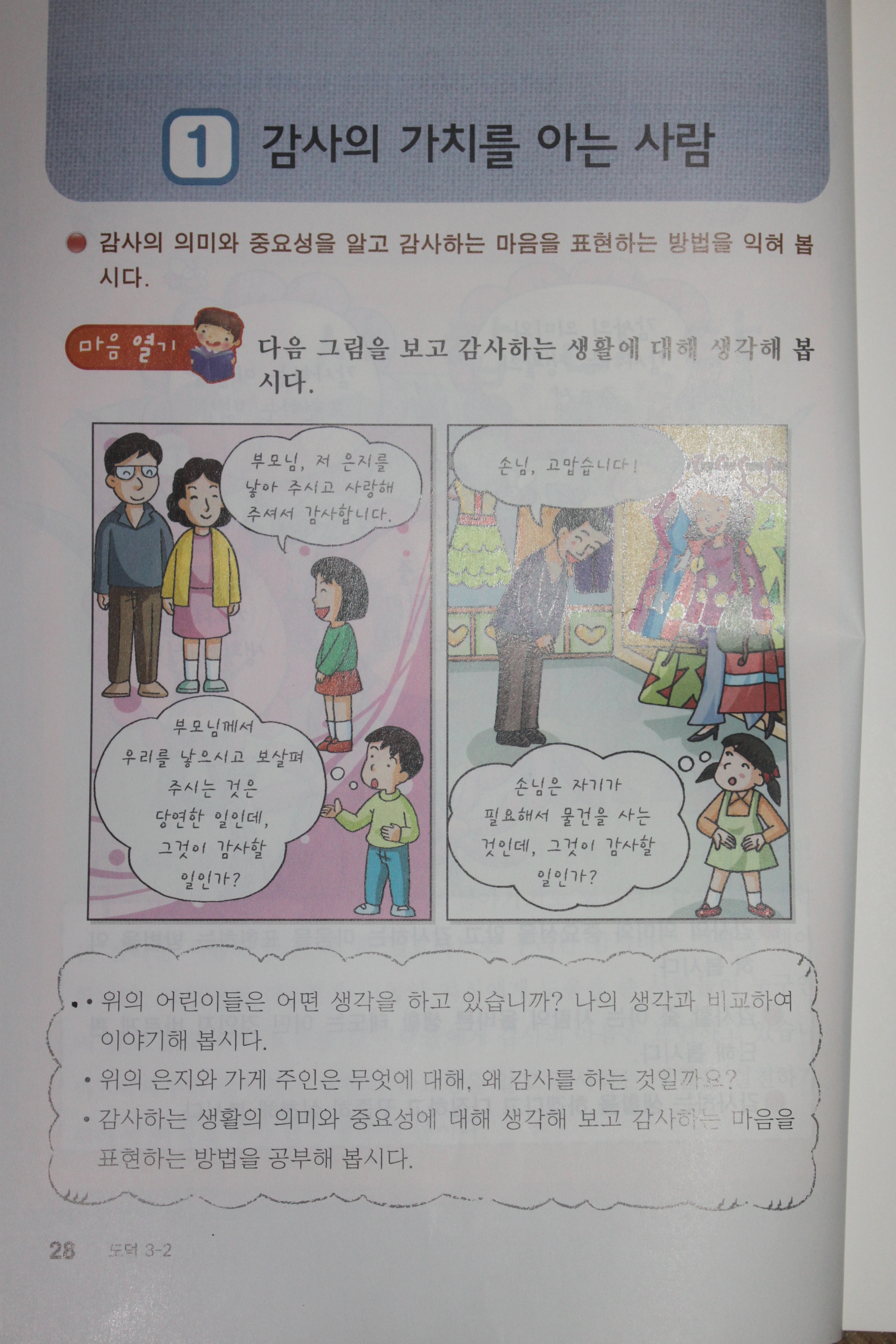
I was also struck by the efforts to address multicultural issues and the children of “multicultural families” (as the phrase goes in Korean).
Seoul Metropolitan Government has launched several campaigns to raise awareness of the threat of climate change. Recently, the following sign has also appeared in the Seoul Metro. The caption reads
“We can reduce the amount of food waste that causes such pain to the earth”
The illustration shows the entire world as bits of leftover food. There is a tremendous problem with food waste in Korea–as in China wasting food is often seen as a sign of living well. As a whole, however, Korea is far less wasteful of natural resources than the United States. I wonder if any American cities are carrying on similar campaigns?
Inverted feudalism
One of the most fascinating phenomena of the current day is the odd structure of government with regards to international relations and national politics, one in which it is local government that is more innovative and more open to concrete international exchange. The waning nation states are suggesting in their action a form of “inverted feudalism.” I formulated this term to describe the current relationship between the central government and local government, drawing on Benjamin Barber’s innovative writings about the new global role of cities and his proposal for a Parliament of Mayors.
In a nutshell, inverted feudalism refers to the tendency of national governments to behave in an increasingly feudalistic manner, inflexible to institutional change and hostile to international exchange except in the extremely limited form of high volume international trade via container ships between multinational corporations.