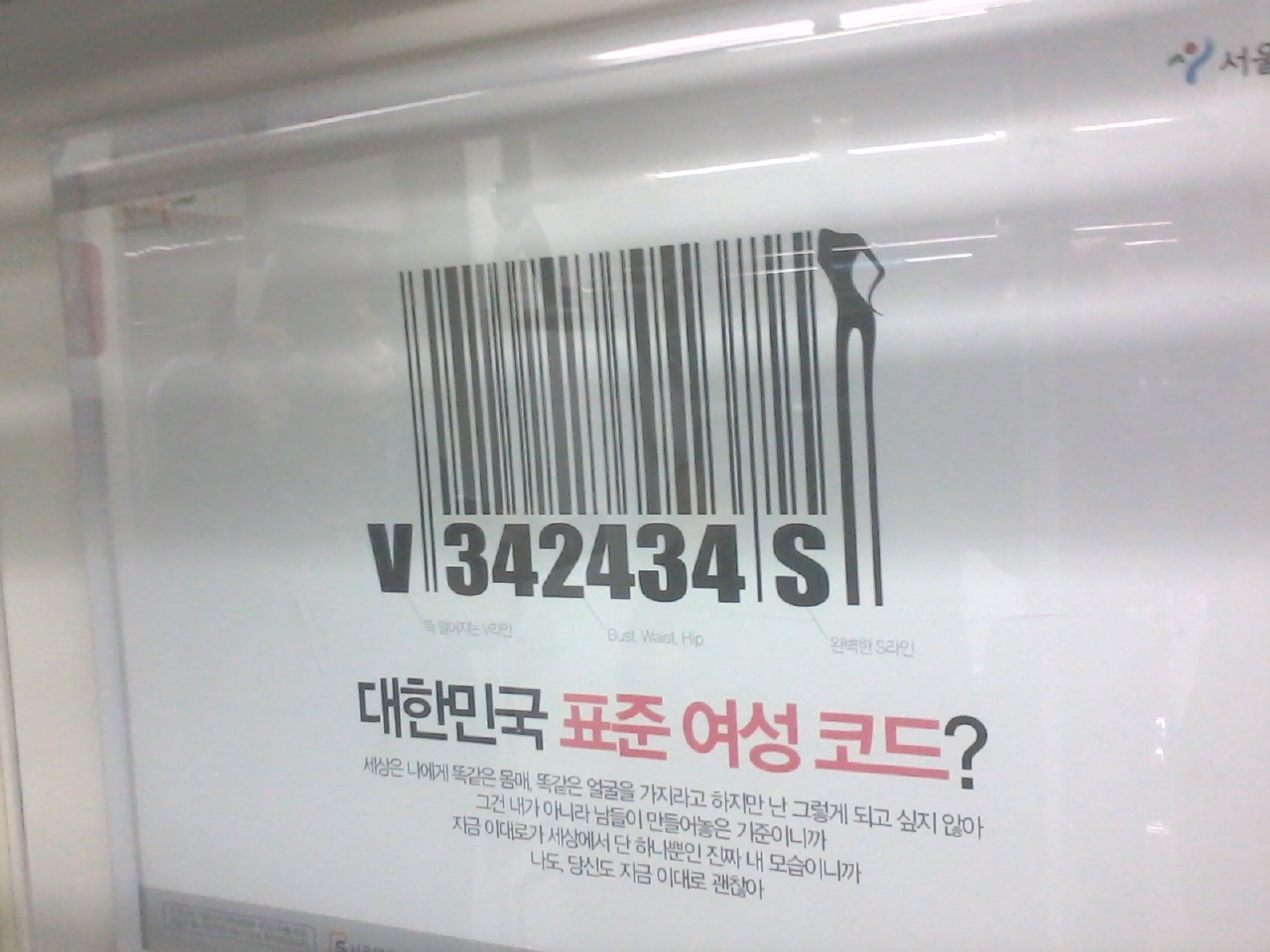
“The standard code for women in the Republic of Korea”

“The standard code for women in the Republic of Korea” 


This remarkable public advertisement has appeared recently in the Seoul Metro and sponsored by the City of Seoul. The graphic is a modified bar code which is referred to as “The standard code for women in the Republic of Korea” beneath.

the “V” is glossed as “V Line” the following numbers are glossed as “bust, waist & hip” and the “S” as “a perfect S line”

The text below reads

“Society tells me i must have the same body, the same face, as everyone, but I do not want to be like that. To do so to conform to a stardard made not by myself, but by others. The way I am now is the one and only true form for me. It is just fine for me, and fine for you, to just be the way we are.”

The ad is remarkable in part because of the striking creativity of employing the bar code image as a symbol of the oppressive domination of women by images and the resulting usage of plastic surgery and other techniques as an artificial means to conform.

The ad is also noteworthy because the city government produced it as a means of playing a positive role in society and offering up an alternative discourse for women in opposition to the dominant one of consumption and indulgence. It seems like a positive model for the role that government can play in society.

 

being human

The Snail is Smothered by his Shell

The Snail is Smothered by his Shell

Emanuel Pastreich

December 25, 2013 

Do humans determine what will happen, or is it the system, the material culture that grows up around us the power that determines the future? Humans are surrounded by objects and institutions that are not part of their bodies, but an essential part of their lives and experience. Perhaps the closest analogy to human culture is the snail and his shell, an essential external item that is nevertheless not actually the snail. But recently those institutions and habits of the human are shifting and changing so quickly, and growing so rapidly, that we find complete chaos around us. It is a chaos that we cannot see.  An ideological chaos in which each person thinks he or she is doing his or her best but cannot even make the slightest modifications in behavior.

We cannot even require reuse-able glass with a deposit for all liquid products sold. It is such a simple step that would do much to help reduce such mindless consumption, but not only can we not implement such a policy, in spite of all our sophisticated conversations over cappuccino at Starbucks, we cannot even formulate it as a priority.

Perhaps this fog in our thinking is one of the greatest dangers of rapid technological change. There is the distinct risk that when we encounter the greatest crisis of climate change many citizens of the world will only be vaguely aware of what is happening to them.

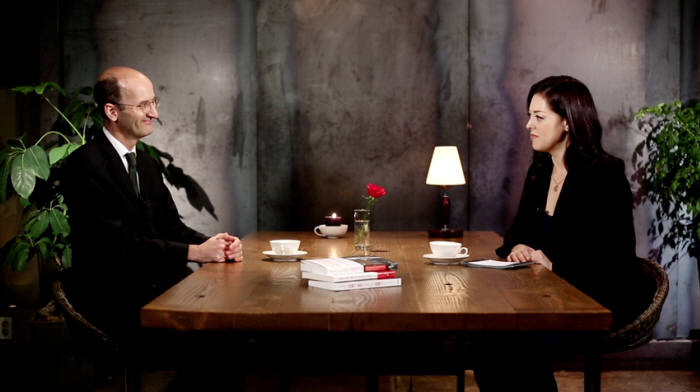
Emanuel interviewed on Arirang’s “The Inner View”

innerview_main

arirang_series_1

The INNER VIEW

Focus: Emanuel Pastreich

In five installments on Youtube:

Part 1

Part 2

Part 3

Part 4

Part 5

Arirang TV Description:

Emanuel Pastreich, who obtained his doctorate at Harvard University, views Korea differently from most people. While Koreans are busy promoting their culture through the Korean wave, or Hallyu, and K-pop, he advocates that we should focus more on the deeply rooted traditions such as the traditional practices related to Chuseok, one of Korea’s most important holidays. He also argues that we should develop the rural areas, which have preserved some of these traditions, to attract foreign tourists because their natural scenic landscape can be compared to Provence in France.

Emanuel has another name, Lee Man-yeol, which was given to him by his father-in-law. It resembles his actual name in its sound, but has a different meaning – ‘a man of many passions.’ He is indeed a very passionate person. While others praised Korea on the conspicuous achievements, he spoke about the beauty of Korea that was yet to be discovered by the global community by looking beneath the surface. He studied the traditions and history of Korea, based on which he attempted to provide solutions for Korea’s future.

“Korea can create a better future for itself by incorporating the administrative system of the Joseon period.”

Everything seems to be evolving very quickly these days, with the traces of the past diminishing just as fast. Emanuel Pastreich says that it is in these times, we need to look to the past to seek solutions for the future.

It has only been 7 years since he set foot on Korean soil, and it hasn’t been easy, adapting to a society that’s different from his home country in many aspects. But on the other hand, coming from a different ethnic and cultural background, he can offer a fresh perspective on various sides of Korea from an objective point of view.

innerview

“美, 근시안적인 ‘내기’ 전술 벗어나야” (중앙일보 Sunday)

중앙일보 Sunday

“美, 근시안적인 ‘내기’ 전술 벗어나야”

페스트라이쉬 경희대 교수가 본 바이든 ‘베팅’ 발언

2013년 12월 8일


임마누엘 페스트라이쉬

조 바이든 부통령이 6일 서울에서 박근혜 대통령을 접견하며 한 발언 가운데 한 구절은 동아시아에서 미국의 안보공약을 믿는 사람들에게 충격을 줬다. “미국이 아닌 다른 곳에 내기를 거는 건 좋지 않다”가 그것이다. ‘내기(betting)’란 단어는 상처 난 엄지손가락처럼 눈에 확 띄었다. 이 단어만 없었다면 그의 말은 아주 사려 깊은 연설이 됐을 것이다.

국제사회에서 미국의 역할은 내기를 거는 게 아니다. 그것은 분쟁 국가 간에 가교를 놓고, 공통의 가치를 창출하며 동아시아와 세계의 장기적 비전을 추구하는 것이다. 바이든 부통령은 매우 점잖고 성실한 사람이다. 가장 뛰어난 정치인 중 하나다. 그러나 월스트리트와 투기경제의 상징인 ‘내기’란 말로 인해 발목이 잡힌 셈이 됐다. 내기란 발상은 동아시아와 세계가 공통의 사회를 창출하려는 노력을 왜곡한다.

Read more

“‘정보 혁명’의 危機를 직시하자” (조선일보)

조선일보

“‘정보 혁명 危機를 직시하자

2013년 11월 28일

임마누엘 페스트라이쉬

http://premium.chosun.com/site/data/html_dir/2013/11/27/2013112704220.html


현재 한국에서는 지난 대선 기간 중 국정원의 댓글 조작에 의한 날조된 정보의 확산에 관한 격렬한 토론이 지속되고 있다. 이러한 이야기가 어디까지 사실일지 내가 판단할 위치에 있지는 않지만 이러한 정보 조작 활동에 참여하고 있는 기관과 개인은 세계 도처에 존재하고 있다. 현실적으로 누가 구체적으로 무엇을 한 것인지 확인하기 매우 어렵다.

미국도 국가 차원에서 NSA(국가안전보장국)를 통해 한국을 비롯한 세계 각국의 정보를 무차별적으로 수집했다는 사실은 전 세계적으로 미국에 대한 극도의 불신을 초래하였다. 정치적 경제적 이득을 위한 미국 정부의 이러한 타국에 대한 승인되지 않은 정보 취득은 국가 간 중대한 분쟁을 일으킬 수도 있다.

그러나 정보 위조와 승인되지 않은 정보 수집을 단지 도덕적 관점에서 다루는 것은 오류일 수 있다. 왜냐하면 정보를 수집하고 위조하는 능력은 기술 발전에 따라서 소위 ‘무어의 법칙’ 속도로 발전하고 있기 때문이다. 정보 위조는 이제 너무나 쉬워서 유혹이 된다. 따라서 정보의 승인되지 않은 수집과 위조는 그 행위자에 대한 처벌만으로는 해결될 수 없고 이러한 정보 오용을 근본적으로 규제할 수 있는 새로운 체계를 만들어 내는 것만이 궁극적 해결책이 될 것이다.

우선 우리는 매우 강력하고 탄탄한 정보 관리 시스템이 필요하다는 것을 인식할 필요가 있다. 또한 이러한 새로운 정보 관리 기관은 무엇보다도 정치적 압력으로부터 독립적이어야 하며 정보의 정확성을 그들의 본질적 과제로 삼아야 한다. 아울러 이러한 정보혁명의 위기는 국경이 없는 국제적 차원에서 다루어져야 할 문제임을 인지해야 한다.

동아시아 국가 중 가장 민주적이며, 문화적 활력과 과학기술을 지닌 대한민국은 정확한 정보를 유지하기 위한 국제적 기준을 만들어 낼 충분한 능력 및 자격이 있다. 우리는 무엇보다도 국제적인 ‘정보의 헌법’에 따른 정보 관리 협력 기구에 대한 청사진을 제시해야만 한다. 그러나 한국이 제시할 국제적 ‘정보의 헌법’ 청사진의 실마리를 스티브 잡스에게서 찾을 수는 없을 것이

Read more

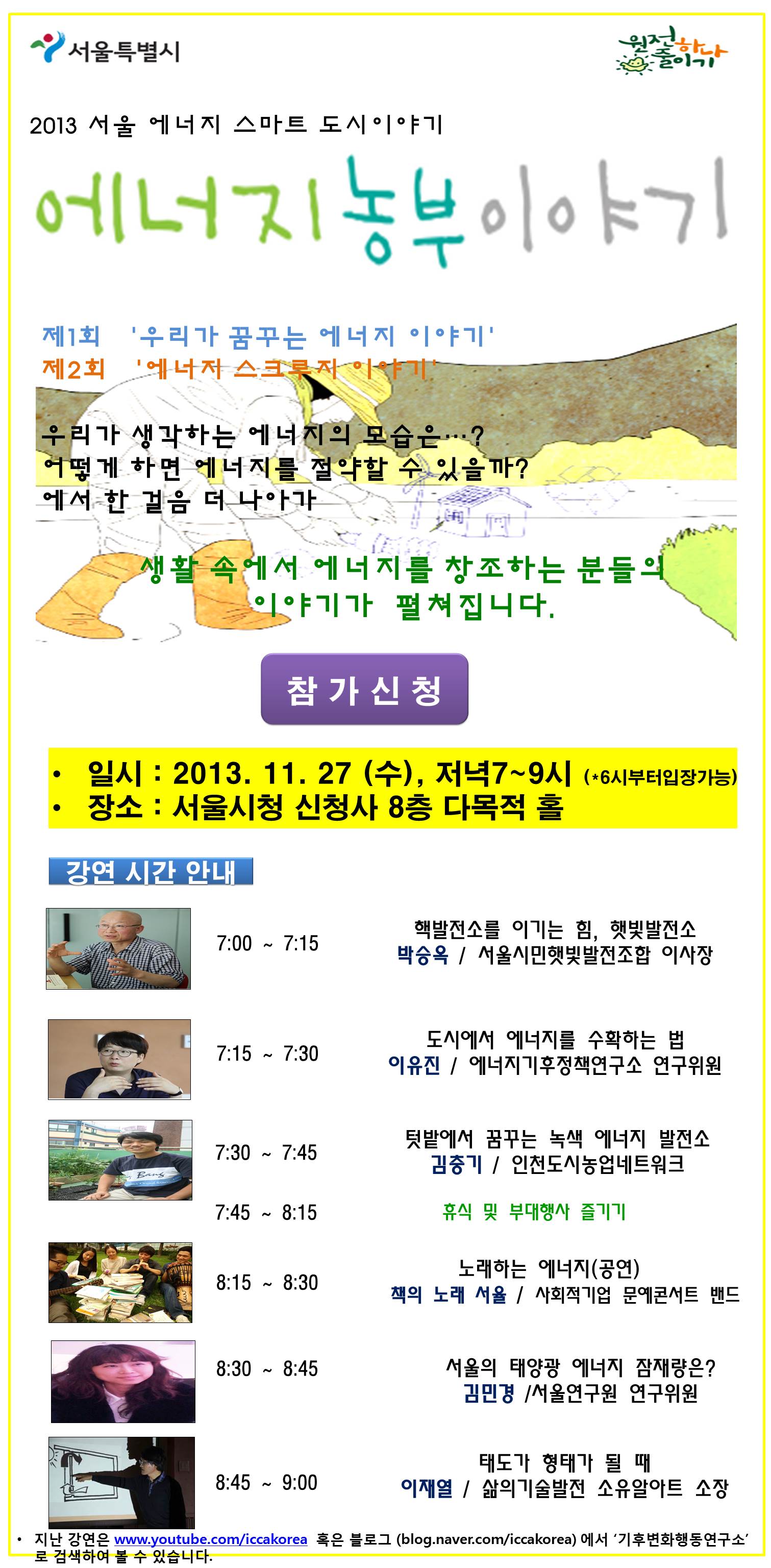
“Tale of Energy Farming” Seminar on November 27 sponsored by Seoul Metropolitan City

“Tale of Energy Farming” Seminar for citizens on November 27 sponsored by Seoul Metropolitan City as part of the “Tale of an Energy Smart City” series at City Hall. This event features short discussions taht are extremely practical about  solar energy and its potential, about “harvesting energy” in the city and the issue of climate change and about green energy. The speakers come from a variety of local NGOs and represent well Mayor Park’s vision. 

event on climate change and urban farming sponsored by Seoul Metropolitan Government

“친구 결혼식 때문에 한국에 잠깐 들렀다가…” (여성조선 2013년 10월)

“친구 결혼식 때문에 한국에 잠깐 들렀다가…”

여성조선

2013년 10월


인터뷰 전 임마누엘 페스트라이시 교수에게 혹시 단골 찻집이 있냐고 물었다. 잘 아는 곳이 있다며 장충동의 한 찻집을 추천했다. 전통찻집 한가운데 앉아 있는 파란 눈의 꺽다리 교수가 이질적이면서도 잘 어울렸다. 기꺼이 주말을 내준 그와 그렇게 처음 만났다.

페스트라이시 교수는 올해로 한국 생활 18년째에 접어든 ‘베테랑 외국인’이다. 예일대, 도쿄대, 하버드대를 거쳐 현재 경희대학교 국제학부 교수로 있다. 그가 얼마 전 <한국인만 모르는 다른 대한민국>이라는 책을 냈다. 한국말로 된 책으로는 벌써 세 번째다. 지난 두 권의 책과 차이가 있다면, 지정학적 위치에서 현재의 한국을 적나라하게 ‘후벼팠다’는 것. 애정이 있지 않으면 절대로 할 수 없는 말, 외국인의 시각에서 본 한국의 진실 말이다. 그와 유창한 한국말로 한 시간여 대화를 나눴다.

박지원 소설 “스토리텔링이 있어 좋아해”

임마누엘 페스트라이시 교수의 한국 이름은 이만열이다. 소리 내어 읽어보면 알겠지만, 영어 이름과 가장 유사한 발음의 이름이다. 꽤 오랜 기간 한국에 발붙이고 살면서 그는 한국인보다 더 한국에 정이 들었다.

“이번 책은 기존에 낸 두 권의 책과는 목적이 좀 달라요. 전에는 누구나 읽을 수 있는 내용의 책을 냈다면, 이번엔 덜 대중적일지도 몰라요. 한국인 스스로 자국의 단점을 깨닫고 가능성을 찾아갈 수 있게 만든 책이에요.”

그가 기존에 쓴 책들을 쭉 펼쳐 보였다. 그중 유일하게 영어로 번역된 책 한 권이 눈에 들어왔다.

“연암 박지원 소설을 번역했어요. 18세기 한국 고전문학 중 가장 외국인이 접근하기 쉬운 소설이라 생각했어요. 일단 스토리텔링이 있거든요. 다른 고전소설은 단조로운 면이 있는데, 박지원 소설은 등장인물도 다채롭고 스토리가 재미있어요. 당시로서는 드물게 하층민을 주인공으로 내세웠다는 점도 흥미롭고요.”

Read more

“Be Here Now” and the Nature of Political Change

Although there are many who were involved in the debate over the Vietnam War, in many respects Richard Alpert’s book played a central and underestimated role. Perhaps that was the whole point of Alpert’s approach, especially when he assumed the name Ram Dass and became a yogi of sorts. I have gone through a few sections of the book I found on the internet recently and found them of great relevance today.

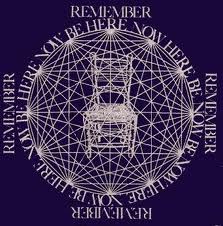
"Be Here Now"   This classic book by Ram Dass (Richard Alpert) was released in 1971 at the height of political chaos in the United States towards the close of the Vietnam War.
“Be Here Now”
This classic book by Ram Dass (Richard Alpert) was released in 1971 at the height of political chaos in the United States towards the close of the Vietnam War.

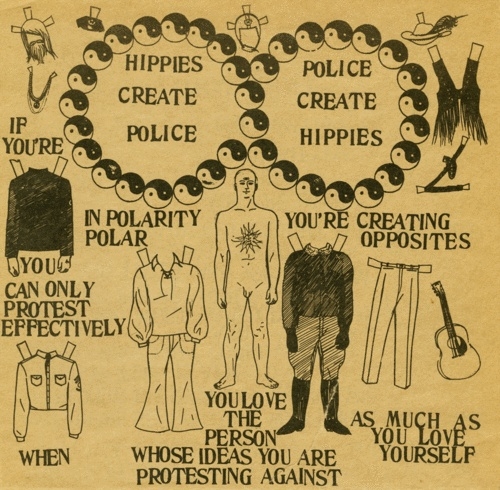
This illustration about the seeming conflict between the police and the hippies is of great interest.

Deceptively simple, this description of the duality that underlies all political discourse made a deep impression when I first saw it many years ago.

Using Buddhist ideas about duality, Alpert suggests how the two forces we see in front of us feed off of each other. I would not suggest that “Be Here Now” offers a solution, but it does offer much in the way of insight.


A few more selections:


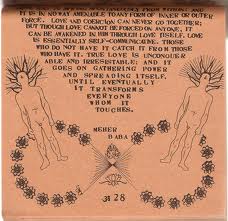
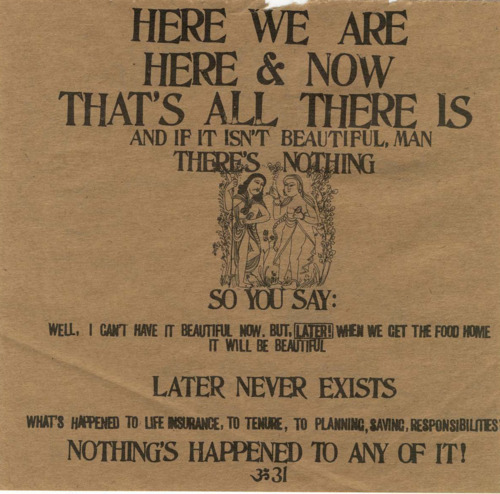
56509ce026dad1ad95d89cf8e0deb4bcimages (1)images (2)images (3) images (4)imagestumblr_lfv5wdaCjW1qc01tho1_500다운로드