“한중일 3국의 문자에 대한 고찰”

Trilateral cooperation secretariat

한중일 협력사무국

강연회

“한중일 3국의 문자에 대한 고찰”

  •  EmanuelPastreich (이만열) – 아시아인스티튜트 소장
  •  2014년 2월 13일 오후 2시- 4시


  • 한중일협력사무국은 2014년 2월 13일부터 매월“Three Strands of Asia” (동아시아 문화의 세 갈래)란

    주제로 강연회를 개최합니다. 본 강연은 한중일 전문가

    들을 초청하여 비교적인 관점에서 3국의 주목할만한

    사회문화적 특징에 대한 다양한 설명을 하는

    자리가 될 것입니다.
    많은 참석과 관심을 부탁 드립니다.

  • 장소 :
  • 한중일협력사무국 회의실


110-700 서울특별시 종로구 새문안로 82 에스타워 20층

  • 언어 : 한국어
  • 대상 : 일반인 (대학생 및 대학원생들의 참여를 환영합니다)
  • 신청방법 : 2월 7일까지 담당자 양수영 연구원 (syang21@tcs-asia.org)에게 이메일을 통해 신청
  • * 참가는 무료이며 선착순입니다. 이메일에 신청자 이름과 소속을 적어주시기 바랍니다.

link 

Giáo sư Lee Man Yeol: “Hãy tìm tương lai Hàn Quốc trong thời Chosun” (Việt)

Giáo sư Lee Man Yeol:

“Hãy tìm tương lai Hàn Quốc trong thời Chosun”

KOREA.NET

17.06.2013

Giáo sư trường Nhân văn thuộc Đại học Kyunghee Hàn Quốc – Emanuel Pastreich (tên tiếng Hàn: Lee Man Yeol) đã sống ở Hàn Quốc được hơn 10 năm. Trước đây, ông từng theo học Đại học Yale, Đại học Harvard, Đại học Tokyo, Đại học Seoul… Với chuyên ngành văn học Đông phương, ông đặc biệt quan tâm và yêu thích văn hóa Hàn Quốc. Ông từng dịch cuốn Nhật ký Yeolha của nhà văn thời Chosun Park Ji Won sang tiếng Anh và hiện đang tập trung viết một cuốn sách về văn hóa Hàn Quốc với chủ đề “Một Đại Hàn Dân Quốc khác”, chia sẻ những gì ông thấy, cảm nhận và suy nghĩ về Hàn Quốc.

Người ngoại quốc mắt xanh này thật đúng với biệt danh “người theo chủ nghĩa thế giới của thế kỷ 21”. Nếu như người đàn ông 50 tuổi quốc tịch Mỹ này trông khá khác lạ với người dân Hàn Quốc, thì việc ông thao thao bất tuyệt về những tác phẩm văn chương của Nhật Bản, những cuốn tiểu thuyết thời Chosun của Hàn Quốc, hay những tác phẩm kinh điển của Trung Quốc như “Hồng Lâu Mộng”, “Kim Bình Mai”… phải nói là điều kỳ diệu. Hãy cùng lắng nghe những chia sẻ của giáo sư Lee Man Yeol về thời Chosun cũng như thế kỷ 21.

Đi khắp Trung Quốc, Nhật Bản và rồi đến Hàn Quốc để theo đuổi việc học, ông khiến tôi liên tưởng đến một chuyến du ngoạn từ thời Cổ đại, Trung đại, tới thời Xuân Thu (BC770~BC403), thời Chiến Quốc (BC403~BC221).

Read more

“Amerikanischer Professor sucht in Koreas vergessenen Traditionen nach der Zukunft” (Deutsch)

“Amerikanischer Professor sucht in Koreas vergessenen Traditionen nach der Zukunft”

17.06.2013

Emanuel Pastreich, der in Seoul unter dem koreanischen Namen Lee Man-yeol bekannt ist, lebt seit mehr als sechs Jahren in Korea. Er ist Professor an der Hochschule für internationale Studien der Kyung Hee University und Gründer des Asieninstituts. Pastreich begann seine Asienstudien am Yale College und setzte seine Ausbildung an der Harvard University, der University of Tokio und der Seoul National University fort. Er entwickelte eine bemerkenswerte Zuneigung für die koreanische Kultur, als er vergleichenden Studien durchführte, und übersetzte kürzlich die Kurzgeschichten des Intellektuellen und Romanautors Park Ji-won (1737-1805) ins Englische.

Pastreich hat eine Leidenschaft für die Kultur und Literatur der Joseon-Dynastie (1392-1910) – eine Ära, die, wie er denkt, von den Koreanern, die sich kopfüber in die Modernität stürzten, unterschätzt wurde. Er schreibt nun ein neues Buch, in dem er darüber spricht, wie die traditionelle koreanische Kultur eine Rolle in der modernen Gesellschaft spielte. Das Buch mit dem Titel „Ein anderes Korea“ präsentiert außer Acht gelassene Aspekte von Korea, die seiner Ansicht nach relevant für moderne Probleme sind. Das Buch wird im Juli 2013 auf Koreanisch herauskommen.

Ich habe mit dem blauäugigen Amerikaner in seinem Seouler Stammcafé gesprochen, mit jemandem, der besser ein “Kosmopolit des 21. Jahrhunderts“ genannt werden sollte. Dieser Brillenträger, der auf die 50 zugeht, unterrichtete mich in fließendem Koreanisch über seine Ansichten zu Erzählungen aus der Joseon-Zeit, mit denen die meisten Koreaner nicht vertraut sind, nicht zu vergessen chinesische vormoderne Erzählungen wie „Die Pflaume in der goldenen Vase“ (Jin Ping Mei) und „Der Traum der Roten Kammer“ (Hóng Lóu Mèng) sowie japanische Erzählungen wie die des Yomihon-Genres aus der Edo-Zeit (1603-1867). In dem Gespräch stellte er sein breites Wissen über die koreanische Tradition unter Beweis, das vom Gedankengut und der Literatur der Joseon-Dynastie bis zu Themen der zeitgenössischen koreanischen Gesellschaft reichte.

Read more

“Un professeur américain voit dans les traditions oubliées de la Corée les réponses pour l’avenir” (Français)


“Un professeur américain voit dans les traditions oubliées de la Corée

les réponses pour l’avenir”

KOREA.NET

17.06.2013

Emanuel Pastreich, connu à Séoul sous son nom coréen de Lee Man-yeol, vit en Corée depuis plus de six ans. Professeur à la Faculté d’Etudes internationales de l’Université Kyung Hee, il a fondé l’Institut d’Asie. Durant ses études à Yale, E. Pastreich a commencé à se spécialiser sur l’Asie. Il a poursuivi ses études à Harvard, puis à l’Université de Tokyo et à l’Université Nationale de Séoul. C’est alors qu’au fil de ses recherches comparatives, il a développé une affinité particulière pour la culture coréenne. Il vient récemment de traduire en anglais les nouvelles de l’intellectuel et écrivain Park Ji-won (1737∼1805).

Emanuel Pastreich est un passionné de culture et de littérature de la Dynastie Joseon (1392-1910), période que les Coréens ont, selon lui, par trop mésestimée dans leur course en avant vers la modernité. Dans le nouveau livre qu’il rédige actuellement, il explique que la culture traditionnelle peut jouer un rôle fondamental dans la société contemporaine. A cet égard, cet ouvrage intitulé «Une Autre Corée» présente des facettes méconnues de la Corée qui, selon lui, peuvent s’avérer utiles s’agissant des problèmes contemporains. Le livre sera publié en Corée en juillet 2013.

C’est dans un café de Séoul qu’il affectionne tout particulièrement que j’ai rencontré ce chercheur américain, que nous pourrions qualifier de «globetrotteur du 21ème siècle». Cet homme au regard bleu clair cerclé de fines lunettes, qui approche la cinquantaine, m’a fait part, dans un coréen parfait, de ses réflexions sur les écrits de l’époque Joseon, peu connus de la plupart des Coréens, sans oublier les romans pré-modernes chinois comme «Fleur en Fiole d’or» (Jin Ping Mei) et «Rêve dans le Pavillon Rouge» (Hóng Lóu Mèng), de même que les écrits japonais, tels que le genre yomihon de la période Edo (1603–1867). Ainsi, la conversation a-t-elle reflété sa connaissance approfondie de la tradition coréenne, son immense érudition s’étendant de la pensée et de la littérature de la Dynastie Joseon à la société coréenne contemporaine.

Read more

“Crisis and opportunity for K-pop” (Joongang Daily January 20, 2014)


Joongang Daily

January 20, 2014


“Crisis and opportunity for K-pop”

 Emanuel Pastreich


Let me apologize to my Korean friends in advance. I know how proud of Psy Koreans are, and how fascinated they are with the success of his “Gangnam Style.” I grant that his one billion hits on YouTube is impressive.

Nevertheless, the critical issue for Korea is direction, not speed. The speed with which Psy became a world icon is breathtaking. But if the direction is wrong, it is simply wrong. If the Korean Wave lacks ethical and aesthetic content, it simply will not last; if Korea puts all its efforts into cultivating a culture of lavish consumption, and of meretricious images that rush by, where will we be when the party is over?

Psy embodies a materialist culture of consumption, a narcissism that draws us to surfaces. Friends tell me that he is engaged in an elaborate parody of materialism, but that is not how he is understood by his followers around the world. They are drawn rather to his indulgence, to his compulsive behavior and to his prepackaged masculinity.

I ask you whether a handicapped girl will find inspiration in the prancing teens of K-pop bands to know that commitment, trust and belief are more powerful than appearances and fleeting thrills? Will youth find in the videos they watch an inspiration to give back to society and create a new global network to advance peace and to save the environment?

I doubt it. Gangnam is in danger of becoming a cultural desert. Not unlike the spreading deserts in China that now fill the air we breathe with dust and sand.

All the greater is the tragedy of this consumer interpretation of the Korean Wave, as its original appeal was based on the compassion, emotions and humaneness of Koreans.

Korea was the only country that has become a global power without the baggage of colonialism and imperialism, without the cultural elitism of other such powers. That is the true essence of the Korean Wave.

If the direction for the Korean Wave is wrong, the tragedy is one we will share with the entire world. If Korea’s youth throw garbage on the ground, waste natural resources and energy without even a thought, and pursue a personalized life of disposable paper cups and late-night drinking in which there is no room for parents and friends, let alone those who have had less advantages in life, we can be sure that youth in Southeast Asia, Central Asia, the Middle East and elsewhere will follow that model. That will lead to a true cataclysm for humanity in this age of limited resources.

And what about that traditional Korea that we have left behind? The Korean mother who saved every single grain of rice, was she so backward and uncultured? In an age of climate change, those traditional virtues of frugality, that concern for soil, water and nature should be at the core of the Korean Wave.

And what about those yangban scholars? Were they foolish and backward when they sat in simple unadorned rooms and read the Confucian classics all day, speaking of personal morality and of responsibility to family and society? Or did they grasp some truth about the need for a spiritual space in our lives and the importance of avoiding the mindless consumption that so damages the environment?

So what can the Korean Wave be? Imagine an African in a small village in Kenya who rises up to build a new drainage system for his people and fights to preserve his culture against the onslaught of international culture. He says, “I am the King Sejong of Kenya.” He finds inspiration in the greatness of the past, a universal past, which comes from Korea.

Imagine a woman combating drug gangs in Mexico City. She tries to bring together the community to pursue common interests and build a system that is inclusive. She says, “I am the Dasan of Mexico,” and she finds a model for action in a Korean intellectual who stood up for commoners and embraced a new vision for his country.

A Mexican can find in that Korean tradition something she can make her own. That is not a Korean Wave you will find in popular songs today. But it could be.

link
“世界主义者贝一明:在朝鲜时期寻找韩国的未来” (中文)


世界主义者贝一明在朝鲜时期寻找韩国的未来

Korea.Net

2013.06.17

世界学者贝一明(英文名Emanuel Pastreich)有个韩国名字叫做李万烈。他在韩国已经生活了10多年,目前执教于庆熙大学人文学院。贝一明曾就读于耶鲁大学、哈佛大学、东京大学和首尔大学。他的专业是东方文学,还曾经将朝鲜时期的实学家朴趾源所著的《热河日记》翻译成英文介绍向西方。他对韩国与韩国的文化有着不一般的热忱。他正在执笔的书籍《不同的大韩民国》是一本关于现代韩国文化的书籍,里面记录了他眼中看到的,他感受到,他认为的大韩民国的面貌。该书预计将在6月末出版。

笔者很想要给这个长着蓝眼睛的外国人贴上一个“21世纪的世界主义者” 的称号。这个已经到了知天命年纪的美国男人用非常流畅的韩国语讲起连韩国人都觉得陌生的中国小说《金瓶梅》、《红楼梦》和日本读本小说的时候的滔滔不绝的样子让人惊讶万分。笔者不久前与他见面进行了一场关于朝鲜时期和21世纪的对话。


o 您为了追求学问先后去了中国和日本来又定居在韩国这很容易让人联想到古代和中世纪的学僧以及在春秋战国时期的智慧之旅请问您是在哪个方面感受到韩国文化的活力呢

– 我对学问的追求是从中国开始的,我也在台湾和日本留学过。韩中日这三个国家有着本质上的不同。在当今的21世纪,韩国文学是最具魅力的。跟另外这两个国家相比,韩国有着最健全的政府体系,企业和政府之间也具有均衡和谐的合作体系。我在韩国生活并不是偶然的决定,而是因为这里的环境非常符合我的性格。在韩国比较有弹性,又可以做一些新的事情,这个氛围让我非常满意。韩国的科技和文化基础非常扎实,未来也充满前景。在韩国,“日新又日新”的氛围非常强烈。我曾经在美国教过8年日本文学,也在日本和台湾生活过。但是没有地方像韩国的政府和机关这样积极,向我提出很多提议。我在驻华盛顿的韩国文化院工作的时候,就接到了在线杂志Dynamic Korea总编辑的工作,我也曾经担任过韩国忠南道地方长官的国际关系顾问。外国人能够直接参与到政策的决定中来,这种既开放又具活力的(政府)面貌让我感到非常新奇。

o 这个以ICT为象征的21纪尖端科技的时代里您一直主张要拯救朝鲜时期的传统并对其进行重新认识这是出于什么原因

– 韩国实现了的科技发展和经济成果让全世界都羡慕不已,而且这还都是在非常短的时期内就完成的。现在应该发展到下一个阶段了。现在应该重新寻找“原来曾有过的文化”并将其世界化才对。这个文化指的就是礼学。19世纪以前,朝鲜的礼学对个人、家庭和国家的行为进行了规定,是非常了不起的合理的制度。我认为,在现在这个对与他人、与同事之间的关系没有规定的网络时代中,礼学也是有作用的。礼学可以对个人、组织和国家进行管理。仅仅依靠刑法是没有办法管理人类的,所以我认为在21世纪也是需要礼学的。

o 您为什么要在历史中寻找解决现在的问题的方法呢

– 我们拿《朝鲜王朝实录》来举例说吧。《朝鲜王朝实录》的编纂工作就是由政府运营的体系完成的。早在朝鲜时期就存在一个体系,能够对历史进行准确记录并进行长久地管理。要想做到一个详细、客观的记录,在现在都不是那么容易的事情。政府为这个对信息进行客观均衡管理的体系提供了典范。韩国有着很多优点,但是韩国人却缺乏自信,好像并不知道自己有着很多好的地方,我认为这是问题的所在。我想在回顾历史的同时也发现现在的问题。所以韩国的未来其实就在历史中。

o 您说要回到朝鲜时期寻找目前韩国社会上出现的问题的解决对策这个想法与西方历史中要恢复古希腊古罗马的人文主义的文艺复兴的构想非常类似对此您怎么看对朝鲜时期的礼学进行重新认识是否就意味着21纪韩国的文艺复兴呢

– 是这样的。《朝鲜王朝实录》的高品质是现代媒体无法追赶的。文艺复兴的情况是15世纪拜占庭帝国灭亡之后,知识分子都逃命到了罗马。现如今就有很多海外学者来到了韩国。15世纪的科技相当发达,在科技与文化的结合下创造了很多融合性的内容产物。非常具有代表性的就是梵蒂冈的西斯廷教堂和大教堂壁画。这些都是在古希腊古罗马时期不存在的新的艺术形态。

还有一个就是文化自信的问题。韩国在这方面非常有利。因为韩国有着积极的意志。在韩国,回顾过去,对过去进行重新认识从而创造新的事物的这种法古创新的能量还依然存在。在这些方面上,欧洲的文艺复兴和21世纪的韩国文化有着很多相似之处。韩国(在国内外的政治方面)维持着健全的环境。我认为韩国能够像文艺复兴时期的佛罗伦萨一样成为的文化的中心。大家应该了解韩国人能够为世界做出贡献,以及韩国人做出的贡献是什么。

o 您与连韩国人都很难理解的韩国古典文学具体点说就是朝鲜时期的古典文学有什么渊源

– 我在进行比较文学研究的时候就知道了韩国,所以我的博士论文写得就是韩国与日本的小说比较研究。换句话说,我研究的是韩国与日本的知识分子如何接受和诠释中国小说,特别是中国的白话小说。金万重的《九云梦》虽然也很有意思,但是它跟朴趾源的作品不是一个层次的。朴趾源的小说中充满了讽刺和对待人的乐观因素,他本人虽然身为两班却将庶民作为自己小说的主人公,这个构思是非常新鲜和独特的。这在日本、中国和欧洲的小说中都很难看到。


o 您尊敬的朴趾源和丁若镛都分别与中国和日本进行过交流朴趾源对清朝进行过诠释丁若镛对日本留学也显示出浓厚的兴趣您认为这样的交流能够为现如今的韩国带来什么样的启示

– 丁若镛和朴趾源都颇具实用主义的想法,这就能够给现在带来很多的启示。我们能够看到他们在对待满族和日本人的时候有着一个开放型的姿态,他们接受对方的优点却并不涉及个人感情的喜好。朴趾源的想法就非常开放,他从中国学到了好的城市和城廓建筑制度和技术。朴趾源在《北学议》的序文中也是这样说的。

“学问之路无他。有不识。执途之人而问之可也。童仆多识我一字姑学。汝耻己之不若人而不问胜己。则是终身自固于固陋无术之地也。”

o 您在收录了与世界学者对话的说韩国的未来书中说过韩国与春秋战国时期的周国很像这意味着现在要起到一个什么样的作用呢

– 考虑到现在的国际关系,(韩国)应该在东方历史上得到一些启示。周国虽然不是强国,但是拥有模范的政策、很好的对外关系并且讴歌繁荣。这样的历史在现如今也是有效的。


o. 韩国的经济增长和急速的社会变化都是前所未有的成就但是韩国人的幸福指数却不再上升甚至是有所下降了对次您有什么要对韩国人说的吗

– 就像物理学中的作用与反作用定律一样,要得到很高的成就一定会有副作用产生。高自杀率、低出生率等等忧郁的现实是存在的。我认为要解决这些问题就要对朝鲜时期的礼学传统进行重新地学习和诠释。对外在的执着原本并不是韩国的文化,追求肉眼看不到的本质才是核心。21世纪的韩国在面对危机的同时也迎来了机会。爱因斯坦曾经说过,“有时候一个人为不花钱得到的东西付出的代价最高(You pay the most of for the things you get for free)。” 现在的韩国应该带着责任感为世界做出贡献。尽管不能称之为完美,但是韩国的政府和企业的体系是健康的。虽然与其他国家相比,只存在着细微的差异,但是随着时间的流逝,这些细小的差异就会被放大。

我们想象的理想的发达国家在这个世界上是不存在的。无论是哪个国家都存在着社会矛盾和贫富差异等问题。至少,在韩国国民是相信政府的。这在混乱的时代中有着很大的意义。我相信韩国有着不惧怕变化,创造新项目和制度的能力。

http://chinese.korea.net/NewsFocus/People/view?articleId=109128#sthash.xpj1ZM63.dpuf

「コスモポリタン」 イ・マニョル教授、「韓国の未来は朝鮮時代に」


「コスモポリタン」

マニョル教授、「朝鮮時代に」

KOREA.NET  

2013年 6月 17日

エマニュエル・パストリッチ(Emanuel Pastreich)、韓国名イ・マニョル(李萬烈)。10年以上韓国に滞在する慶熙大学ヒューマニタスカレッジの教授だ。イェール大学やハーバード大学、東京大学などのほかソウル大学にも在学した。東洋文学を専攻し、特に朝鮮時代の実学者(philosopher and novelist in the late Joseon Dynasty)の「燕巌」パク・チウォン(Pak Ji-won、朴趾源、1737~1805)の「熱河日記(Yeolha Ilgi、Jehol Diary)」などを英語に翻訳するほど韓国と韓国文化に愛情を持っている。彼は現在、韓国文化に関する本を執筆中だ。彼が見て感じて思った大韓民国の姿を綴った『違う大韓民国』で、6月末に発刊される予定だ。

この青い目の外国人には「21世紀のコスモポリタン」の愛称がピッタリだ。50代の米国人男性が、韓国人もピンと来ない朝鮮時代の小説のほか、『金瓶梅(Jin Ping Mei、or The Plum in the Golden Vase)』や『紅楼梦(Dream of the Red Chamber、Hóng Lóu Mèng;)』といった中国の白話小説(Literature in vernacular Chinese)や日本の読み本を、まるで座敷で語りかけるように、美しい韓国語で読み上げる姿は驚きそのものだった。彼と話し合ったテーマは朝鮮時代から21世紀まで多岐に渡った。

○学びの場を求めて中国と日本を経て韓国に安着した姿は、古代・中世の学僧、春秋時代(The Spring and Autumn Period、Chūn–Qiū Shídài, BC770~BC403)と戦国時代の知的遍歴を物語っている。どんな面に韓国文化の活力を感じるのか

‐まず学問の出発は中国から始まり、台湾と日本で留学した。日中韓3国には本質的な違いがある。21世紀の現代は韓国文化が最も魅力的だ。韓国は他の両国に比べ最も健全な政府システム、官民のバランスよく調和のとれた協力体制が備わっている。

Read more

“Profesor estadounidense trata de encontrar en tradiciones olvidadas de Corea el futuro de esta nación” (Español)

Español

“Profesor estadounidense trata de encontrar en tradiciones olvidadas

de Corea el futuro de esta nación”

KOREA.NET

17.06.2013

Emanuel Pastreich, más conocido en Seúl por su nombre coreano, Lee Man-yeol, ha vivido en Corea más de seis años. Es profesor del Colegio de Estudios Internacionales de la Universidad de Kyung Hee, y es el fundador del Instituto de Asia. Pastreich inició sus estudios sobre Asia en la Universidad de Yale, y continuó éstos en la Universidad de Harvard, la Universidad de Tokio y la Universidad Nacional de Seúl. Conforme iba realizando estudios comparados, fue desarrollando un afecto cada vez mayor por la cultura coreana. Hace poco tradujo al inglés cuentos cortos del intelectual y novelista Park Jin-woon (1737~1805).

Pastreich profesa gran admiración por la cultura y literatura de la Dinastía Joseon (1392 a 1910), un periodo que él considera que ha sido subestimado por los coreanos en su precipitada carrera en pos de la modernidad. Actualmente trabaja en un nuevo libro en el que plantea cómo la cultura tradicional coreana podría desempeñar un papel importante en la sociedad contemporánea. El libro en cuestión se titula “Otra Corea”, y en él se abordan facetas de Corea que se pasan por alto y que él considera de gran relevancia para abordar problemas contemporáneos. El libro se publica en coreano y estará a la venta a partir de julio de 2013.

Conversé hace unos días con este estadounidense de ojos azules, alguien a quien sería más exacto llamar ‘cosmopolita del siglo XXI, es un café en Seúl frecuentado por él, Este personaje calvo que lleva gafas y que se acerca a los cincuenta años de edad, me comentó en perfecto coreano varias de sus apreciaciones sobre la narrativa de la época Joseon, las cuales la mayoría de los coreanos desconoce, y ni qué decir las novelas premodernas chinas tales como Ciruelas en una vasija de oro (Jin Ping Mei) y El sueño de la cámara roja (Hong Lou Meng), y narraciones japonesas pertenecientes al género yomihhon del periodo Edo (1603-1867). A lo largo de la conversación, el profesor hizo gala de su vasto conocimiento de la tradición coreana, desde la filosofía y literatura de la Dinastía Joseon, hasta temas relacionados con la sociedad coreana contemporánea.

P: Después de vivir muchos años en China, Japón y los Estados Unidos, ahora se ha establecido en Corea. Ello me recuerda a los eruditos maestros del Periodo de la Primavera y el Otoño de la antigua China (770.403 a. C.), como Confucio, quienes deambulaban por el reino en busca de la sabiduría y de un estado que prestara oídos a sus sensato consejos. ¿Qué es lo que le ha atraído de la literatura coreana,-una faceta del vigor cultural de este país?

R: El camino que he recorrido en mi estudio de Asia empezó por China, concretamente en Taiwán; posteriormente fui a Japón y finalmente, a Corea, siempre tratando de estudiar y acercarme de la mejor manera posible a esta grandiosa tradición. En este momento, al inicio del siglo XXI, la cultura coreana es la más vital y creativa, y fue esa faceta del país lo que más me atrajo. En comparación con China y Japón,

Read more

America’s Future Role in Asia (Chosun Ilbo, January 1, 2014)

Chosun Ilbo

January 1, 2014

 America’s Future Role in Asia

(translation of article published in the Korean language)

During his recent visit to Korea, Vice President Joseph Biden remarked, “America is a Pacific power – a resident Pacific power – and we are going nowhere.”

I could not agree more with Vice President Biden. The United States should be a “resident Pacific Power.” Since I started studying Chinese language at Yale University I felt that the future of the United States lay with Asia. I have had the opportunity to learn about that vision of a United States committed to a Pacific age from such Asia experts as Edwin Reischauer, James Laney, Donald Gregg and Ezra Vogel.

But as I imagine the future role of the United States in Asia, I am reminded of what my father told me as a young boy. My father said repeatedly, “Never do the same job for more than one year.” He did not mean you should quit your job every year! What he meant was that although one has the same title in the same organization, one must constantly innovate, transforming how one works and adapting to new issues and circumstances. That advice applies to the role of the United States in East Asia today. That role is vital and increasing in importance. But the nature of that role must shift fundamentally in response to demands of this age.

Read more

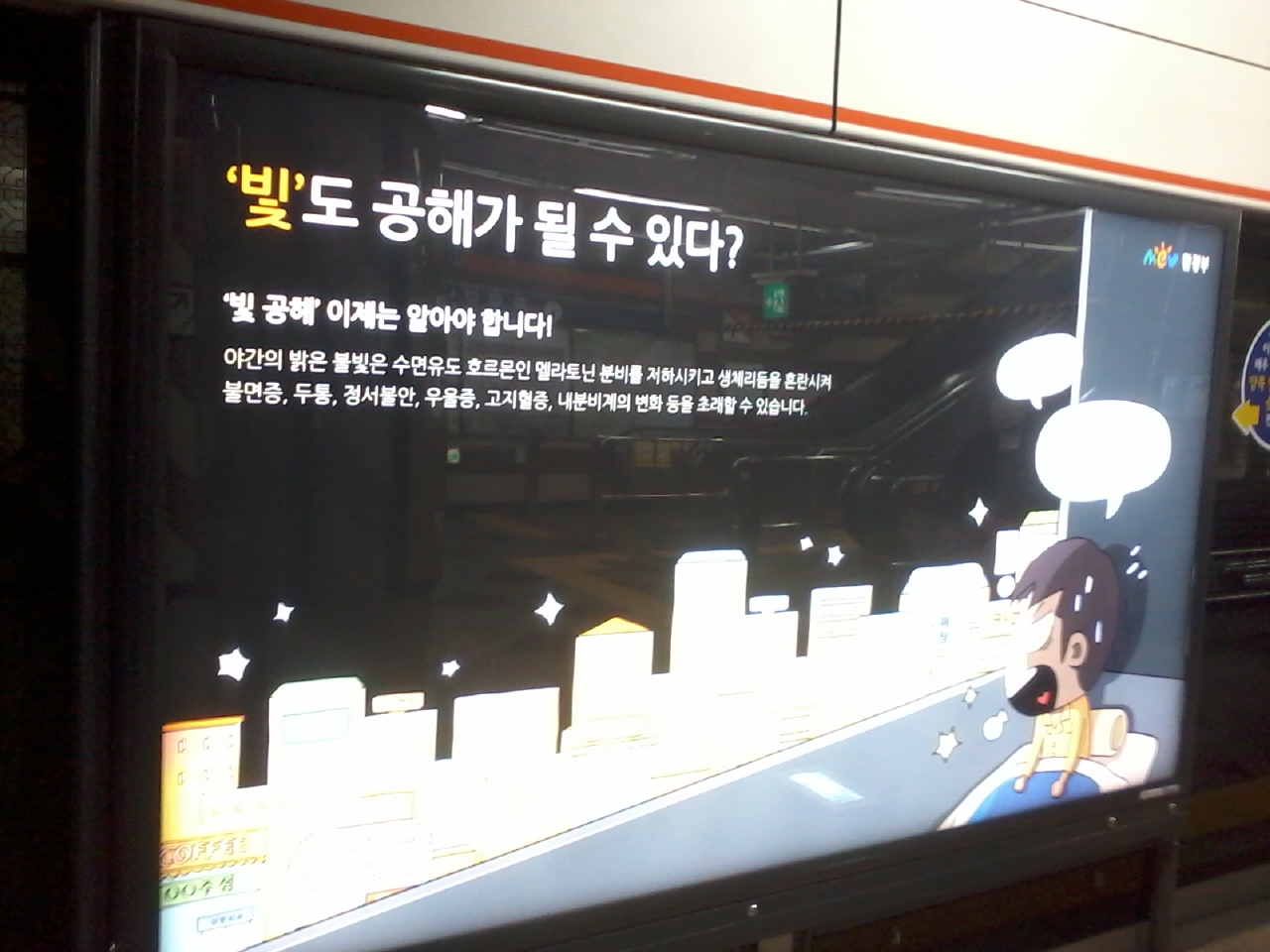
“Can light be a form of pollution?”

I was very impressed by this recent poster put up by the Ministry of Environment here in the Korea which calls for a greater awareness of light as a form of pollution. As Koreans are often completely unaware of the tremendous waste of energy, and the negative impact on daily life of the needless use of light. I am delighted to see a consensus at last emerging on this critical point.

Subway poster put up by the Ministry of Environment draws attention to light pollution and the waste of energy.