“Media as a way of understanding our world accurately” Korea times


Korea times

“Media as a way of understanding our world accurately”

January 27, 2018

Emanuel Pastreich


I ask a journalist friend how we should respond to the precipitous decline in investigative reporting and disturbing replacement of a calm presentation of the facts about policy by sensationalist news about food, fashion, and the personalities of politicians.

But when I explained the superficiality of reporting these days, the response I received is that readers (or viewers), and especially the young, do not have the patience to read anything too long. That is to say that the audience for media demands materials that writing must be entertaining and short, lest they be bored by the details.

But the whole assumption behind the response seemed so completely wrong that I was left speechless. The fact that citizens lack the concentration to read long articles, or probe into the details of how their society works is not a reality, like sun rising in the East, to which the media must adjust.

Rather that lack of patience among our citizens, and above all among our youth, is the greatest crisis we face and makes it impossible for our society to function and for us to make responsible long-term policy. It is a social ill whose solution should be our primary concern.

Rather, we must change everything else in order to restore to our citizens the ability to concentrate and to consider complex issues without resorting to the stimulus of social network memes, video games or gaudy gag shows. It is not an interesting fact of modern society that citizens have trouble concentrating on significant content, or remembering names and dates. Rather the degeneration of media, and decline in the intellectual sophistication of average citizens, undermines the formulation and implementation of policy and if we follow this path, Korea will become ungovernable.

It seems as if we assume that journalism is a process by which a product is produced, not unlike a candy bar, and it must be marketed so that consumers will buy it. The goal, it seems, is that people purchase appealing media products and that this process produces profit for media corporations.

But the profit from media reporting should be the least insignificant aspect of newspapers, magazines and television broadcasts. Rather the media must serve above all to provide relevant, carefully-researched information about what is happening in local society, and around in the world, in a systematic manner to citizens. The news needs to not merely relate what famous people did, but also present the historical background for contemporary events and explain the structure and the nature of the institutions of our country. Unfamiliar terms must be defined and the articles should be accessible manner for a broad audience.

The media should take the time to explain in detail the historical background behind current society. We must create a culture in which citizens have the patience and concentration to engage in a serious discussion about what the significance of the past is for the present and future. The media assumes that all citizens know what the World Bank or the United Nations are and how the functions. But this is not an honest approach to journalism. Most people have only the vaguest idea of what these organizations do. Moreover, even for those with real experience, the institutions have changed considerably over the last five years, demanding that we consider their nature because it is relevant to the story.

Our focus should be on producing a culture in which citizens take the time to read and to think about what they read, on establishing a culture in which the significance of narratives, rather than their entertainment value, is the highest priority. We must insist on such a culture from kindergarten through old age.

If anything, media should demand that the reader challenge himself, that he rise to the occasion and embrace the difficulty of understanding our complex society. In light of the rise of anti-intellectualism, and the decline of scientific analysis, in our current approach to governance and economics, we need to create a society in which people slow down, think about what they read and have the mental leisure to take ruminate on complexity.

Populism is not the result of politicians, but rather is the product of a self-indulgent attitude of the citizen, combined with indifference toward fact. Populism is disturbingly anti-scientific even as it embraces glitzy technology.

Such a bread and circuses approach to political and economic dialog in the media renders our citizens unable to put grasp the subtle factors that drive change in our society and to formulate policy in response. Political leaders feel compelled to create drama for the media and the process of formulating and implementing policy becomes a sideshow.

The question is how we can create a culture for the nation that encourages concentration and that allows citizens to engage in a sophisticated dialog with each other on the critical issues of our time

Encouraging our citizens to be more intellectual, for example, by showing them images of educated and thoughtful people in the media around them who wrestle with complex ethical questions, is a first step. It must be clear to our youth that being an informed citizen, rather than wealthy or powerful, is the only way to live a meaningful life. We must be patient enough and brave enough to observe our world as it really is. E. M. Forester wrote, “Either life entails courage, or it ceases to be life.”

If we need to significantly decrease the role of cell phones and on-line social media in Korea in order to achieve this goal of a reading public that thinks deeply about what it reads, we should not hesitate for a moment.

It is far more critical for Korea to have citizens who can comprehend the profound and complex social and environmental issues that they face today than it is for Korea to be a leader in the sales of smartphones.

The time has come to for us to focus on the essentials of creating a healthy society, starting by creating a media whose purpose is to engage citizens in the most sophisticated of intellectual dialogues, demanding that they rise to the challenge, rather than the media treating them like ignorant children. We have a responsibility to avoid being distracted from the crisis of our age by short-term thrills.

 

“From the corridors of academics to “Earth management” Korean Spirit

Korean Spirit

“From the corridors of academics to “Earth management”

A common quest for true intellectual commitment

Interview with Emanuel Pastreich

January 5, 2018


Emanuel Pastreich, a professor at Kyung Hee University, is the author of numerous books and articles about culture, history, politics, technology, and international relations that have been published in English, Korean, Japanese and Chinese. Originally an expert on classical Asian literature, he has become a major public intellectual in Korea, and in the region, over the last ten years. His book “A Different Republic of Korea of which Koreans are Ignorant” was the most successful of three best sellers. It was officially recognized by the Korean government as a major achievement.

Pastreich recently announced that he intends to leave Kyung Hee University to launch University Of Brain Education (UBE) and a brand-new think tank entitled “The Earth Management  Institute.”

We had a chance to catch up with Pastreich and we asked him about the reasons for this decision, and about his plans for the future.


You are a famous scholar of Asian studies educated at Harvard, Yale and University of Tokyo who has taught at the University of Illinois, Urbana-Campaign, George Washington University and Kyung Hee University for almost 20 years. You are established at a well-known university. 

Why would you leave to be the director of this brand-new Earth Management Institute?

Emanuel Pastreich

Being a professor, or being affiliated with a famous university, should not be the goal for an intellectual. An affiliation with a major institution can help one to realize one’s goals, but being at a major institution is only a means.

I have had the good fortune to receive an excellent education and to learn multiple foreign languages. That education and those skills are not my possessions, they are not a special right that I possess for which I must be rewarded with an exalted position at a famous university.

I was able to focus on my studies for these years because so many people helped me, whether I knew it or not. I am talking about the men who cleaned my elementary school, the women who cooked my meals in college (and today), the many efforts of drivers, librarians, secretaries, to maintain an environment in which we can work. I have a tremendous responsibility to all of them, and to even more people, to return that debt to society.

I have a duty to share what I have received with as many people as possible, and to do that as we struggle to respond to a rapidly changing and dangerous world.

Let us first face the truth: the institutional decay of educational institutions in Korea, and around the world, is making the goal of responding to the needs of young people, and of our precious Earth, more and more difficult.

In a normal age, I might have spent my life as a committed teacher helping his students to understand the world. But I believe that there are extraordinary moments in history, such as come every few hundred years, which offer overwhelming risks and also some substantial opportunities.

This is such a moment and action is demanded of me. I cannot simply teach my classes and publish the academic papers.

The rapid evolution of technology has overwhelmed our society and the institutions of local, national and global governance. Artistic and literary expression, which should provide inspiration for a better society to all citizens, has degenerated into an ode to consumption and to immediate satisfaction.

We know many facts and we have many skills but we are completely paralyzed and incapable coming together as a community and taking action.

This is a very dangerous time. We must alter our priorities and change our habits.

What have you seen at the university that has changed your thinking?

Emanuel Pastreich

I am profoundly aware of the crisis in education from my teaching at the Kyung Hee University, and elsewhere. Our students are forced to study topics that do not interest them in order to get jobs that do not inspire them, jobs that have little to do with creating a better society or with helping their neighbors.

Sadly, education has been reduced to a diploma, a document that allows you to get a job. If students could secretly buy one of these documents and get a good job, I think many would be tempted to do so as the classes themselves, and the wisdom and knowledge contained in them, are not important in our society anymore.

Education is not about understanding the world, or about considering one’s ethical role in it. It has become increasingly difficult for me to teach in such an environment.

The university in specific, and education in general, has become a place for competition, and not for cooperation. Students who should be making life-long friendships with professors,

and with each other, are increasingly alienated from each other and are drawn into the deceptive world presented in their smart phones.

And the professors also are forced to compete with each other, rather than forming an intellectual community. The only thing that matters is that professors publish articles in SSCI journals. But what are SSCI (Social Science Citation Index) Journals? They dull magazines, chock full of jargon, that are edited by a few scholars. These journal articles, the only important contribution of the professor, have literally no impact on our society.

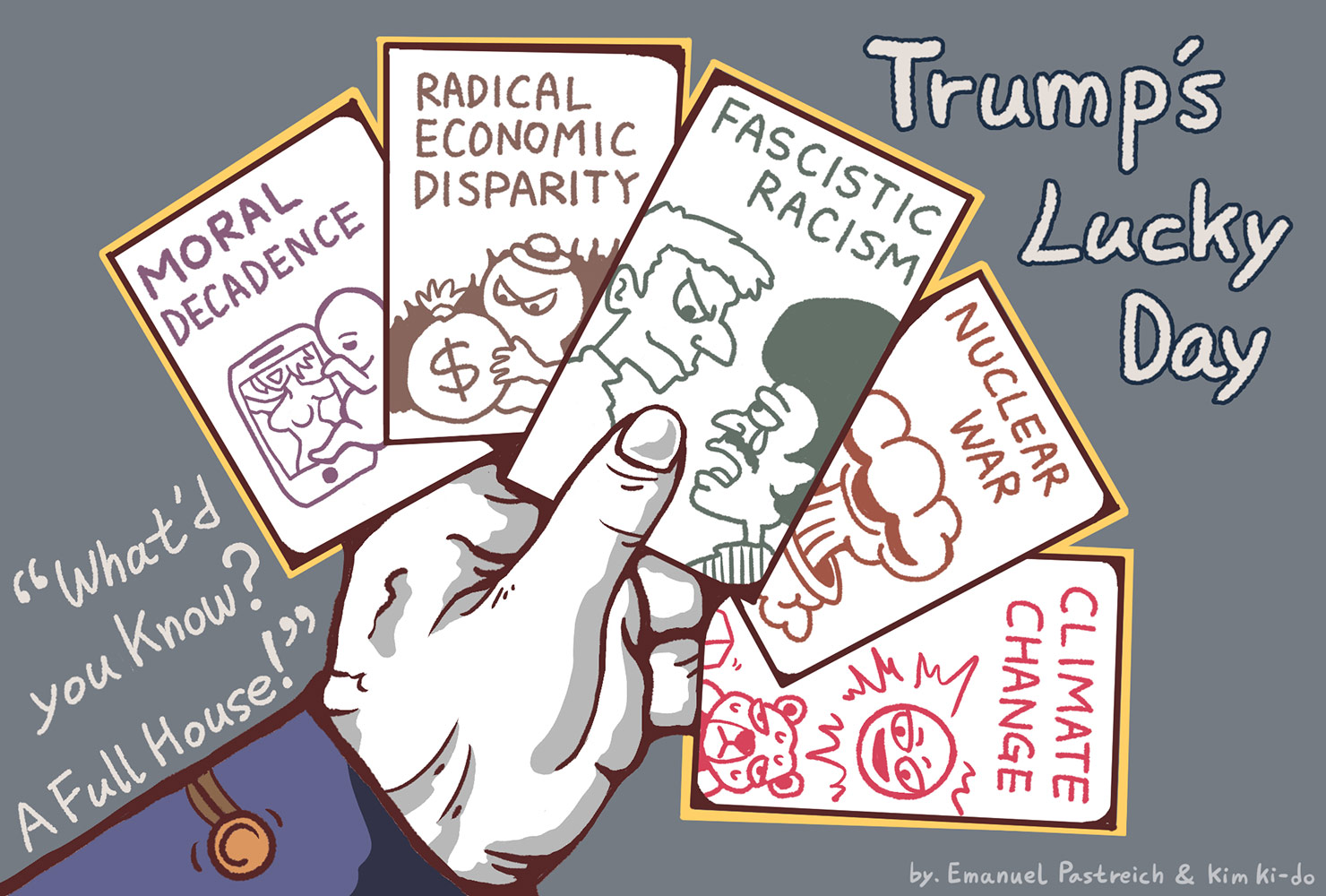
I feel I have an ethical obligation to talk to ordinary citizens, to truly engage my students, and all young people, in a serious debate on the risks of our age: climate change, the disparity of wealth, the threat of nuclear war, the decay of values in our society and the importance of understanding history and culture in order to create a future that is solid, not illusionary.

Was there some specific event that changed your mind about working at Kyung Hee University?

Emanuel Pastreich

I have given numerous lectures for the public on serious issues in our society. I have written hundreds of articles for the people in newspapers and magazines read by ordinary people. But as far as the university is concerned, that was not important. I am still not a full professor and the last time my university renewed my contract was with hesitation because I lacked the qualifications demanded. But I felt that I should do what is demanded by these dangerous times, not what the Ministry of Education requires for promotion as a professor.

This semester I taught a class on climate change for the first time. I made tremendous efforts to design a course that would appeal to young people and that would teach them about the severity of the dangers that we face. I wanted to work with them to come up with a plan to transform our society, and above all to change our thinking.

But when I showed up for the first day of classes, there were only five students in the classroom. Until that time I had never taught a class in Korea that was not full from the beginning. I was shocked.

The department informed me that if I did not have ten students in the course, it would be cancelled and that my salary would be reduced as a result.

I learned later that many of the economics classes in the university had been made into required courses and that my course was designated as just an elective. That change in the rules meant that students who wanted to take my course (and there were plenty) were not able to do so.

The Climate Change course was not cancelled, ultimately. But I learned that the nature of the university has been fundamentally changed while we were asleep.

Our role is not to prepare our students for the future, or to give them ethical guidance. Our purpose as a professor is to grade papers, write letters of recommendation and write specialized journal articles that almost no one reads.

Personally, I think economics classes that teach students how to use mathematics to calculate inflation and interest rates without any consideration of the ethical and cultural aspects of economic exchange are far less valuable than my course on climate change. I told my department head I wanted an open discussion about whether climate change is less important than economics. But no such discussion was even possible.

Young people, intellectuals, everyone, should be focused on the critical issues of our times and we should do things directly to help solve problems. We need to stop be passive consumers, manipulated by the media and distracted by video games, and we should be active citizens, thinkers, who decide for ourselves what is an ethical life and who take brave and creative steps to realize that world every day.

Read more

Was the tree of the knowledge of good and evil the first false flag operation?

1280px-Orvieto061My friend Jiun just posed one of the most amazing suggestions to me today that I have ever heard.  I was completely floored and had to sit down and catch my breath.

He suggested that the fruit offered to Adam and Eve in the Garden of Eden, the so-called apple (although that designation seems to be fake news–we still do not know exactly what fruit it was) on the tree of the knowledge of good and evil, was planted there by God as a set up for humans. It was the first false flag operation made to snare humanity into joining the fallen world. Something like luring the Japanese into bombing Pearl Harbor, perhaps?

I admit it is a bit far fetched, even disrespectful to the Almighty, but what a conspiracy theory!


Jiun says:


“Had Adam not eaten from the “Tree of Knowledge”, he wouldn’t be discerning to be able to separate right & wrong.

Thus, he did not listen to God, and ate the “Forbidden fruit”.

Didn’t God basically set him, a trap, from which he could never escape?”


“유엔 본부를 한국으로 옮겨오자!“ 다른 백년

다른 백년

“유엔 본부를 한국으로 옮겨오자!“

2018년 1월 2일

임마누엘 페스트라이쉬

미국의 유엔 분담금을 대폭 삭감하겠다는 트럼프 행정부의 결정은 예루살렘을 이스라엘의 수도로 인정하려는 미국의 입장을 유엔이 거부한 것에 대한 충격 및 이에 따른 보복이라고 대체로 해석된다. 그러나 니키 헤일리(Nikki Haley) 주유엔미국대표부 대사가 뭐라고 언급했건, 도널드 트럼프의 유엔 연설과 존 볼튼(John Bolton)이 일찍이 트럼프 행정부 하에서 했던 논평 속에는, 유엔을 통한 전 세계 거버넌스에서 미국의 참여를 획기적으로 축소하거나 아예 종료하려는 의도가 계속 시사되어 왔다.

미국이 국제사회를 실망시킨 것은 이번이 처음이 아니다. 글로벌 거버넌스를 향한 최초의 노력을 좌절시킨 것이 1919년 미국 의회의 국제연맹(the League of Nations) 비준 실패였고, 훗날 일본과 독일이 국제연맹을 용이하게 탈퇴하고 결국 파국적인 결과를 가져오게 한 것이 바로 신흥 강대국의 비극적인 의지 부재였다.

Read more

“Bring United Nations headquarters to Korea” Korea Times

Korea Times

“Bring United Nations headquarters to Korea”

January 1, 2018

Emanuel Pastreich


The Trump administration’s decision to reduce drastically the U.S. contribution to the United Nations was generally interpreted as payback after the stunning rebuke to the American decision to recognize Jerusalem as Israel’s capital.
However, whatever US ambassador to the U.N. Nikki Haley may have said, there were plenty of hints in Donald Trump’s speech at the UN, and in comments by John Bolton early on in the administration, that it was the intention all along to limit drastically, or end, U.S. participation in global governance via the U.N.

This is not the first time the U.S. has disappointed the international community. It was the US Congress’ failure to ratify the League of Nations back in 1919 that undercut the effectiveness of that first effort at global governance. Tragically, it was this lack of commitment by a rising power that made it easier for Japan and Germany to pull out later, with catastrophic consequences.

Read more

On the decay of US media

I remember when I watched the United States launched spacecraft to the Moon on television as a child. The process of preparation was shown for hours with occasional commentary by scientists and experts. There was no thrilling gossip by overpaid TV personalities or attempts to spice up the story with exclusive interviews “behind the scenes.” The entire point of the reporting was to present the facts in an accessible manner to the public. People had the patience to listen to the complex narrative because the systematic pursuit of facts, and science had value. Now all that tradition has been washed away by an obsession with the self, and by an appeal to immediate satisfaction.

“세상을 바꾸는 방법” 인디고서원 세미나

 인디고서원 세미나

이만열 과 같이

세상을 바꾸는 방법


2016년 10월에 시작한 촛불집회의 1주년이 되던 날, 이만열 선생님과 함께하는 제92회 주제와 변주가 열렸습니다. 국정농단 사태로 촉발된 촛불집회에서 시민들은 적폐세력에 대해 분노했습니다. 매주 토요일 밤마다 시민들은 전국 각지의 드넓은 광장에서 만났고, 결국 새로운 변화를 끌어냈습니다. 실제로 권력의 정점에 서 있던 이들이 수사를 받고 구속되는 등 잠시 동안 사건은 해결되는 듯 보였습니다. 대통령도 한 차례 바뀌면서 대한민국은 희망을 꿈꾸었습니다. 그러나 1년이 지난 지금, 아직도 세상의 부조리는 보란 듯이 일어나고 있습니다. 어느 한 편에서는 비리에 대한 처벌이 너무한 것 아니냐 하는 태도를 보이고 있습니다. 이런 상황에서 우리는 촛불집회의 목적에 대하여 의심하지 않을 수 없었고, 결국 그것은 우리가 지속하는 사회 전반적인 시스템에 대한 의심으로 이어집니다. 우리는 과연 새로운 세상을 만들어갈 수 있을까요? 일찍이 이 문제에 대해서 관심을 가져온 이만열 선생님을 모시고, 현실을 정확히 진단하고 우리 사회가 어떤 방향으로 나아가야 하는지에 대하여 이야기 나누는 시간을 마련하였습니다.

이만열 반갑습니다. 이만열입니다. 청소년 여러분과 만나게 되어 기쁩니다. 여러분 앞에 있는 저는 벌써 50대입니다. 60대, 70대 어른들이 여러분을 많이 실망하게 해서 미안합니다. 정말로 새로운 세상과 미래를 위해서는 여러분의 노력이 꼭 필요합니다. 다른 유명한 누군가를 기대하지 마시고 스스로 자기 손으로 새로운 한국을 만드시면 좋겠습니다.

저는 원래 예일대학에서 중국 문학을 전공하였습니다. 다가오는 시대에 세계 사회에서 중국이 중요하다고 생각했습니다. 언어를 배우는 방법으로 문학을 공부하는 게 가장 좋았기 때문입니다. 그렇게 중국과 중국어를 공부했습니다. 그리고 이어서 한동안 일본에서 공부했습니다. 실제로 한국어는 외국어 중에서 가장 못하는 언어였습니다. 하지만, 동아시아에서 한국이 차지하는 중요성을 깨달았고, 제가 한국에 정착하여 살았던 지난 10년 동안 한국에 살면서 어느 정도 한국어로도 대화를 나눌 수 있게 되었습니다.

Read more

Trump’s National Security Strategy (December, 2017)

For those who would like to read the actual text, here is the recently released to National Security Strategy from the White House. Although some of the language is predictable, it reveals that bizarre mixture of isolationism and aggressive militarism which we have grown to know and love.

The focus is on the “homeland” and there is little, or nothing, to suggest that security requires international cooperation. In fact, most allies reading it might wonder what the purpose of an alliance might be. There is no sense that the United States is going to sacrifice itself for anyone else. Perhaps the assumption is that the United States is so powerful that the world will come to seek its help. Seems to be a poor bet.

The term “take direct actions” is used to signify entirely illegal and off-the-record actions against perceived enemies. It does not take much imagination to see where this might lead.

Much more to say, but as I have not finished reading it yet, I want to share it first.

Take a look.


trump national security strategy