Colin Allen just posted an article entitled
“The Future of Moral Machines”
on the New York Times Opinionator page. The article offers offers some interesting insights into the moral authority of machines both past and present.
Colin Allen just posted an article entitled
on the New York Times Opinionator page. The article offers offers some interesting insights into the moral authority of machines both past and present.
Here is Emanuel’s review of Winslow Wheeler’s book on defense spending “The Wastrels of Defense” as it appears on the site of the Center for Defense Information
“Rebels Within the U.S. Federal System ”
Emanuel Pastreich
January 10, 2006
Casually observing the mainstream media in
the United States gives one the impression that conservatives support the
administration of George W. Bush and the Republicans in Congress. Nothing could
be further from the truth. In fact, the most strident and damning attacks on
the “neo-conservatives” come not from “liberals,” but
rather from conservatives themselves. Moreover, although many Americans
foolishly buy into the argument that they should be afraid of “government,”
in reality, those in government have provided the strongest resistance to
corruption and corporate manipulation.
An excellent example of the rebellion
against the present rule of money and privilege in America is Winslow Wheeler.
Like the Democratic senator John Murtha, who recently called for U.S. troops to
be withdrawn from Iraq unconditionally, Wheeler is an insider with strong ties
to the military and the institutional culture that has dominated the U.S. for
the last 40 years who decided things have gone too far and has taken a stand.
He has written at length about the corruption in the military procurement
system, which is so deep that it poses a serious security threat.
Professor Scott Strobel, Vice President for West Campus at Yale University, has taken a deep interest in Korea of late. He recently wrote this very thoughtful article about Korea’s possible future role in science and technology.
KOREA IT TIMES
“Korea’s Potential in Scientific Discovery: A Strategy for Realization”
Thursday, October 6th, 2011
Scott Strobel
Vice President for West Campus
Yale University
The Growing Trend towards Asia in Science and Technology
Korea has a tremendous opportunity to play a central role in the future of discovery in science and technology if it takes advantage of some emerging trends. We can already see the growing sophistication of science in Asia in terms of the quality of its
Both of Emanuel’s recently published books will be used in graduate courses in the United States this semester.
His book on the reception of the Chinese vernacular in Japan, The Observable Mundane: Vernacular Chinese and the Emergence of a Literary Discourse on Popular Narrative in Edo Japan, will be assigned in the East Asian Studies graduate program at Princeton
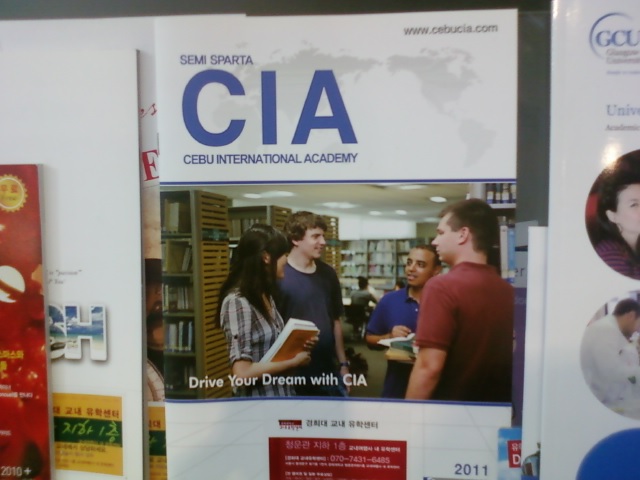
This advertisement for the Cebu International Academy is quite revealing. The term CIA is rather amusing, of course. But it also suggests something about some fundamental trends in our times. As we can see here, the term “CIA,” originally associated with the Central Intelligence Agency established by Harry Truman, has been reduced to a rather amusing phrase that can be assigned to just about anything in a rather light-hearted manner. The authority of force, and the control of information, known from a previous age has been reduced and cheapened. Of course some might say that it is a positive trend, granted the abuses associated with intelligence. But although we should be honest with ourselves about the mistakes of the past, we should also be quite wary of the degradation of terms. Once terms cease to have any real gravitas, authority can be grabbed by just about anyone.
Most of us are still a bit vague about where all that money is going to be cut from the federal and state governments of the United States. Perhaps some of the cuts will come out of the bloated military budget, thereby reducing the threats that our troops around the world are subject to, and at the same time also generate. Certainly many who actually serve in the military would welcome such a reduction in spending.
But we need to start thinking about a new and unprecedented security threat on a global massive scale: the United States without safety protocols and effective inspection regimes for the vast range of dangerous materials collected over the last sixty years.
The United States is a pile of chemical waste dumps, aging nuclear power plants, nuclear materials—and weapons—storage facilities, oil rigs, oil pipelines, mines (active and abandoned), armories and any number of railroads and highways that require an enormous investment to maintain safely.
I originally wrote this article with Eric Marler for OhmyNews, and it was published on May 3, 2006. The article can still be found online here.
“Political Passivity Undermines US: Parallels with the predicament of late Imperial China”
A distinguished historian wrote thus about a world power that had slipped into irreversible decline as a result of its citizens turning inward and its elite refusing to concern themselves with the fate of the nation:
“When intellectual irresponsibility and moral degradation fell to this level, it meant that scholars had become oblivious to their duties to the society and had lost track of the importance of the unity of knowledge and action. The society was deprived of real leadership. That the general decline of morality in the government was due in part to this very intellectual delinquency is an unavoidable conclusion.”