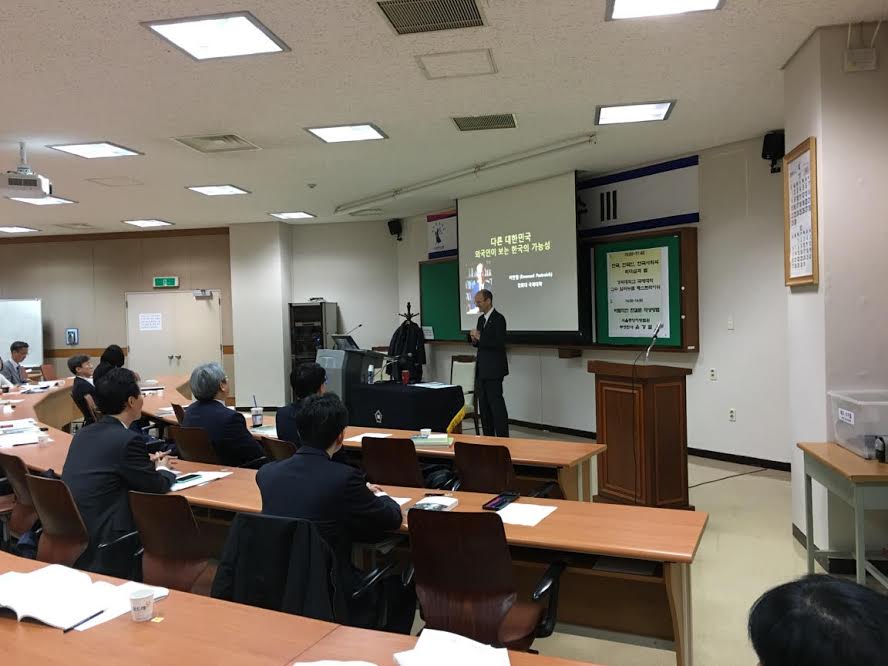
“IT 시대, ‘필담’ 전통으로의 회귀가 필요하다” (월간 과학과 기술 2015년 12월 )

월간 과학과 기술

(한국과학기술단체총연협회)

2015년 12월


“IT 시대, ‘필담’ 전통으로의 회귀가 필요하다”


임마누엘 페스트라이쉬  


아시아 전역의 전문가들이 국제회의 참석 차 모여 있을 때가 있다. 아마도 정부 장관, 교수나 사업가일 텐데 서로 어색하게 악수하고, 서투른 영어로 가볍게 인사를 나누다가 성급하게 대화를 끊고 서로에게서 떨어진다. 필자는 이런 모습을 목격할 때마다 민망해진다.


심도 있는 정보교환 이끄는 국제회의 환경 필요

이런 전문가들을 집결하는데 필요한 비행기 티켓 값과 호텔 숙박비는 값비싸다. 그런데도 전문가들 사이에 진지한 대화는 거의 오가지 않는다. 공유할 수 있는 엄청난 양의 지식과 경험이 있는데도 말이다. 정부나 산업체에 의해 마련된 비용이 많이 드는 큰 행사임에도 불구하고, 안타깝지만 대부분의 경우, 전문가들은 도착했을 때와 마찬가지로 돌아갈 때도 여전히 서로 전혀 알지 못 한다. 비싼 식사 모임을 갖는다고 해서 추후 협력에 대한 약속으로 이어지거나, 같은 행사에 참석한 다른 전문가의 지혜와 지식을 알게 되는 것도 아니다.

국제 정상회담과 회의에 참석하는 아시아 전역의 대표들에게 시간제한 없이 진지하게 대화할 기회가 생긴다면, 서로에게서 엄청난 양의 지식을 얻을 수 있을 것이다. 예를 들면, 다른 나라의 동료 전문가들이 자국에서 어떤 방식으로 새로운 혁신적 행정 전략을 사용하는지 배우고, 그 방식을 채택해 사용할 수도 있다. 또는 제조업에서 사용되는 새 기술이 어떻게 생산성을 크게 향상시킬 수 있는지 배울 수도 있다.

Read more

Interview: Lawrence Wilkerson @ The Diplomat

The Diplomat

Interview: Lawrence Wilkerson

A discussion of tensions in East Asia, and some possible solutions

By Emanuel Pastreich

December 03, 2015


What do you see as the underlying sources for the tensions between China and the United States today? 

The tensions between the United States and other ASEAN nations with China over the South China Sea today are extremely serious. The South China Sea and the tensions with Russia over Ukraine are the two greatest sources of possible conflict today and I believe that either problem could lead to war if not properly handled.

The problem is in part one resulting from an American drive to confront China, but it is exacerbated, almost daily, because the Chinese leadership has discovered that nationalism serves as a great replacement for the void in ideology that the death of communism has produced. I fear that as growth slows below 7 percent, the Chinese government will increasingly feel a need to throw nationalist red meat to the Chinese people. I fear that the speculation about a possible military conflict could become a self-fulfilling prophecy and I suggest that America and China, and other nations, take concrete steps to reduce the tension and create a broad dialogue. The United States or China could end up in a situation in which both parties, to avoid a loss of face, are forced to do what they said they would do. In the South China Sea – and in particular around the Spratly Islands – we see the greatest risk of a major confrontation.

All sides should recognize that we have a dangerous situation. Such confrontation is not in the interest of the United States, China or the region.

I am not interested in defending China regarding the South China Sea, but there are those who have argued that although some see Chinese activities in the South China Sea as excessive, or arrogant, China’s actions are certainly not worse than American interference in South America in the 1960s and 1970s and that there is no justification for the United States to get involved in what is essentially a regional problem. What are your thoughts?

The argument regarding the United States’ meddling is a fair one to make. I would rather want to focus on the need to start a broader and more level-headed discussion about territory in the South China Sea that moves beyond an emotional and nationalist fight between the claimants such as Vietnam and the Philippines, and China. Let us also bring in countries like Indonesia who have a stake in the region. I think the best way to address what I personally think is a mistake on the Chinese part is to have other voices say, “Listen China, these claims are causing an unnecessary problem. You are making claims that are far beyond what any international law would codify and approve.”

There are laws and processes that can be invoked to deal with these claims without escalating military tensions. The United States should pull back and not try to make itself the center of attention.

The United States could say, but currently is not saying, “Let’s resolve this dispute in a way that benefits everyone and sets a positive precedent for the future.”

Read more

“Law in Contemporary Korea and Prospects for the Future” Lecture at Judicial Research Training Institute

“Law in Contemporary Korea and Prospects for the Future”

A visit to the Judicial Research Training Institute


Emanuel Pastreich


It was a pleasant walk from the subway stop to the Judicial Research Training Institute on a sunny autumn morning and I felt oddly inspired by this rare opportunity I had been granted to speak before a group of senior judges and engage them in a frank and open about the challenges that face Korea, and the world, today.

Although I did not think deeply about the significance of speaking before judges when I started drafting my short remarks, I could not help thinking about my aunt Jeanne Rouff, who passed away last year, as I struggled to articulate my perspective concerning the future of law in Korea.

Jeanne Rouff, my mother’s older sister, spent her entire career in Luxembourg, and was not as talented in English as my mother who went off to study in the United States and never returned. Aunt Jeanne served as the first women lawyer, the first woman judge and the first women member of the supreme court of Luxembourg.

Read more

“Virtue is not solitary” (Emanuel’s lecture to public officials)

“Virtue is not solitary”

My search for Korea’s future in its ancient tradition of ethical government

Emanuel Pastreich


I was rushing to a meeting around 11 AM on August 4th when a rather odd message from a friend showed up on my smart phone: “The President talked about your book!” I had no idea what the note referred to, or why President Park Geun-hye (I assumed that President Obama was unlikely to have read any of my books in Korean) would have mentioned me. It would be another two hours before I learned that President Park not only referred to my book “Another Korea That Only Koreans Don’t About” at her first cabinet meeting after her summer vacation, but that she made it the centerpiece of an argument for the next phase of her “creative economy” project, stating,

“Depending on what we do now, Korea can or cannot take the leap and become a No. 1 nation, create value in the international community and lead not only in the global economy but also in the arts and society.”

It was an honor for me to be recognized at such a high level in the Korean government and I was deeply impressed that Korea takes someone like me, a scholar of classical literature and Confucian philosophy, that seriously in the field of policy. I have always dreamed of a world in which an intellectual trained in literature could play a major role the policy debate as was the case in traditional Korea and China. Although the United States has many tremendous qualities that we still do not find in Korea, I can say definitively that it would be absolutely impossible for a scholar of classical literature to play such a role in my country.

But the most exciting result of that brief comment by President Park at the cabinet meeting was an invitation from the Minister Lee Geunmyeon, Director of the Agency of Personnel Management, to deliver a series of four lectures for high-ranking civil servants at the Central Officials Training Institute (중앙공무원교육원) starting the following week. I had delivered talks at Central Officials Training Institute, but this time was different. I was directed to talk with them about the value of Korea’s past for helping us chart a path for the future, about the deep truths to be found in the writings of scholars from past dynasties.

Read more

“The Mannerism Threat ” (Emanuel Pastreich November 23,2015)

JoongAng Daily

“The Mannerism Threat ”

Nov 23,2015


Emanuel Pastreich


I am deeply impressed with the level of the scientific research in Korea and by the quality of the products Korea produces. I have witnessed first-hand just how hard Koreans work to design and fabricate increasingly sophisticated products with global appeal.

At the same time, however, I fear that a mannerism is creeping into the thinking of Koreans when it comes to the development of new industries that will seriously undermine all of their hard work in the most profound manner.

When I use the word mannerism, I am not referring to art of the high renaissance, but rather to an obsession with the virtuoso command of style within a set genre, a tendency to value minute details over the grand vision that results in myopia and a profound cultural stasis. Specifically, mannerism refers here to an obsession with the details of a certain product and a turning away from the social and economic significance of the product itself.

The field of smartphones is typical of the new mannerism in industrial design. These days we find engineers working around the clock to add new functions to smartphones that are of minor functional significance and do not represent the development of a new field or concept. 

Read more

“오늘날의한국의법, 그리고미래” 사법연수원 특강


이만열 (임마누엘페스트라이쉬)

아시아인스티튜트소장

사법연수원

오늘날의한국의법, 그리고미래”

2015.11.11


58fde82e-fc75-45ff-abb1-9ee639b39fb9


전철 삼호선을 타고 멀리 북쪽으로 계속 가서 한번도 가본 적도 없는 마두역 에 내렸어요.

맑은 가을 날 아침, 지하철역에서 사법연수원으로 걸어가는 길은 즐거웠다.  한국과 세계가 머지 않아 넘어서야 하는 여러가지 도전들에 대한 나의 생각을, 판사들에게 솔직하게 이야기할 수 있는 이 귀한 기회에 나는 크게 흥분이 되어 있는 상태였다.

사실 강연에 대한 초안을 작성하기 전에는 판사들에게 강연을 한다는 사실의 중요성에 대해 깊게 생각해보지 않았었다. 그러나 강연 준비에 본격적으로 착수하면서 작년에 돌아가신 나의 이모 Jeanne Rouff에 대한 생각을 멈출 수 없었다.

Jeanne Rouff는, 우리 어머니의 언니이다. 그녀는 Luxembourg에서만 평생을 일했었다. 미국으로 유학을 떠난 후 고국으로 다시 돌아가지 않았던 우리 어머니와 달리 Jeanne은  영어에는  재능이 없었다.  Jeanne 이모는 룩셈부르크의 첫 여성 변호사이자 판사, 그리고 첫 여성 대법관이었다.

Jeanne 이모의 지적인 업무와 일에 대한 열정의 깊이는 항상 어린 나에게 가장 큰 영감의 원천이 되었다. 나는 항상 커서 그녀처럼 되고 싶었다.  언젠가 룩셈부르크의 숲속에 위치한 회색 치장벽을 가진 그녀의 집에 방문했었을 때, 검토 중에 있는 사건 파일들과 놀라운 책들이쌓여있던, 윤광이 나는 긴 나무 책상이 있는 서재를 나는 지금도 잊을 수 없다. 나도 그녀처럼 법을 해석하고 정책을 결정하는 사람이 되고 싶었다. 나는 뭔가 크고 중요한 일을 하고 싶었다.

Read more

The Cat Cafe in Sinchon

A remarkable cafe has opened in Sinchon, just a few minutes away from the gates of Yonsei University. This “Cat Cafe” is inhabited by 19 cats who walk back and forth between the adoring customers, and also climb up the elaborate cat structures that run along the walls and the ceiling of the large room.


I had heard rumors about the Cat Cafe previously, but only stumbled upon it when I met someone dressed up in a cat outfit walking along the street nearby.


cat cafe


The Cat Cafe is extremely popular with young Korean girls, but it is also increasingly frequented by Chinese tourists. The staff is deeply attached to the nineteen resident cats and they are happy to relate tales about the cat fights and the rankings of the cats in the hierarchy.

Read more

“A chance to transform” (JoongAng Daily November 9, 2015)

JoongAng Daily

November 9, 2015

“A chance to transform”

Emanuel Pastreich


The recent trilateral summit with Korea, China and Japan was a success. Not only did the leaders of the region’s three economic powerhouses sit down for a serious discussion, they also agreed to hold another summit next year, perhaps in Tokyo in May.

There are so many important issues in the world that require the collaboration of these three powers, from trade and investment, to North Korea’s nuclear program and climate change. We must make sure that this trilateral summit remains “sustainable” into the future and that it will be held regularly regardless of differences of opinion.

Furthermore, the trilateral summit should not be billed simply as an exclusive event for high-ranking diplomats, but rather an ongoing dialogue among the citizens from each nation.

The summit must be innovative and creative, employing culture and personal exchange to build closer relations between participants. But even more essential is that the summit be transformative.

We often assume that diplomacy is a ritualistic interaction between static and unchanging groups who work out a compromise that meets their unchanging interests. But there are moments in which one can achieve a meeting of minds, wherein the players are transformed by the process and come out of the event seeing the world, and each other, differently.

Despite the enormous bureaucracies involved, it would be naive to assume that one summit can effect a profound change.

Nevertheless, I would suggest that there are certain symbolic and substantial steps that can be made that will set a new tone for these talks and create a positive cycle. 

Read more

“UI Professor travels to East Asia” (The Daily Illini July 5, 2000)

I returned to the University of Illinois from what I thought was a rather successful trip to universities in East Asia to discuss collaboration in internet education with universities in East Asia. I was at the time an  assistant professor in the Department of East Asian Languages and Cultures. It was an unusually hot July in 2000 and I had to move into a new apartment in a few days, so I felt but overwhelmed and also infinitely excited about the possibility of holding live video seminars with my peers in Asia in the near future.

I was quite optimistic as I thought that this trip to Asia was one that would determine my career. But I found an article in the school paper Daily Illini that had come out while I was in Asia that suggested something else was going on. I was quite puzzled by the negative statements in the article and sensed that something was very, very wrong. Although I did not know it then, my life would never be quite the same again.


The Daily Illini

“UI Professor travels to East Asia”

July 5, 2000

http://www.illinimedia.com/di/july00/july05/news/news02.html


by Andy Grimm

Daily Illini reporter


University professor Emanuel Pastreich is spending the rest of his summer vacation touring the campuses of some of East Asia’s premier universities.

Pastreich, an assistant professor in East Asian Language and Culture at the University, left Tuesday for Seoul, Korea, hoping to develop contacts which will lead to preliminary discussions with administrators of some of East Asia’s leading universities.

Pastreich will only talk with administrators at the East Asian universities. He is not serving as a formal representative of the University, said Jerry Packard, head of the EALC.

“We in the department told him to cool his heels and take things in a methodical fashion, but he’s chosen not to do that,” said Packard.

The EALC has not given any funding for Pastreich’s trip. Representatives said that University administrators “have not decided whether they want to buy in” to Pastreich’s plan. Pastreich said he has contacted other departments, but Packard said he thought Pastreich was paying for the trip largely out of his own pocket.

The technology necessary is already largely in place, but there are still substantial challenges. If Pastreich felt getting University support was difficult, he might face even more challenges overseas.

“Talk about dealing with red tape, you may think it’s difficult to push something through (at the University), but it’s relatively easy compared to China,” said Packard. “Red tape is much more tangled there. It’s very difficult, especially when you’re an outsider.”

While the University has used videoconferencing to create collaborative courses with schools in the United States, the international exchange would be the first of its kind.

Pastreich envisions East Asian history courses taught using video lectures that students could watch in class or online. Students at different universities would complete group projects using e-mail. Pastreich will visit the University of Tokyo, Seoul National University and Peking University in hopes of creating a series of courses that will use videoconferencing and the Internet to link students across the Pacific together for classes.

“The most exciting thing to me is that students here, who maybe know Pokemon or tae kwon do, or like Chinese food get a chance to experience East Asian culture,” said Pastreich.