I am not sure exactly what is going on, but plastic surgery means more than a bit of surgery in Korea these days. First, plastic surgery does not seem to be that optional anymore. The more attractive you are, the more likely you are to think you need it to be even more attractive. Just about all girls are under pressure to do so, and an increasing number of boys.
Moreover, it is increasingly an international business, bringing in people from around the world into Seoul. There are now plastic surgery complexes in Shinsa and Apgujeong, the heart of Gangnam, that are a combination of ritzy cafe, hotel, hospital and amusement park. People sip cafe lattes, flirt and lounge around between bouts with the knife. The “plastic surgery” total experience is not to be missed. And materials and advertisements are found everywhere in Chinese and Japanese. In fact, many of those working at the clinics speak Chinese and Japanese.
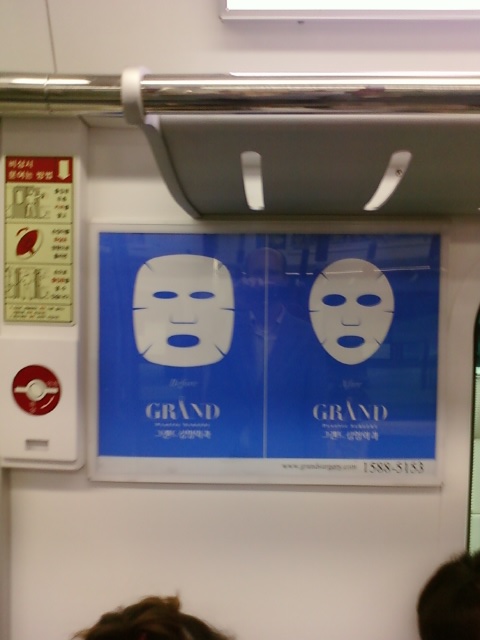
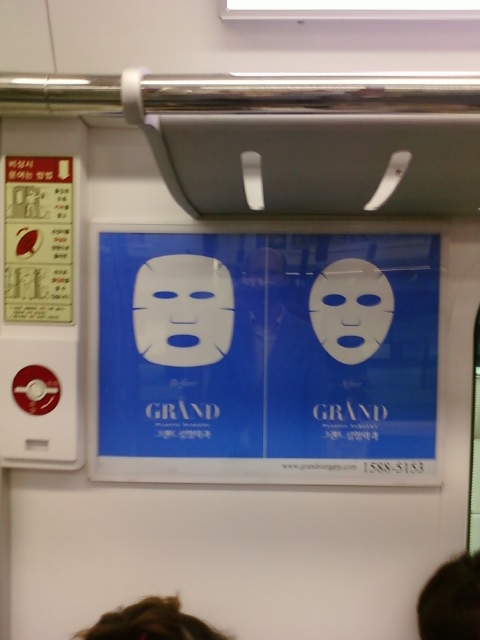
The first advertisement featured here shows two somewhat abstract faces. One is the before and the other the “after” picture. It is not hard to understand what is represented, but the interesting point is how much it looks like some sort of an online game.
Young people tend to see, by analogy, their own bodies as somehow akin to the possible forms you can select in a video game. Look at this example from the popular kids game “Bubble Fighter” as an example.
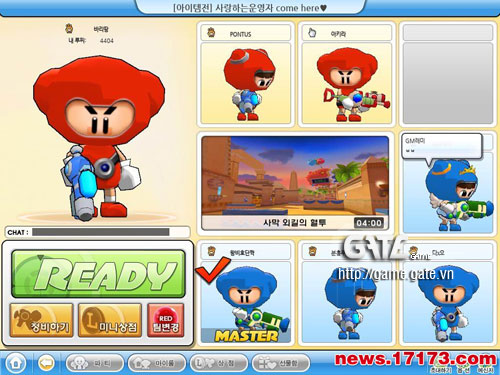
The player picks what body type and characteristics he or she wants. So also with games for young girls in which one picks dresses and facial and body types. In an odd way, the consumer selection motif is being carried over to the body itself. As if the virtual reality on line were spilling over into daily quotidian life.
Of course the result is an illusion, for much in plastic surgery creates more serious problems in later life. We have a strange combination of a virtual on-line culture where the most recent event cancels out everything before with an unprecedented life expectancy that suggests most people will live much longer than they ever imagined.
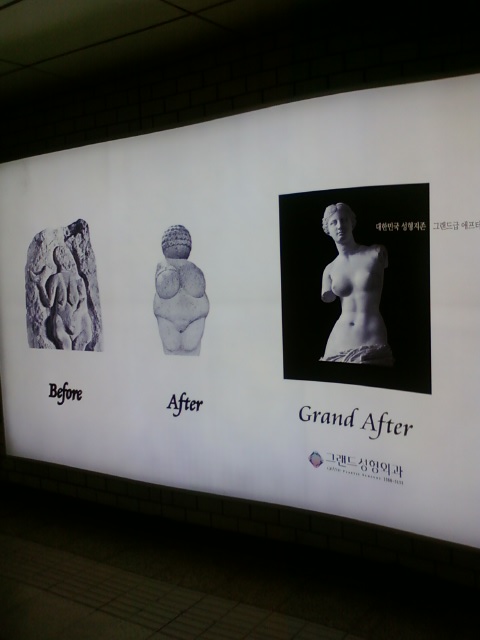
The second advertisement is more artistic, following the general conflation between plastic surgery are art (the blending of the natural and artificial) that we see in East Asia. Compared with the United States, the cultural context for plastic surgery quite elevated. it is a topic that is discussed openly and which becomes a topic for real artistic expression–part of a high cultural and social register.
I know that in the technology convergence field, and “medical tourism” field, plastic surgery is seen as a growth industry for Korea. The assumption is that the IT component, the ability to employ advanced technology for the manipulation of information will give Korea the advantage over Thailand and other places strong in the field.
This ad starts out on the left with a cave painting suggesting a more primitive culture (and of course implying that some societies are more “primitive”). The central image is the famed Venus of Willendorf, also “primitive” but at the same time erotic. And the crescendo is the Venus de Milo. The evolution of the human body through technological modification is mapped on a pattern of increasing artistic sophistication. The reference is entirely Western.
We could almost say that the concept of the avatar from gaming has been carried over to the individual’s body, or maybe even the metaphor of the robot has been carried over. Suddenly, the body as an extension of technology, of customized technology, the blending of the carbon-based and silicon-based systems.