Meeting with Noam Chomsky on May 25

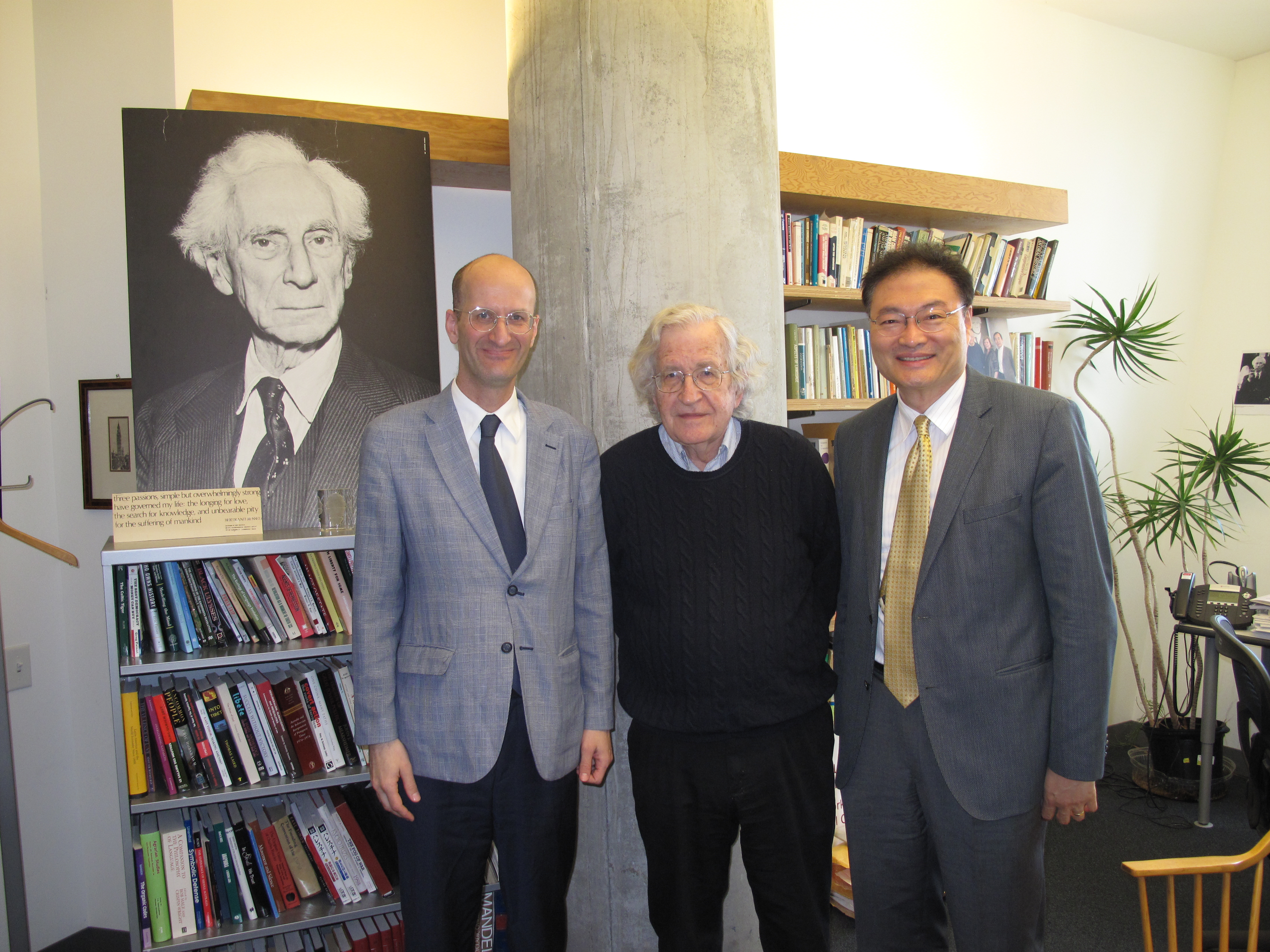
I corresponded with Noam Chomsky about five years ago frequently and started up the conversation again over the last few months. We had never had the occasion to meet in person, but on my recent visit to MIT as part of the larger effort to promote global collaboration in technology convergence I managed to meet him at his office. Here is a picture which includes also my close friend Eugene Pak of Seoul National University’s AICT (Advanced Institutes of Convergence Technology). A fourth member of the group is Bertrand Russell, logician,  political activist and author of “Has Man a Future.” I read that book as a child when I found it in the library of my aunt Jeanne in Luxembourg. Clearly Noam has him included in all portraits taken to indicate the spirit behind what he is doing today.

Interesting, the Wikipedia biography for Bertrand Russell has no mention of Noam Chomsky.

Read more

Kyung Hee University and the Tuition Hike

Kyung Hee University recently held a meeting to discuss the proposed raise in tuition. Representatives from various student groups were invited and a serious discussion on tuition rates ensued. I was unable to attend, but my understanding is that Kyung Hee University was the only university to actually engage in such a dialog. I also understand that the raise in tuition was substantially reduced.

Kyung Hee University’s Media Center: People Around Us

The Media Center at Kyung Hee University recently featured the video interview with Kim Seong-ung (김성운) the guard who stands watch at the entrance to the international campus of Kyung Hee University. The interview falls under the category “People Around Us” and is a thoughtful introduction to a member of the community.

I have been quite impressed by the Kyung Hee tradition of inclusion and respect for labor. I wonder whether any other university would have produced such a video.  You can see the video for yourself here.

ICT Convergence can make Korea the Environmental Leader of the World

I originally wrote this article for Seoul Magazine and it was published on November 1, 2010.  I have republished it here.

Recently, there has been discussion about environmentally friendly ICT (information and communications technology) in Korea. The focus falls on energy-efficient electronic devices and a new generation of smart grids in which electricity will be directed by computers to avoid waste. But there has been a hesitation to take the plunge, to embrace ICT as the central medium for resolving the pressing issue of our time: the massive consumption of fossil fuels for the transportation required by our modern life. If Korea can bring together its expertise in multiple technological fields to make Internet-mediated exchange so effective that the need to commute by car or plane is eliminated, it can become the leading nation in the fight to preserve the environment and reduce energy usage.

Read more

Foreign Exchange Bank Credit Card for Chinese Students

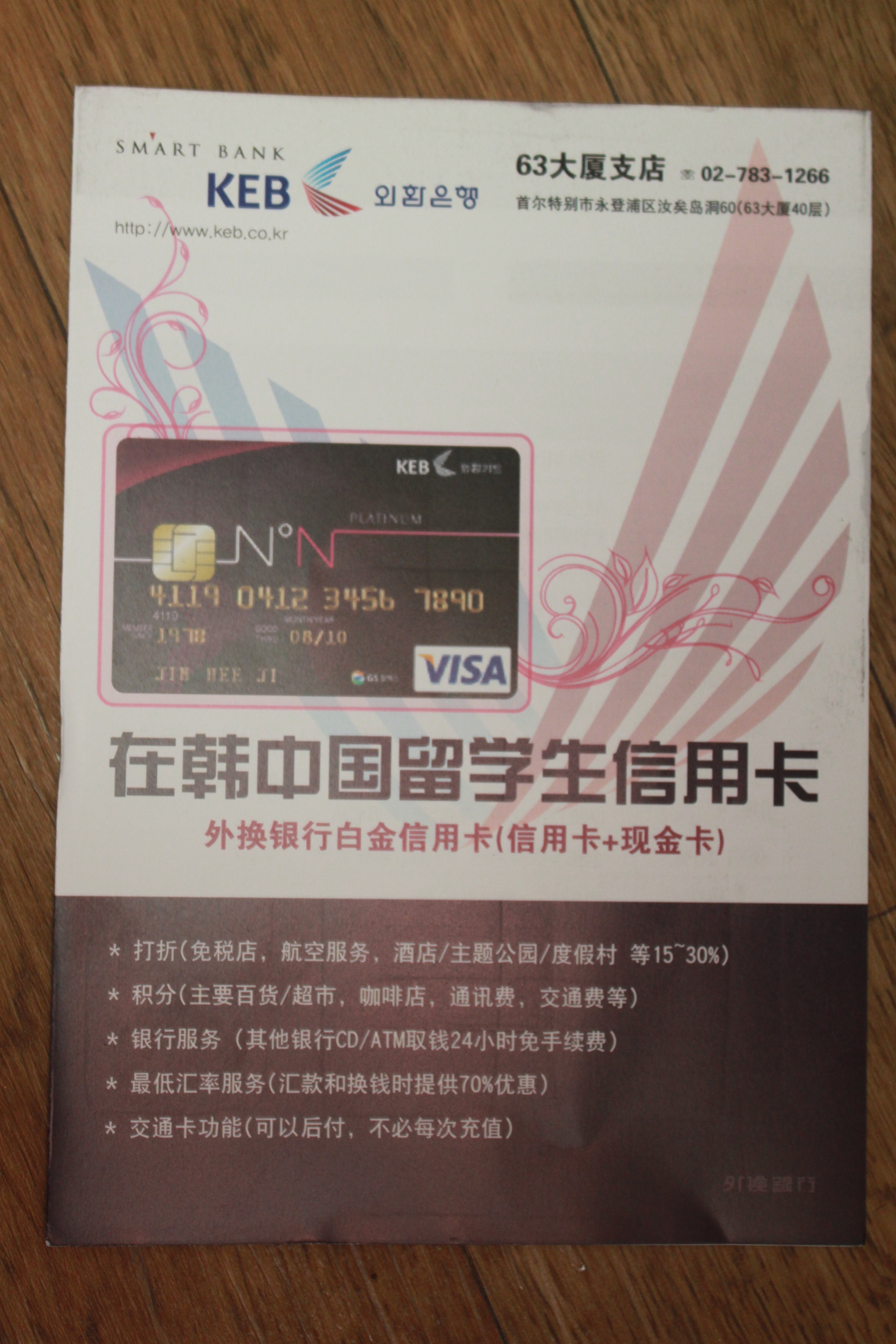
The campuses of Korean universities are filled with these fliers for a new credit card from the Korean Foreign Exchange Bank targeting Chinese students. I have heard that Chinese students at Korean universities in many cases have more disposable income than Korean counterparts. The flier is entirely in Chinese and offers a variety of benefits including discounts at stores and restaurants. The financial world of Korea is being remade quite quickly indeed.

福島原発以降の再建

福島原発以降の再建というのは人間がロケットにのって月に行くのと同じようなことだと思います。私たちがまず大胆な計画を建てて、あらゆる技術をその目的に適用するために集中してがんばれば、望みが生じます。いまは不可能だと思われることでも、技術融合を通してそのうち可能になると思います。もしかしたら思ったよりはやく解決方法が見つかるかもしれません。でも大きなヴィジョンがないかぎり、なかなか進まないでしょう。

例えば今のところは放射能に汚染された土地は100年や200年は使えないだろうと常識的に考えられています。福島原発あたりの農地がどうなるかまだはっきり論じられていませんが、すぐにはつかえません。でも全世界の技術をあわせていろんな角度からその問題に取り組めば、方法があるかもしれません。ちかごろの技術は先例のない速さで進んでいるので、もしかして融合的な方法を取り入れれば、モットモット早く解決できるかもしれません。生命工学とナノ工学をあわせれば土壌を清瀞する技術を新しく開発できるかもしれません。ただし、国際的な共同研究が絶対必要であり、その研究はお金儲けのためではありません。

農業も早く復興できるかもしれません。いわゆる垂直農業があります。完全に保護されている室内で水と資源を永遠に再利用する形で運営される農業ですが、今のところは本格的に始まっていません。もしかしたら、垂直農業施設に放射能保護設備をつければ、原発の付近でも農業ができるかもしれません。同じように、室内漁業も可能かもしれません。そのために想像力と意志と技術をあわせて乗り出すしかありません。

そしてロボット開発のことですが、今のところ放射線が多い環境で作業できるロボットは多くありません。放射線に強い電子回路が特に無いからです。ゆっくり測定できるロボットは今のところ福島で活動しているそうですが、土を掘ったり、建物と囲いを立てたりできる対放射装置のあるロボットはまだまだありません。でも集中して努力すれば開発可能かもしれないし、電子回路ではなくその他の方法でロボットを操ることもありうることです。

もしも国際技術開発連合を組んで福島原発内で活動できるロボット・プロトタイプを開発しようと決心するなら、うまくいけば、技術融合を使ってそのような特殊ロボットの開発が思ったより早くできるかもしれません。なぜかというと単純な機械工学の問題ではないからです。様々な分野の知識と理解を合わせて進めるべきプロジェクトです。

最後ではないですが、原発の六面:上下南北東西に放射能物質を防ぐ材料の囲いを設置して、土にも海にも淡水にも汚れる恐れがない完璧な離隔システムを開発すればいいと思います。今のところは夢みたいな話ですが、ナノ工学と先端ロボット技術を合わせれば、5年以内にそのような完璧な隔離材料で作られた囲いが可能かも知れません。モットはやくできるかもしれません。

今のところは具体的な提案が難しいかもしれませんが、国際社会の多くの協力を得て一緒にがんばれば、解決できるかもしれません。

“Daejeon: Environmental Capital of Asia”

“Daejeon: Environmental Capital of Asia”

( with Han Jeonghun)

OHMYNEWS International

January 10, 2008

http://english.ohmynews.com/ArticleView/article_view.asp?menu=A11100&no=381436&rel_no=1&back_url=


No one would expect that it would be Daejeon, of all cities, that would take a leading role in adopting policies to reduce the consumption of energy, mitigate pollution and implement aggressive recycling policies, but it is easy to see that because Daejeon is blessed with such remarkable scientific resources, it is poised to become the environmental capital of Korea and serve, eventually, as a model for all cities in East Asia that are now engaged in the battle to rid themselves of the specter of environmental degradation and the addiction to imported oil.

The first step towards this goal is simple: a contest for elementary school children asking for an answer to this question: “What is the best way for Daejeon to reduce its use of energy and reduce pollution?” The winner will be given a scholarship for university. The essays will be published in all of the newspapers. And it will be made clear that freedom from oil and pollution is critical to our city’s future.

The next step for us will be a careful survey of all the technologies that have been developed in Daejeon and research underway at universities or government research centers that is relevant to energy conservation and pollution reduction. The most valuable and practical technologies and strategies will be identified, analyzed and a plan put forth for their application in Daejeon. That process will require considerable imagination, as the applications of technologies being developed to the reduction of energy consumption or elimination of pollution may not be immediately obvious. For example, technologies developed at the Korea Institute of Machinery and Materials or Korea Aerospace Research Institute may allow us to build highly efficient electric bikes that will reduce automobile traffic.

Daejeon will not only be a center for research, it will become a testing ground for the applications of the new technologies developed here. Experimental trains with minimum emissions and maximum efficiency will be built using special computer coordinated tracks. New cutting-edge heating systems will be subject to large-scale testing in Daejeon to see whether we can cut down inefficiency. Space-age insulation materials will be added to all new housing to bring down heat loss, and the next generation of solar cells will be seen first in Daejeon.

Daejeon will rapidly become a showroom for advanced energy and pollution technologies available nowhere else. We can expect global attention and increased interest in the region. Moreover, Daejeon can become a leader in environmental technologies as a result: a field that promises to grow exponentially as the environmental problems of China, India and the developing world are confronted over the next decade.

We should think of this effort as equivalent of the plan to put a man on the moon. We will declare that Daejeon will be the greenest city in Asia in 8 years and will cut its energy use and pollution emissions by half in spite of anticipated growth. We will then have a clear, and difficult goal. We can then focus on using every technology that we have at hand to realize that ultimate goal.

Let us consider the concrete steps we should take:

We should conduct a survey of technologies with applications to reducing energy consumption and pollution.

Technologies that reduce emissions; technologies that reduce energy waste; technologies that insolate homes; technologies that generate energy cheaply and cleanly; technologies for collecting and processing garbage; technologies for reducing garbage in the first place; technologies for making transportation more efficient; technologies for cleaning up pollution, etc.

We can then identify which of those technologies can be applied effectively in Daejeon as part of an experimental run before global application. We should consider which technologies can be readily applied in China and India, but at the same time, we should also aim for a global standard, undertaking projects without precedent. Daejeon will become the center in Asia for environmental technologies.

Establishment of a center for environmental issues in Daejeon that will coordinate the development and implication of these technologies.

Identify companies or organizations that can cheaply and effectively produce and distribute these new technologies in Daejeon.

Promote policies and habits that reduce energy consumption and eliminate pollution in Daejeon.

Technologies related to the environment will be immensely valuable in the years ahead. If Daejeon leads the way, we can become a center for the world economy over the next 15 years.